
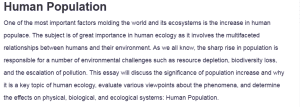
Human Population
One of the most important factors molding the world and its ecosystems is the increase in human populace. The subject is of great importance in human ecology as it involves the multifaceted relationships between humans and their environment. As we all know, the sharp rise in population is responsible for a number of environmental challenges such as resource depletion, biodiversity loss, and the escalation of pollution. This essay will discuss the significance of population increase and why it is a key topic of human ecology, evaluate various viewpoints about the phenomena, and determine the effects on physical, biological, and ecological systems: Human Population.
Human Population as a Human Ecology Issue
A specific area and the entire planet can be defined by one metric called the human population. Some scholars argue that it is a human ecology issue because it is directly related to the environment (Dyball & Newell, 2022).
A variety of perspectives and assumptions surround the topic of human population. Some think that in order to develop economically and technologically, the population needs to increase. Others believe that the growing population results in environmental problems like resource depletion and unchecked growth (Dyball & Newell, 2022).
Viewing it from a socio-economic standpoint, increased population drives economic growth due to greater availability of labor and expansion of the market. However, this growth often leads to the degradation of nature. Environmentalists, on the other hand, believe that every corner of the earth can only sustain so much and if that limit is crossed, it will result in exploitation of resources, habitat destruction, and pollution (Dyball & Newell, 2022).
Effect on the Interrelationship of the Physical, Biological, and Ecological Systems
Global human activities drive changes within the ecosystem. An increase in human population leads to increased land usage, which results in deforestation and urban sprawl. Agriculture also expands, and all of these activities alter the balance of the ecosystem. Urban cities transform natural habitats, which leads to a sharp decrease in space for wild animals while simultaneously increasing the demand for water and energy (Lopez, 2007).
The overpopulation of humans also causes declining biodiversity and the extinction of various species. Subsequently, expansion of humans comes at the cost of numerous plant and animal species as natural habitats get destroyed. An ecosystem’s balance and resilience suffer from the loss of biodiversity. Furthermore, foreign species that are introduced through human activities pose a danger to the native species and ecosystems already in existence (Dyball and Newell, 2022).
On the other hand, a rise in human population impacts ecology on the micro level through the services provided by nature, clean air, fresh water, and fertile soil. These services have the potential to be overexploited due to a rising population. For instance, overfishing depletes certain fish populations, jeopardizing the entire marine ecosystem alongside the fishing economy, and similarly using groundwater for irrigation excessively depletes aquifers, diminishing overall water supply (Lopez, 2007)
Environmental Impacts of Human Decisions
Effects of human decisions made by humans in regard to placing limitations on population growth, urban expansion, and how resources are utilized have substantial effects on the environment. Natural resources can be protected through family planning policies and educational programs aimed at restricting population growth. These policies are not always effective, though, as they face political and cultural barriers.
Decisions related to urban planning, such as the construction and modification of cities, greatly influence the environmental impact of a population. Integrated sustainable urban planning practices, like encouraging public transport use, constructing energy-saving buildings, and creating urban parks, can lessen the harmful effects of urbanization. On the other hand, urban sprawl that is not based on proper planning can result in higher levels of pollution, traffic jams, and destruction of wildlife areas (Dyball & Newell, 2022, p. 120).
Management of resources is another factor that has a great impact on the environment (An et al., 2023; Brož et al., 2023). The abuse of certain resources, such as water, land, and minerals, leads to environmental harm. Notably, sustainable practices of resource management, such as reducing water consumption, adopting soil conserving methods, switching to renewables, and lowering waste production, are effective in alleviating the negative consequences of overpopulation
Conclusion
To sum up, overpopulation is a multifaceted human ecology issue that is bound to have a direct impact on the environment and the ecosystem that needs to be dealt with at an early stage. The rise in the number of people directly affects factors of a social system including the social, biological, and ecological components, resulting in changes in land use patterns, diminution of both plants and animals, and reduction of functions of the ecological systems. Undeniably, decisions about controlling population growth, urban planning, and managing resources greatly influence how population increases affect the environment.
To address issues brought about by population growth, there’s a need for a well-rounded approach that balances economic and social growth with caring for the environment. By using sustainable practices and policies, there can be a decrease of the negative effects of having more people and maintain a strong, healthy environment for those who come after us.
References
An, L., Jiang, X., Liu, Z., & Li, Q. (2023). Retracted: Socio‐economic impact of Natural Resource Management: How environmental degradation affects the quality of life. Geological Journal, 58(9), 3310–3325. https://doi.org/10.1002/gj.4787
Brož, D., Čábelková, I., Hlaváček, M., Smutka, L., & Procházka, P. (2023). It starts from home? explaining environmentally responsible resource and waste management. Frontiers in Environmental Science, 11. https://doi.org/10.3389/fenvs.2023.1136171
Dyball, R., & Newell, B. (2023). Understanding human ecology: A systems approach to sustainability. Routledge, Taylor & Francis Group.
Lopez, B. H. (2007). The Future of Nature: Writing on a human ecology from Orion Magazine. Milkweed Editions.
ORDER A PLAGIARISM-FREE PAPER HERE
We’ll write everything from scratch
Question 
Research paper: Environmental Issues
Topic Examples: Climate Change, Loss of Biodiversity, Pollution, Water Scarcity, Human Population, and Energy. If you are not sure if your topic is a relevant issue, obtain pre-approval.
The research paper must be a minimum of three full pages, 12-point font, double spaced, APA format with a separate cover page and reference page.
The following must be covered in the paper:
Human Population
- Give a complete explanation of why your topic is a human ecology issue and assess different points of view, assumptions, and/or arguments regarding your topic.
- Describe the issue in terms of its effect on the interrelationship of the physical, biological, and ecological systems.
- Describe the impacts on the environment resulting from human decisions related to this issue.
- This assignment will require you to apply the skills gained during the library activities you completed in Modules 1 through 5. Using library resources, research a human ecology topic of your choice and follow the directions to complete a research paper on the topic evaluating both the issue and the impacts from human decisions regarding the issue.