
Historical Divides and Ethical Obligations Within Social Work
Schism Between Jane Addams and Mary Richmond
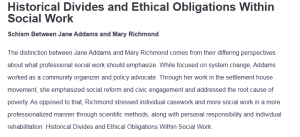
The distinction between Jane Addams and Mary Richmond comes from their differing perspectives about what professional social work should emphasize. While focused on system change, Addams worked as a community organizer and policy advocate. Through her work in the settlement house movement, she emphasized social reform and civic engagement and addressed the root cause of poverty. As opposed to that, Richmond stressed individual casework and more social work in a more professionalized manner through scientific methods, along with personal responsibility and individual rehabilitation: Historical Divides and Ethical Obligations Within Social Work.
This fundamental difference divided macro-level structural reform from micro-level individual interventions (Sawatzky et al., 2021). Although both perspectives empowered a large part of social work growth, they had different priorities, emphasizing an ongoing tension in the field.
Contemporary Schisms in Social Work
Today, there is still a similar divide between clinically oriented practitioners and broader community and policy engagement-oriented practitioners. Because of licensure, funding structures, and academic focus, the profession has increasingly leaned toward individual therapy and clinical models. As a result, fewer social workers have been trained for or pursuing macro practice.
Despite the core professional value of social justice, community organizing and advocacy are usually overshadowed by clinical work (Habibzadeh et al., 2021). Consequently, contemporary social work may be disengaging from its activist roots and community-based change that it once manifested.
How Schisms Prevent Social Workers from Fulfilling Ethical Obligation(S).
Modern schisms, however, prevent social workers from performing their ethical responsibility to participate in political action and uphold systemic change. Without emphasizing community practice and putting compliance before advocacy in educational programs, practitioners may become ill-equipped to advocate for policy reform or unsupported in pushing for policy reform. However, their ability to address the structural inequalities for their clients is constrained.
An ethical dilemma occurs when social workers understand that advocacy is needed but exists in systems that prevent or punish advocacy (Abdulrazeq et al., 2024). However, without stronger institutional support for macro practice, the obligations of social workers to challenge injustice and advocate for more equitable social systems are very difficult to meet.
References
Abdulrazeq, F., März, J., Biller-Andorno, N., & Gastmans, C. (2024). Healthcare providers’ advocacy approaches and ethical challenges in delivering healthcare to undocumented migrants: A scoping review. Medicine Health Care and Philosophy, 27(4), 579–606. https://doi.org/10.1007/s11019-024-10225-8
Habibzadeh, H., Jasemi, M., & Hosseinzadegan, F. (2021). Social justice in health system; A neglected component of academic nursing education: A qualitative study. BMC Nursing, 20, 16. https://doi.org/10.1186/s12912-021-00534-1
Sawatzky, R., Kwon, J., Barclay, R., Chauhan, C., Frank, L., van Den Hout, W. B., Nielsen, L. K., Nolte, S., & Sprangers, M. A. G. (2021). Implications of response shift for micro-, meso-, and macro-level healthcare decision-making using results of patient-reported outcome measures. Quality of Life Research, 30(12), 3343–3357. https://doi.org/10.1007/s11136-021-02766-9
ORDER A PLAGIARISM-FREE PAPER HERE
We’ll write everything from scratch
Question 
The National Association of Social Workers (NASW) specifies the ethics and values of the profession in its Code of Ethics. This code, in essence, should serve as a central guide for the decisions social workers make in their practice and advocacy. Why, then, have there been divides—or schisms—among social workers in their approach to policy advocacy and action?
The section “Purpose of the NASW Code of Ethics” (2021) on NASW’s website explains:
Reasonable differences of opinion can and do exist among social workers with respect to the ways in which values, ethical principles, and ethical standards should be rank ordered when they conflict. Ethical decision making in a given situation must apply the informed judgment of the individual social worker… In situations when conflicting obligations arise, social workers may be faced with complex ethical dilemmas that have no simple answers. Social workers should take into consideration all the values, principles, and standards in this Code that are relevant to any situation in which ethical judgment is warranted.Social workers’ decisions and actions should be consistent with the spirit as well as the letter of this Code… Instances may arise when social workers’ ethical obligations conflict with agency policies or relevant laws or regulations. When such conflicts occur, social workers must make a responsible effort to resolve the conflict in a manner that is consistent with the values, principles, and standards expressed in this Code. If a reasonable resolution of the conflict does not appear possible, social workers should seek proper consultation before making a decision.
The Code of Ethics recognizes the likelihood for conflicts to arise between ethical and moral practice in service of clients and the laws and policies that so often govern the ability for social workers to successfully implement their practice. Thus, it would benefit social workers to be engaged in social and political action to influence policy and legislation that ultimately impacts the quality of care their clients receive; however, there is little political activity among clinical social workers.
Historical Divides and Ethical Obligations Within Social Work
Why? What barriers exist that prevent social workers from fulfilling this ethical obligation?***For this Discussion, you will consider the standard for social workers to engage in political action in their practices and explore the different perceptions of the responsibility for political action among social work professionals.
Discussion Instructions:
Post to your Discussion, addressing the following:
- Describe the schism that developed between Jane Addams and Mary Richmond with respect to an understanding of the social work profession through policy advocacy and action.
- Describe similar schisms that exist in contemporary social work.
- Explain how the contemporary schisms prevent social workers from fulfilling their ethical obligation(s).
Be sure to support your post with specific references to this week’s resources. If you are using additional articles, be sure to provide full APA-formatted citations for your references.
- Textbook: Read Chapter 1 of the textbook
- Attached is a material to review along other materials.
- https://www.socialworkers.org/
About/Ethics/Code-of-Ethics/ Code-of-Ethics-English