
HIPAA Violation and Client Data Exposure
Improvements in patient data efficiency, accuracy, and accessibility have been achieved through the use of health technology. On the other hand, remarkably severe ethical, legal, and regulatory consequences can arise from inefficiency in using technology. HIPAA violations are a pressing issue in today’s healthcare, as protected health information (PHI) is easily mishandled. In this paper, a nurse without an electronic medical record (EMR) system functionality uses her phone to chart. When an alert is posted on their social media, the nurse is distracted and inadvertently shares confidential information with the media, resulting in a serious HIPAA breach. This essay analyzes HIPAA laws, legal and regulatory requirements, and the consequences of incidents. It also proposes additional measures to mitigate such incidents. Furthermore, it evaluates the positive and negative implications of healthcare technology from an ethical perspective, considering nursing informatics.
HIPAA, Legal, and Regulatory Discussion
The Health Insurance Portability and Accountability Act (HIPAA) of 1996 established nationwide standards for the privacy of patients’ health information as well as for the security of the information. The HIPAA Privacy Rule (45 CFR § 164.502) directly prohibits the disclosure of PHI without the patient’s consent. The totality of the safeguards encompasses the implementation of administrative, technical, and physical measures that protect electronic PHI from unauthorized access, as outlined in the HIPAA Security Rule. In this case, the nurse’s personal use of a phone to access the patient’s records is a breach of hospital policy as well as HIPAA standards, which presents a danger to other workers as well. As Edemekong et al. (2020) state, unintentional unlawful access greatly changes the legal consequences. The punishment was also increased in violation of the HIPAA policy, as the HITECH Act of 2009 substantially intensified the enforcement of HIPAA. It raised the fine that can be imposed for data breaches to $50,000 per violation and even opened the door to criminal prosecution for willful neglect.
As mandated by The Joint Commission and the Office for Civil Rights, confidentiality of the patient is essential in compliance with HIPAA. Failing to follow these rules can result in institutional consequences, legal action against healthcare providers, and loss of accreditation. This may also lead state boards of nursing to impose sanctions, such as suspension of the license, in cases of negligence resulting in HIPAA violations (Ernstmeyer & Christman, 2024). This example shows how important it is to have patient and professional regulations and legislation in health care technology
Scenario Ending and Recommendations
Scenario Outcome and Evaluation
In this instance, the nurse’s unauthorized use of a personal device led to the accidental disclosure of patient information to the media. The healthcare organization becomes subject to regulatory investigation, possible litigation, and loss of reputation. Disciplinary measures for nurses also range from fines to discharge or cancellation of licensure, depending on the degree of the breach. System failures prompted the nurse to bypass hospital procedures for secured EMR access. The breach occurred due to the misuse of social media and a disregard for HIPAA policy, resulting in divided attention. Additionally, the healthcare facility is responsible for not providing a stable, secure, and functional EMR system to its staff, thereby prompting staff members to find alternative ways of documenting.
Recommendations to Prevent Future HIPAA Violations
To minimize future HIPAA violations and safeguard patient privacy, healthcare organizations must do the following:
Strict Personal Device Policies
Healthcare organizations must have policies prohibiting the use of personal devices to access patient records. Theodos and Sittig (2021) state that rigorous guidelines and specified disciplinary actions are necessary for non-adherence.
Improved EMR System Reliability
A secure and functional EMR system with minimal downtime discourages nurses from using unauthorized workarounds. The technical support team should be available 24/7 to promptly address any problems.
Regular HIPAA and Cybersecurity Training
Healthcare personnel require ongoing training in cybersecurity threats, HIPAA compliance, and ethical practices in digital data handling. Data security best practices can be solidified using simulation training.
Multi-Factor Authentication and Encryption
Any electronic device accessing patient records should have encrypted communication channels and multi-factor authentication (MFA) for added security (Park & Park, 2022).
Monitoring and Compliance Audits
Regular HIPAA compliance audits should be conducted to identify security gaps and enhance staff accountability.
Distraction-Free Work Policies
Policies to limit distractions in inpatient wards, like prohibiting the use of personal mobile phones during working hours, can avert distraction-based errors.
Advantages and Disadvantages of Healthcare Technology
Advantages of Healthcare Technology
Enhanced Efficiency and Documentation
EMR systems make patient data available, which helps reduce paperwork and improve the workflow efficiency of the EMR system. Vos et al. (2020) also state that real-time updates facilitate seamless connections between healthcare professionals, reducing errors and leading to better patient outcomes.
Improved Patient Safety and Decision Support
Healthcare providers can identify medication errors, allergies, and contraindications, and, when combined with electronic medical records (EMRs) and clinical decision support systems (CDSS), prevent adverse effects on patients (Sutton et al., 2020). Electronic alerts also reduce preventable medical errors and help prevent certain kinds of harmful drug interactions.
Disadvantages of Healthcare Technology
Risk of Cybersecurity Threats and Data Breaches
The exposure to cyberattacks, data breaches, and unauthorized access to healthcare organizations increases with the increased use of electronic records. Insufficient security controls can lead to HIPAA offenses, legal penalties, and loss of patient confidence (Theodos & Sittig, 2021).
System Downtime and Technical Failures
Regular technical failures and system downtimes disrupt patient care, resulting in treatment delays and additional frustration for healthcare providers. As pointed out, unstable EMR systems compel healthcare personnel to find alternative methods, raising security risks.
Ethical and Professional Considerations
When applying technology, healthcare professionals are ethically responsible for adhering to principles like beneficence, non-maleficence, and justice. The American Nurses Association (ANA) Code of Ethics focuses on patient confidentiality and safe technology management to avoid harm (Nurses Association, 2020). Nurses must be cautious against cybersecurity attacks, uphold professional boundaries, and adhere to laws and ethics while dealing with PHI.
Conclusion and Reflections
This scenario highlights the necessity of HIPAA compliance and cybersecurity consciousness in modern medicine. The unintentional disclosure of patient information directly resulted from the nurse’s improper use of a personal device and highlights the dangers of technology misuse in healthcare settings. Legal penalties, loss of reputation, and professional censure underscore the importance of implementing robust security procedures and adhering to strict HIPAA compliance. By utilizing secure Electronic Medical Record (EMR) systems, instituting blanket prohibitions on personal devices, and implementing ongoing staff training, healthcare organizations can prevent such breaches in the future. The nurses must also recognize that they have an ethical responsibility to ensure the patient’s confidentiality and to prevent any distractions that compromise data security. As a future healthcare provider, this case further underscores the importance of being vigilant about data security measures and adhering to HIPAA standards. I will maintain professional ethics in the future by adhering to institutional policy, promoting secure alternative technologies in the field, and upholding patient confidentiality in all aspects of clinical practice.
References
American Nurses Association. (2020). Privacy and Confidentiality – ANA Position Statement. ANA. https://www.nursingworld.org/practice-policy/nursing-excellence/official-position-statements/id/privacy-and-confidentiality/
Edemekong, P. F., Annamaraju, P., & Haydel, M. J. (2020). Health Insurance Portability and Accountability Act. PubMed; StatPearls Publishing. https://pubmed.ncbi.nlm.nih.gov/29763195/
Ernstmeyer, K., & Christman, E. (2024). LEGAL IMPLICATIONS. Nih.gov; Chippewa Valley Technical College. https://www.ncbi.nlm.nih.gov/books/NBK610473/
Park, J., & Park, J. (2022). Identifying the knowledge structure and trends of nursing informatics. CIN: Computers, Informatics, Nursing, 41(1), 8–17. https://doi.org/10.1097/cin.0000000000000919
Sutton, R., Pincock, D., Baumgart, D., Sadowski, D., Fedorak, R., & Kroeker, K. (2020). An overview of clinical decision support systems: benefits, risks, and strategies for success. NPJ Digital Medicine, 3(1), 1–10. https://doi.org/10.1038/s41746-020-0221-y
Theodos, K., & Sittig, S. (2021). Health Information Privacy Laws in the Digital Age: HIPAA Doesn’t Apply. Perspectives in Health Information Management, 18(Winter), 1l. https://pubmed.ncbi.nlm.nih.gov/33633522/
Vos, J. F. J., Boonstra, A., Kooistra, A., Seelen, M., & van Offenbeek, M. (2020). The Influence of Electronic Health Record Use on Collaboration among Medical Specialties. BMC Health Services Research, 20(1), 1–11. https://doi.org/10.1186/s12913-020-05542-6
ORDER A PLAGIARISM-FREE PAPER HERE
We’ll write everything from scratch
Question 
HIPAA Violation and Client Data Exposure
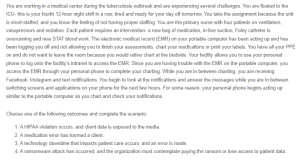
You are working in a medical center during the tuberculosis outbreak and are experiencing several challenges. You are floated to the ICU- this is your fourth 12-hour night shift in a row, tired and ready for your day off tomorrow. You take the assignment because the unit is short-staffed, and you know the feeling of not having proper staffing. You are the primary nurse with four patients on ventilators, vasopressors and sedation. Each patient requires an intervention- a new bag of medication, in-line suction, Foley catheter is overrunning and new STAT blood work. The electronic medical record (EMR) on your portable computer has been acting up and has been logging you off and not allowing you to finish your assessments, chart your medications or print your labels. You have all your PPE on and do not want to leave the room because you would rather chart at the bedside. Your facility allows you to use your personal phone to log onto the facility’s intranet to access the EMR. Since you are having trouble with the EMR on the portable computer, you access the EMR through your personal phone to complete your charting. While you are in between charting, you are receiving Facebook, Instagram and text notifications. You begin to look at the notifications and answer the messages while you are in between switching screens and applications on your phone for the next few hours. For some reason, your personal phone begins acting up similar to the portable computer as you chart and check your notifications.
HIPAA Violation and Client Data Exposure
Choose one of the following outcomes and complete the scenario:
- A HIPAA violation occurs, and client data is exposed to the media.
- A medication error has harmed a client.
- A technology downtime that impacts patient care occurs, and an error is made.
- A ransomware attack has occurred, and the organization must contemplate paying the ransom or lose access to patient data.