
High School Sport: Case of a Basketball Program
High school athletics shape the academic and personal development of students. Essentially, high school athletics foster teamwork, discipline, and leadership. At the same time, athletics strengthen the school’s community spirit. Nevertheless, running a successful high school athletic program requires a detailed financial plan that bridges between the existing needs and program needs. This paper presents a budget and financial plan for a high school basketball team. According to Post et al. (2024), basketball is one of the most popular sports that is recognized by the National Federation of High School (NFHS). Notably, this report will focus on budget projections, revenue generation strategies, facilities, personnel, equipment needs, and approaches that will be deployed to address any potential financial challenges.
Budget Projections
An ideal budget should ensure that all program needs are met. No financial shortfalls should be expected. For that matter, the projected annual budget for a varsity and junior varsity boys’ basketball program is given in Table 1 below.
Table 1
| Category | Item | Estimated Cost (USD) |
| Personnel Costs | Head Coach stipend | $5,000 |
| Assistant Coaches (2 × $3,000) | $6,000 | |
| Athletic Trainer (shared allocation) | $2,000 | |
| Officials/Referees | $3,500 | |
| Scorekeepers/Clock Operators | $1,000 | |
| Subtotal – Personnel | $17,500 | |
| Facilities & Maintenance | Gym utilities (lighting, HVAC) | $3,000 |
| Floor maintenance & refinishing | $2,500 | |
| Locker room maintenance & supplies | $1,000 | |
| Subtotal – Facilities | $6,500 | |
| Equipment & Uniforms | Practice basketball (20) | $1,200 |
| Game basketball (8) | $480 | |
| Team uniforms (24 players, two sets) | $4,800 | |
| Warmups, travel bags, gear | $2,400 | |
| Training aids & shooting machine | $3,000 | |
| Subtotal – Equipment | $11,880 | |
| Travel & Competition | Bus transportation (10 trips) | $4,500 |
| Meals & lodging for tournaments (2 events) | $3,500 | |
| Tournament entry fees | $2,000 | |
| Subtotal – Travel | $10,000 | |
| Miscellaneous/Contingency | Insurance contribution | $1,500 |
| Marketing & promotional materials | $500 | |
| Contingency reserve | $1,500 | |
| Subtotal – Miscellaneous | $3,500 | |
| Grand Total | $49,380 |
The projected budget presented above indicates that about $49,380 will be required to run a successful basketball program. With this budget, it is expected that high school will be competitive. It is worth noting that actual costs may change depending on school size, location, and resources held by the schools.
Revenue Generation Strategies
The sustenance of a successful basketball program requires multiple revenue streams. Various streams are identified in Table 2 below. The streams will raise revenue that falls between $35,000 and $40,000. Even though this falls below the budgeted costs, the budget variance can be reduced through funding from the school district. Furthermore, costs can be re-evaluated to check the potential for cost reduction. The revenue projections are as follows:
Table 2
| Revenue Source | Description | Estimated Annual Revenue (USD) |
| Ticket Sales | Admission fees ($5 adults, $3 students) × avg. 400 spectators × 15 home games | $12,000 |
| Concessions | Food and beverage sales at home games (run by boosters/volunteers) | $4,000 – $5,000 |
| Sponsorships & Advertising | Local business sponsorships and banner/program ads (bronze/silver/gold tiers) | $6,000 – $8,000 |
| Fundraising Events | Preseason dinners, youth clinics, and an alumni 3-on-3 tournament | $5,000 – $7,000 |
| Booster Club Support | Membership dues, parent donations, and volunteer fundraising | $5,000 |
| Merchandise Sales | School-branded apparel (hoodies, T-shirts, hats) | $3,000 – $4,000 |
| Total Potential Revenue | Combined annual revenue from all sources | $35,000 – $40,000 |
Facilities Planning
The basketball program relies heavily on many facilities. It will need access to the school gymnasium. Therefore, planning for the facilities will emphasize maintenance of the annual gym floor. The floor will be inspected periodically to ensure it is safe from any potential hazards. Another aspect for consideration will be the schedule for using the gym. Careful scheduling will be done to ensure coordinated gym usage. Upgrades will be made to various relevant materials such as scoreboards, sound systems, and bleachers. Lastly, planning will entail creating time for renting out the gym space to the community (DeFroda et al., 2022). Notably, this will ensure that extra revenue is raised and better relationships are established with the community.
Personnel Requirements
A successful basketball program will require essential staff. These will include the head coach, who will be responsible for the overall program leadership. Assistant coaches will be required to focus on scouting opponents and player skills. An athletic trainer will be required to provide medical coverage, injury prevention, and rehabilitation services. Lastly, officials will be required to ensure compliance with the existing NFHS rules. Notably, this will facilitate smooth event operations. Costs associated with the staff are one of the largest line items, crucial for program quality.
Equipment
There is a need for continuous quality equipment investment. The investment will touch on uniforms that should be updated every three years, basketballs to be replaced annually, safety gear such as knee pads, ankle braces, and first-aid supplies, and technology for analysis. Safety should be paramount for equipment planning.
Addressing Potential Financial Challenges
Various financial challenges can arise, making the need for proactive strategies paramount. First, budget cuts will be considered in areas that are not urgent, and this can be addressed through revenue channel diversification. Another challenge likely to occur is increased costs. To address this, a contingency reserve will be created in the budget to mitigate this risk. Lastly, there is a likelihood that attendance may not be consistent (Lempke et al., 2021). As a measure to address this, there should be fan engagement efforts such as themed nights and social media promotion.
Conclusion
A careful alignment of projected expenses with various sources of income is crucial for creating a sustainable budget. For the basketball program, the same will be required. For this reason, a budget of $49,380 to support personnel, facilities, equipment, and contingency needs is established. Leverage will be required regarding revenue generation to meet the identified revenue needs. Additionally, there will be a need for proactive planning to ensure program stability and compliance with equity standards.
References
DeFroda, S. F., Patel, D. D., Milner, J. D., Yang, D. S., & Owens, B. D. (2022). Performance after concussion in National Basketball Association players. Orthopaedic Journal of Sports Medicine, 10(3). https://doi.org/10.1177/23259671221083661
Lempke, L. B., Chandran, A., Boltz, A. J., Robison, H. J., Collins, C. L., & Morris, S. N. (2021). Epidemiology of injuries in National Collegiate Athletic Association Women’s Basketball: 2014–2015 through 2018–2019. Journal of Athletic Training, 56(7), 674–680. https://doi.org/10.4085/1062-6050-466-20
Post, E. G., Rivera, M. J., Robison, H. J., Rauh, M. J., McGuine, T. A., & Simon, J. E. (2024). Injury risk factors related to sport specialization in high school basketball: A prospective study. Journal of Athletic Training, 59(12), 1213–1218. https://doi.org/10.4085/1062-6050-0066.24
ORDER A PLAGIARISM-FREE PAPER HERE
We’ll write everything from scratch
Question 
Case of a Basketball Program
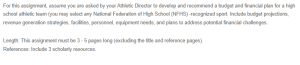
For this assignment, assume you are asked by your Athletic Director to develop and recommend a budget and financial plan for a high school athletic team (you may select any National Federation of High School (NFHS) -recognized sport. Include budget projections, revenue generation strategies, facilities, personnel, equipment needs, and plans to address potential financial challenges.
Length: This assignment must be 3 – 5 pages long (excluding the title and reference pages).
References: Include 3 scholarly resources.