
Hematology Disorder Concept Map – Anemia
Disorder/Disease process: Anemia
PATHOPHYSIOLOGY OF THE DISORDER:
The pathophysiology of anemia depends on the cause of anemia (Turner et al., 2022). Anemia is caused by decreased production of red blood cells, excessive blood loss, and increased destruction of red blood cells. Decreased production and increased destruction of red blood cells cause a decrease in the number of red blood cells in circulation, referred to as anemia. Adequate red blood cells are essential in transporting oxygen to body tissues; hence, patients with anemia experience hypoxia and shortness of breath.
Sources:
Turner, J., Parsi, M., & Badireddy, M. (2022). Anemia. StatPearls Publishing. https://www.ncbi.nlm.nih.gov/books/NBK499994/.
ETIOLOGY:
Anemia is caused by increased destruction of red blood cells, loss of blood, and decreased production of red blood cells (Turner et al., 2022). Nutritional etiologies include malnutrition, starvation, and a diet deficient in iron, folate, and vitamin B12.
Genetic disorders that cause anemia include thalassemia, hemoglobinopathies, Rh null disease, abetalipoproteinemia, and glycolytic pathway abnormalities.
Physical etiologies include burns and trauma. Infectious causes of anemia include bacteria such as clostridia, viruses such as cytomegalovirus, and protozoa such as toxoplasmosis and malaria.
Sources:
Turner, J., Parsi, M., & Badireddy, M. (2022). Anemia. StatPearls Publishing. https://www.ncbi.nlm.nih.gov/books/NBK499994/.
CLINICAL MANIFESTATIONS:
Fatigue
Headache
Chest pain
Weakness
Irregular heartbeats
Lightheadedness
Shortness of breath
Cold feet and hands
Melena signifies gastrointestinal bleeding (Turner et al., 2022)
Sources:
Turner, J., Parsi, M., & Badireddy, M. (2022). Anemia. StatPearls Publishing. https://www.ncbi.nlm.nih.gov/books/NBK499994/.
TREATMENTS:
Treatment depends on the cause and type of anemia (Turner et al., 2022). Anemia caused by underlying conditions such as gastrointestinal bleeding leading to blood loss is treated by management of the underlying condition. Nutritional and dietary adjustments are made to ensure adequate iron, folic acid, and vitamin B12 intake. Iron supplementation using oral ferrous sulfate is recommended for months as the patient is reviewed and monitored. The dosage depends on the patient’s severity and level of iron, folate, and vitamin B12 (Nguyen & Tadi, 2022). Parenteral iron therapy is used in patients with severe anemia. Blood transfusion is recommended in patients with excessive blood loss, hypoxia, and shock.
Sources:
Nguyen, M., & Tadi, P. (2022). Iron Supplementation. StatPearls Publishing. https://www.ncbi.nlm.nih.gov/books/NBK557376/.
Turner, J., Parsi, M., & Badireddy, M. (2022). Anemia. StatPearls Publishing. https://www.ncbi.nlm.nih.gov/books/NBK499994/.
References
Nguyen, M., & Tadi, P. (2022). Iron Supplementation. StatPearls Publishing. https://www.ncbi.nlm.nih.gov/books/NBK557376/.
Turner, J., Parsi, M., & Badireddy, M. (2022). Anemia. StatPearls Publishing. https://www.ncbi.nlm.nih.gov/books/NBK499994/.
ORDER A PLAGIARISM-FREE PAPER HERE
We’ll write everything from scratch
Question 
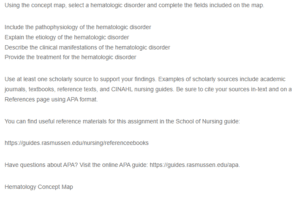
Hematology Disorder Concept Map
Using the concept map, select a hematologic disorder and complete the fields included on the map.
Include the pathophysiology of the hematologic disorder
Explain the etiology of the hematologic disorder
Describe the clinical manifestations of the hematologic disorder
Provide the treatment for the hematologic disorder
Use at least one scholarly source to support your findings. Examples of scholarly sources include academic journals, textbooks, reference texts, and CINAHL nursing guides. Be sure to cite your sources in-text and on a References page using APA format.
You can find useful reference materials for this assignment in the School of Nursing guide:
https://guides.rasmussen.edu/nursing/referenceebooks
Have questions about APA? Visit the online APA guide: https://guides.rasmussen.edu/apa.
Hematology Concept Map