
Heart Failure
Differentiate between systolic and diastolic heart failure.
Heart failure is when the heart fails to pump enough blood for body functions. Heart failure can either be left-sided, right-sided, or biventricular. Consistently systolic heart failure, also known as heart failure with reduced ejection fraction(below 50%), is heart failure that happens in the heart’s left ventricle. Ejection fraction measures how well the heart pumps or ejects blood out of the ventricles every time it contracts. The normal ejection fraction of a healthy heart ranges from 50% to 70%. On the other hand, diastolic heart failure, also termed heart failure with preserved ejection fraction, is characterized by stiffness or rigidity and thickening of the left ventricle, resulting in the heart failing to relax properly between heartbeats. This is different from systolic heart failure, where the left ventricle becomes too weak to squeeze the required amount of blood (Diastolic heart failure 2019).
State whether the patient is in systolic or diastolic heart failure.
The patient is in systolic heart failure. This can be justified by the fine inspiratory crackles bilateral bases observed from the physical exam and his symptoms, which include shortness of breath, which worsens with any activity, leg swelling, and fatigue. Additionally, the patient is a known hypertensive patient: hypertension is known to be a causal factor for systolic heart failure.
Explain the pathophysiology associated with each of the following symptoms:
During exercise or activity, dyspnea on exertion is shortness of breath but gets better with rest. In systolic heart failure, dyspnea on exertion occurs because the left ventricular output fails to rise during an exercise, which results in pressure to the pulmonary venous.
Pitting edema can result from many underlying conditions. However, heart failure results from the retention of too much fluid and poor circulation. This results in the severe swelling of the affected body parts, leaving indentations, also known as pit
With jugular vein distention, blood accumulates in the lungs, which is caused by the failure of the left ventricle to function, which in turn puts more strain on the right ventricle till it weakens, making it less effective in pumping blood. This failure results in the bulging of the jugular vein
Unlike dyspnea, which occurs in any position, orthopnea can be termed as an experience of shortness of breath while lying down; hence, the patient slept much better after propping three pillows or sitting on a recliner seat. This symptom is also improved by standing or sitting.
Explain the significance of the presence of a 3rd heart sound and ejection fraction of 25%.
The presence of the 3rd heart indicates left heart failure, associated with Mitral valve regurgitation and a low ejaculation fraction, which causes shortness of breath and fatigue (Shono et al., 2019). A healthy heart’s ejaculation fraction ranges between 50% and 70%; therefore, any measure below 50% is low, meaning 25% is severely low.
References
Diastolic heart failure. Harvard Health. (2019, August 23). Retrieved November 3, 2022, from https://www.health.harvard.edu/newsletter_article/diastolic-heart-failure
Shono, A., Mori, S., Yatomi, A., Kamio, T., Sakai, J., Soga, F., Tanaka, H., & Hirata, K.-ichi. (2019). Ultimate Third Heart sound. Internal Medicine, 58(17), 2535–2538. https://doi.org/10.2169/internalmedicine.2731-19
ORDER A PLAGIARISM-FREE PAPER HERE
We’ll write everything from scratch
Question 
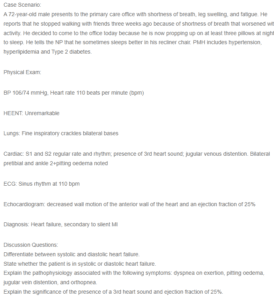
Case Scenario:
A 72-year-old male presents to the primary care office with shortness of breath, leg swelling, and fatigue. He reports that he stopped walking with friends three weeks ago because of shortness of breath that worsened with activity. He decided to come to the office today because he is now propping up on at least three pillows at night to sleep. He tells the NP that he sometimes sleeps better in his recliner chair. PMH includes hypertension, hyperlipidemia, and Type 2 diabetes.
Heart Failure
Physical Exam:
BP 106/74 mmHg, Heart rate 110 beats per minute (bpm)
HEENT: Unremarkable
Lungs: Fine inspiratory crackles bilateral bases
Cardiac: S1 and S2 regular rate and rhythm; presence of 3rd heart sound; jugular venous distention. Bilateral pretibial and ankle 2+pitting edema noted
ECG: Sinus rhythm at 110 bpm
Echocardiogram: decreased wall motion of the anterior wall of the heart and an ejection fraction of 25%
Diagnosis: Heart failure, secondary to silent MI
Discussion Questions:
Differentiate between systolic and diastolic heart failure.
State whether the patient is in systolic or diastolic heart failure.
Explain the pathophysiology associated with the following symptoms: dyspnea on exertion, pitting edema, jugular vein distention, and orthopnea.
Explain the significance of the presence of a 3rd heart sound and ejection fraction of 25%.