
Healthcare Program/Policy Evaluation
| Healthcare Program/Policy Evaluation | The Patient Protection and Affordable Care Act |
| Description | The Patient Protection and Affordable Care Act or Affordable Care Act (ACA) is a policy that was enacted in 2010 for healthcare reformation (HHS, 2022). Its main aim was to make affordable health insurance available to more people, expand the Medicaid program to cover adults with low incomes, and complement innovative medical care methods of delivery meant to lower healthcare costs (HHS, 2022). |
| How was the success of the program or policy measured?
|
The success of the ACA program was measured by how much it reduced the number of uninsured people despite its improvement of quality care and lowering of costs. According to The Editorial Board of the New York Times (2014), it was also measured by its impact on federal and state budgets and employment. However, the major measure of its success was whether the number of uninsured Americans dropped. Based on its goal, its success is also measured by how many states employed the Medicaid expansion. |
| How many people were reached by the program or policy selected? How much of an impact was realized with the program or policy selected?
|
The HHS (2022) reported that 21 million people in over 40 territories and states gained Coverage of healthcare because of ACA’s Medicaid expansion to 65-year-olds and fewer adults with low income. The department also reported that over 2 million people had access to Coverage because of this expansion during the Biden-Harris Administration, ensuring that Coverage was extended to underserved communities during the COVID-19 pandemic phase. Commonwealth Fund (2020) reported that by 2016, the number of uninsured persons reduced to 28.6 million. Enrollment via ACA marketplaces led to about half of health insurance coverage gains (Blumenthal, Collins, & Fowler, 2020). However, Eibner & Nowak (2016) wrote that there is little understanding of the program’s coverage expansion effect on the low-income newly insured patients’ access to healthcare under the Federally Qualified Health Centers (FQHCs) service. The program was expected to enable many uninsured people served by the FQHCs to access Coverage from Medicaid and assist them in having better access to healthcare. However, research shows that little is known about ACA’s impact. Findings show that patients served by FQHC and newly insured have continued limited access to care (Ercia, 2021). For instance, research studies indicate that FQHCs in states employing Medicaid expansion, such as Washington, Oregon, Ohio, Minnesota, and California, have increased visitations than non-expanded states (Ercia, 2021). |
| At what point in program implementation was the program or policy evaluation conducted?
|
The program evaluation was conducted from the initial implementation of the program. According to Schultz (2019), the ACA program ignited a lot of administration, legal, and political issues that had various effects on the viability of the policy. For instance, it was found that the policy did not have initial public support and did not pay attention to the political opposition. After the ACA was passed, there was a division in public opinion regarding support: 54% were opposed, and 40% supported the law (Shultz, 2019). 80% of Republicans opposed the policy, whereas 75% of Democrats supported the policy (Shultz, 2019). |
| What data was used to conduct the program or policy evaluation?
|
The data used to conduct the ACA evaluation was the political polarization that it caused. This is because the ACA was passed effectively without the votes of the Republican Party in Congress, and the opposition towards the policy was highly polarized (Shultz, 2019). Data on legal grounds was also used to evaluate the policy. For instance, the Republican attorney generals/governors argued that the federal government had no constitutional authority to have people buy health insurance or require states to embrace Medicaid expansion. Another legal evaluation data was based on the argument from businesses stating that ACA violated the First Amendment Free Exercise of Religion Rights by requiring payment of health insurance for contraceptives for women (Schultz, 2019). Moreover, data on the argument that ACA permits subsidies to low-income people who buy health insurance via federal health care exchanges. Also, Schultz (2019) notes that the policy resources, such as websites, were evaluated. |
| What specific information on unintended consequences was identified? | The information found on unintended consequences of ACA is hospital monopolies. Over the years, there have been increased acquisitions and mergers to form bigger healthcare conglomerates that acquire smaller healthcare centers, resulting in regional monopolies. These conglomerates include Idaho’s St. Luke’s Health System, Virginia’s Inova Health System, and Massachusetts’s Partners HealthCare (Blumenthal, Collins, & Fowler, 2020). This means that the needed competition in the healthcare market is slashed, and conglomerates will likely command prices. As a result, network providers are reduced, and healthcare costs are likely to increase because of monopoly. |
| What stakeholders were identified in the evaluation of the program or policy? Who would benefit most from the results and reporting of the program or policy evaluation? Be specific and provide examples. | The stakeholders identified in the evaluation of ACA included the healthcare providers, states, employers, consumers, and the Republicans and Democrats.
The groups that would benefit most from the evaluation results include uninsured patients and those who purchase insurance from small markets. Smaller community hospitals and businesses would also benefit as they no longer operate under large regional hospitals. |
| Did the program or policy meet the original intent and objectives? Why or why not? | The ACA program has attained its objectives to some extent because there is some progress in terms of healthcare access and the number of insured persons. However, little has been documented on the cost of reduction intention and whether the program has led to better healthcare outcomes. |
| Would you recommend implementing this program or policy in your place of work? Why or why not? | I recommend implementing ACA in the workplace because it has helped low-income adults get healthcare insurance, especially those in states that have employed Medicaid expansion. |
| Identify at least two ways that you, as a nurse advocate, could become involved in evaluating a program or policy after one year of implementation. | One way I could become involved in evaluating a program or policy after one year of implementation is reshaping the cost of health care by helping the stakeholders understand how cost can affect the quality of care, as Milstead & Short (2019) contend. I would, therefore, advocate for cost transparency for patients. I would also campaign for education for patients about subsidized enrollment in health insurance plans to ensure that the policy is helping people and not hurting them (Milstead & Short, 2019). |
| General Notes/Comments | In any healthcare policy or program, nurses should be key stakeholders because they are frontline responders to the needs of the patients. Therefore, they understand the concerns and needs of patients better than other professionals in the healthcare environment. Including them in a policy program would reflect the true representations of the patient’s concerns throughout the implementation process. Otherwise, gaps such as lack of quality care, high cost, poor services, and lack of access to healthcare would be realized, and the healthcare policy would not realize its intentions and objectives. |
References
Blumenthal, D., Collins, S.R., & Fowler, E. (2020). The Affordable Care Act at 10 Years: What’s the Effect on Health Care Coverage and Access. The Commonwealth Fund Journal Article.
Eibner, C. & Nowak, S. (2016). Evaluating the CARE Act: Implications of a Proposal to Repeal and Replace the Affordable Care Act. The Commonwealth Fund Reports.
Ercia, A. (2021). The impact of the Affordable Care Act on patient coverage and access to care: perspectives from FQHC administrators in Arizona, California, and Texas. BMC Health Services Research, 21(1), 1-9.
Milstead, J.A. & Short, N.M. (2019). Health Policy and Politics: A Nurse’s Guide. Burlington, MA.: Jones & Bartlett Learning.
Schultz, D. (2019). The Implementation and Evaluation of the United States Affordable Care Act. Medicine, Law & Society, 12(1), 17-38.
The U.S. Department of Health and Human Services- HHS (2022). About Affordable Care Act. https://www.hhs.gov/healthcare/about-the-aca/index.html
The U.S. Department of Health and Human Services- HHS (2022). New Reports show a record 35 million People enrolled in Coverage related to the Affordable Care Act, with a Historic 21 million people enrolled in Medicaid Expansion Coverage. https://www.hhs.gov/about/news/2022/04/29/new-reports-show-record-35-million-people-enrolled-in-coverage-related-to-the-affordable-care-act.html
The Editorial Board of the New York Times (2014). Measuring the Success of Health Reform. The New York Times.
ORDER A PLAGIARISM-FREE PAPER HERE
We’ll write everything from scratch
Question 
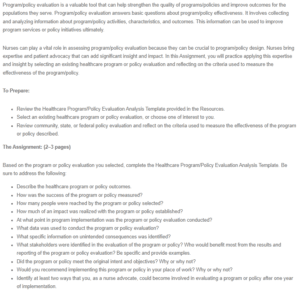
Program/policy evaluation is a valuable tool that can help strengthen the quality of programs/policies and improve outcomes for the populations they serve. Program/policy evaluation answers basic questions about program/policy effectiveness. It involves collecting and analyzing information about program/policy activities, characteristics, and outcomes. This information can be used to improve program services or policy initiatives ultimately.
Healthcare Program/Policy Evaluation
Nurses can play a vital role in assessing program/policy evaluation because they can be crucial to program/policy design. Nurses bring expertise and patient advocacy that can add significant insight and impact. In this Assignment, you will practice applying this expertise and insight by selecting an existing healthcare program or policy evaluation and reflecting on the criteria used to measure the effectiveness of the program/policy.
To Prepare:
- Review the Healthcare Program/Policy Evaluation Analysis Template provided in the Resources.
- Select an existing healthcare program or policy evaluation, or choose one of interest to you.
- Review community, state, or federal policy evaluation and reflect on the criteria used to measure the effectiveness of the program or policy described.
The Assignment: (2–3 pages)
Based on the program or policy evaluation you selected, complete the Healthcare Program/Policy Evaluation Analysis Template. Be sure to address the following:
- Describe the healthcare program or policy outcomes.
- How was the success of the program or policy measured?
- How many people were reached by the program or policy selected?
- How much of an impact was realized with the program or policy established?
- At what point in program implementation was the program or policy evaluation conducted?
- What data was used to conduct the program or policy evaluation?
- What specific information on unintended consequences was identified?
- What stakeholders were identified in the evaluation of the program or policy? Who would benefit most from the results and reporting of the program or policy evaluation? Be specific and provide examples.
- Did the program or policy meet the original intent and objectives? Why or why not?
- Would you recommend implementing this program or policy in your place of work? Why or why not?
- Identify at least two ways that you, as a nurse advocate, could become involved in evaluating a program or policy after one year of implementation.