
Healthcare Cost Containment Fails
Healthcare costs have long been a worry for the public, government, business community, and legislative branches. Legislators have spent much time and effort attempting to find budgets and regulations to control or reduce health expenditure costs without affecting overall healthcare effectiveness. Specific cost-cutting techniques have unintended medical consequences, especially for minority groups. Budget reductions or restrictions may change expenditures, limit or stop providing services to particular groups, or both. This essay gives causes and suggestions for cutting healthcare expenses while enhancing quality.
Causes of the high cost of health care in the U.S.
The United States spends more on healthcare than any other state. The cost of health care in the U.S. has constantly risen in the years without improving health outcomes. Too much spending on healthcare results in different sectors like education and transport being deprived of resources, leading to stagnation. Subsequently, several factors have contributed to this rise, including the rising cost of drugs due to the lack of proper government regulatory policies, the increasing growth of the aging population, the high healthcare administrative costs due to the complexity of the healthcare system, most healthcare centers/ hospitals are more focused on the profit, and lastly initiation of national programs like Medicare and Medicaid (Ryan Nunn, 2022).
Proposed strategies to help lower the cost of healthcare
Firstly, administrative simplification will play a preeminent role in cost reduction. To manage the high administrative expenses in healthcare that are often connected to ineffective coordination, complexity, and redundant regulatory requirements, administrative operations must be simplified with the present health systems. Secondly, global health provider payments were introduced. The healthcare system and providers should implement a prepayment scheme for all services provided to diverse patient demographics. This would aid in containing expenses linked to ineffective and disorganized treatment, a lack of focus on managing chronic illnesses, and financial incentives for healthcare professionals to keep patient healthcare expenditures down. Thirdly, payments for an episode of care. This technique of total payment eliminates the need for patients to pay individually for each treatment they get. This would assist in addressing the ineffective fee-for-service system’s impact on the coordination of patient care. Fourthly, Accountable Treatment Organizations (ACOs). An ACO is a local organization comprising numerous cooperating healthcare providers monitoring the total cost and standard of care a specific patient group receives. They should be mandated to oversee healthcare providers at all times to ensure they monitor the cost. And lastly, equalizing Payment Rates for Healthcare Providers. Payment prices for all patients receiving the same services from the same healthcare provider should be equal, and only the state or the particular provider may establish the rates. This would improve the monitoring and processing of reimbursement schedule claims and address the high healthcare expenses, lack of cost competitiveness, and other issues (Nunn, Parsons & Shambaugh, 2020).
Feedback from the group
According to the information provided by my group members, government and healthcare providers play a critical role in ensuring better healthcare is provided to the patients. The government and healthcare providers need to ensure that better healthcare reforms are enacted to lower costs and provide better healthcare services to patients. In this case, the group members agreed to my proposed strategies for a better-standardized approach.
Proposed Changes
The changes I will propose in this case are about former U.S. President Obama’s dual strategies of increasing healthcare coverage and enhancing quality while controlling costs. Since it was passed, lower healthcare costs and higher quality have shown the benefits and feasibility of this law. A lower incidence of hospital-acquired infections, a greater Medicare beneficiary penetration rate despite payment cutbacks to the Congressional Budget Office, and better stability and resilience of employer-sponsored health plans are some of the changes that need to be introduced to ensure that the cost of healthcare is contained. I will also propose that healthcare facilities frequently collect patient data regarding the services they receive and what needs to be adjusted. Through this, the facilities will have better ways of creating adjustments and ensuring that they use the feedback to reduce the cost of healthcare where necessary.
References
Kelly, P., Porr, C. (2018) “Ethical Nursing Care Versus Cost Containment: Considerations to Enhance R.N. Practice” OJIN: The Online Journal of Issues in Nursing Vol. 23, No. 1, Manuscript 6.
Nunn, R., Parsons, J., & Shambaugh, J. (2020). A dozen facts about the economics of the U.S. healthcare system. The Hamilton Project, Economic Facts.
Ryan Nunn, a. (2022). A dozen facts about the economics of the U.S. healthcare system. Retrieved 22 September 2022, from https://www.brookings.edu/research/a-dozen-facts-about-the-economics-of-the-u-s-health-care-system/
ORDER A PLAGIARISM-FREE PAPER HERE
We’ll write everything from scratch
Question 
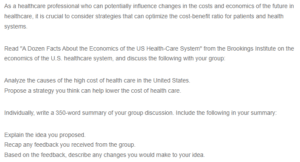
As a healthcare professional who can potentially influence changes in the costs and economics of the future in healthcare, it is crucial to consider strategies that can optimize the cost-benefit ratio for patients and health systems.
Healthcare Cost Containment Fails
Read “A Dozen Facts About the Economics of the U.S. Healthcare System” from the Brookings Institute on the economics of the U.S. healthcare system, and discuss the following with your group:
Analyze the causes of the high cost of health care in the United States.
Propose a strategy you think can help lower the cost of health care.
Individually, write a 350-word summary of your group discussion. Include the following in your summary:
Explain the idea you proposed.
Recap any feedback you received from the group.
Based on the input, describe any changes you would make to your idea.