
Health Factors in the African American Context-Case Study of Shawn Billings
As an African American, Shawn Billings has several socioeconomic, lifestyle, spiritual, and other cultural factors that may influence his illness. For instance, poverty is a significant factor that affects health care among African Americans. African Americans are less likely than white Americans to have full-time jobs and are more likely to be poor due to structural restrictions (Sood & Vanita, 2021). This causes some of them not to seek medical attention when sick. Several African Americans also experience food insecurity. This has significant effects on both health and economic well-being. A household or family experiences food insecurity when they cannot access enough nutritious food. This occurs when people live in economically depressed locations with no grocery stores selling fresh foods or lack the money to buy healthy meals (Dubowitz et al., 2021). Also, African Americans believe home remedies can be as effective as conventional remedies in managing diseases. This makes them use complementary therapies such as herbs to treat their illnesses.
Besides, African Americans believe spirituality plays a role in their clinical experiences. Many African Americans see the church as a reliable source of social assistance and health information and hence resort to spiritual healers and prayers whenever ill (Siler et al., 2021). The issues to be sensitive to when interacting with the patient include cultural practices and religious beliefs. Although the patient may be engaging in cultural practices not recommended in conventional medicine, it would be necessary to respect his practices. This can help promote patient satisfaction with the quality of care provided. When making medical choices, the patient may turn to his spiritual and religious values (Dillard et al., 2021). Specific prayer times prescribed by the patient’s religion may conflict with medical care.
The targeted questions I would ask the patient include:
- Do you think religion has a role in your illness?
- What is your regular diet?
- Do you use any recreational drugs?
- What conditions have you been diagnosed with in the past?
- What do you do for a living?
- Has anything been done anything to manage your illness?
References
Dillard, V., Moss, J., Padgett, N., Tan, X., & Kennedy, A. B. (2021). Attitudes, beliefs and behaviours of religiosity, spirituality, and cultural competence in the medical profession: A cross-sectional survey study. PLoS ONE, 16(6 June), 1–18. https://doi.org/10.1371/journal.pone.0252750
Dubowitz, T., Dastidar, M. G., Troxel, W. M., Beckman, R., Nugroho, A., Siddiqi, S., Cantor, J., Baird, M., Richardson, A. S., Hunter, G. P., Mendoza-Graf, A., & Collins, R. L. (2021). Food insecurity in a low-income, predominantly African American cohort following the COVID-19 pandemic. American Journal of Public Health, 111(3), 494–497. https://doi.org/10.2105/AJPH.2020.306041
Siler, S., Arora, K., Doyon, K., & Fischer, S. (2021). Spirituality and the Illness Experience: Perspectives of African American Older Adults. Physiology & Behavior, 176(5), 139–148. https://doi.org/10.1177/1049909120988280.Spirituality
Sood, L., & Vanita, S. (2021). Being African American and Rural: A Double Jeopardy From COVID-19. Journal of Rural Health, 37(1), 217–221. https://doi.org/10.1111/jrh.12459.
ORDER A PLAGIARISM-FREE PAPER HERE
We’ll write everything from scratch
Question 
Case Study:
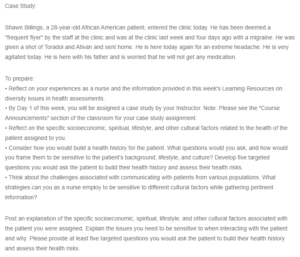
Shawn Billings, a 28-year-old African American patient, entered the clinic today. He has been deemed a “frequent flyer” by the staff at the clinic and was at the clinic last week and four days ago with a migraine. He was given a shot of Toradol and Ativan and sent home. He is here today again for an extreme headache. He is very agitated today. He is here with his father and is worried that he will not get any medication.
Health Factors in the African American Context-Case Study of Shawn Billings
To prepare:
• Reflect on your experiences as a nurse and the information provided in this week’s Learning Resources on diversity issues in health assessments.
• By Day 1 of this week, you will be assigned a case study by your Instructor. Note: Please see the “Course Announcements” section of the classroom for your case study assignment.
• Reflect on the specific socioeconomic, spiritual, lifestyle, and other cultural factors related to the health of the patient assigned to you.
• Consider how you would build a health history for the patient. What questions would you ask, and how would you frame them to be sensitive to the patient’s background, lifestyle, and culture? Develop five targeted questions you would ask the patient to build their health history and assess their health risks.
• Think about the challenges associated with communicating with patients from various populations. What strategies can you as a nurse employ to be sensitive to different cultural factors while gathering pertinent information?
Post an explanation of the specific socioeconomic, spiritual, lifestyle, and other cultural factors associated with the patient you were assigned. Explain the issues you need to be sensitive to when interacting with the patient and why. Please provide at least five targeted questions you would ask the patient to build their health history and assess their health risks.