
Garden Bed and Inequality
Part 1
Perimeter of the garden bed = 2(length + width) or 2(a+ b)
- = 2((2x +1) + x)
- = 2(3x + 1)
- = 6x + 2
Note: x represents the number of bricks
As indicated by the equation solved above, the perimeter of the garden will be given by 6x + 2, whereby x represents the number of bricks to be used. The perimeter covers the distance all around the garden bed.
Part 2
Bricks used on each side of the garden will be given the perimeter equation as given below: Total bricks (perimeter of the garden) = 6x + 2
Solving for the value of x (number of bricks);
- 74 = 6x + 2
- 74 ̶ 2 = 6x
- 72 ÷ 6 = 6x ÷ 6
- x = 12
Therefore, the length side will be (2x + 1)
- Which will be (2 × 12) + 1
- = 25 bricks
- The width side will be equal to x = 12 bricks
Part 3
Width =12 bricks, each with 6 inches, and thus (6 inches × 12) = 72 inches
Length = 25 bricks each with 6 inches, and thus (6 inches × 25) = 150 inches
Each brick is 6 inches; therefore, the width of the garden will have 12 bricks and thus 72 inches. Similarly, the length of the garden of 25 bricks will be 150 inches, as calculated above.
Part 4
Y ≤ $120/$1.75
≤ 68.57
Y represents the number of bricks. In the above inequality, the number of bricks is equal to or less than 68.57, realized by dividing $120 (budget) by $1.75 (cost per brick).
Part 5
- One layer requires 74 bricks
- The current budget will support 68 bricks
- Therefore, another complete layer of bricks on top cannot be made because six bricks are missing.
ORDER A PLAGIARISM-FREE PAPER HERE
We’ll write everything from scratch
Question

Scenario
A friend has given you leftover landscaping bricks. You decide to make a garden bed and surround it with the bricks. There are 74 bricks, and each brick is 6 inches long. You would like the garden bed to be slightly more than twice as long as it is wide, as shown in the diagram below. You have also given yourself a budget of $120 for additional materials should you need them. Your local home improvement store sells the same bricks for $1.75 per brick. The displayed sides present the number of bricks on each side, where x is the number of bricks.Rectangle with one side equaling x and the other side equaling 2x+1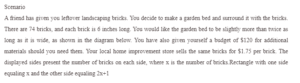
Garden Bed and Inequality
Assessment Instructions
Show and explain all steps in your responses to the following parts of the assignment. All mathematical steps must be formatted using the equation editor.Part 1: Write an equation representing the perimeter of the garden bed.
Part 2: Calculate how many bricks are used on each side of the garden bed.
Part 3: Determine the length of each side after the bricks are added.
Part 4: Write an inequality that represents how many bricks can be purchased within your budget. Let y represent the number of bricks.
Part 5: Will you be able to make another complete layer of bricks on top and stay within your budget? Hint: your budget is only for the second layer of bricks.