
Financing Healthcare
Compared to other developed nations, the United States has the most expensive healthcare system (Commonwealth Fund, 2020). It is thus critical to be aware of healthcare costs during planning. The high price of healthcare services leads to disparities in healthcare services since individuals of low socioeconomic status may be unable to assess the healthcare services. The GDP spent on healthcare in the United States is higher than its peers (Commonwealth Fund, 2020). Many people cannot sustain these high healthcare costs. This negatively affects the population’s health, with many individuals suffering from chronic conditions who cannot visit physicians. Financing in healthcare is done through public insurance programs, private insurance, and out-of-pocket payments (Commonwealth Fund, 2020).
History of Managed Care
Insurance has existed in the United States for many decades, but large insurance players have recently joined the market. The forerunner of modern health insurance started in the 1920s when healthcare facilities began offering healthcare services on a prepaid basis. The first employment-managed healthcare plan started with a group of teachers in Dallas. They came together and created a program where they paid insurance premiums to Baylor University Hospital for any future healthcare services they would receive (Academic Health Plans (AHP), 2020). This program later became Blue Cross. This health insurance plan only offered coverage for hospital services.
The Blue Shield company was established in the 1930s. Employers in the mining and lumber industry joined hands and offered healthcare services to their employees. (AHP, 2020). This insurance plan became the National Association of Blue Shield Plans. The Blue Shield and Blue Cross companies later merged. The Great Depression influenced the adoption of these insurance plans. Baylor Univerisity Hospital developed an insurance plan because of a drop in revenue generated from patients with occupancy rates and contributions significantly reducing (AHP, 2020). It set the insurance plan to ensure there was a steady flow of income.
Over time, healthcare costs have risen, and most employers saw the importance of providing greater benefits for their employees (AHP, 2020). This led to the ballooning of the health insurance industry. In the 1970s, there was the creation of UnitedHealthcare, which is the current largest insurance provider in the country (AHP, 2020). The health insurance industry is lucrative, with payments and revenues running into trillions of dollars in the modern world. Health insurance is continuing to grow.
Federal Laws Governing Private Insurance
Many regulations in the United States regulate private insurance. The first federal law is the Affordable Care Act (ACA). This law applies to employers and employers who are currently covered or seeking to be covered. This act requires that individuals should have healthcare coverage or pay penalties as stipulated in the front. Businesses with no more than fifty full-time employees are not mandated to provide insurance under the ACA, while companies with more than fifty employees must provide coverage (Wettstein, 2017). This law has a provision that governs health insurance marketplaces. It mandates states to develop online marketplaces that enable small businesses and people to combine their finances and buy health coverage (Wettstein, 2017). This law also offers small businesses credit to help pay for health insurance costs (Wettstein, 2017).
The second law is the Consolidated Omnibus Budget Reconciliation Act (COBRA) law. The COBRA law affects employers who offer health coverage for their employees. This law gives participants who lose their healthcare coverage the ability to continue with their group coverage off by their former employers under certain circumstances (U.S. Department of Labor, n.d.). The employees can thus get a temporary extension of their group health plan. This law has regulations on how the employees can decide to continue with coverage, and it also requires that employees provide notice (U.S. Department of Labor (DOL), n.d.).
The third law is the Employee Retirement Income Security Act of 1974 (ERISA). ERISA affects employers in the private sector who offer group health benefits. This law sets standards for voluntary retirements and protects these individuals. This act requires employers to provide their participants with information concerning the health plan, including the features and funding (DoL, n.d.). The last federal law is the Health Insurance Portability and Accountability Act (HIPAA). This is a federal regulation governing employers with no less than two employees. This law allows employees to obtain health coverage when they change their jobs or group health care coverage, even when they have a preexisting medical condition (Edemekong et al., 2021). Employees cannot be denied insurance due to their past medical history.
Consumer-Driven Healthcare
Consumer-driven healthcare ensures that employees have health plans with high deductibles, low premiums, and savings accounts (Ferguson et al., 2020). These healthcare plans lower the costs for employers while prompting employees to make informed healthcare decisions and increasing the number of individuals accessing insurance plans. In consumer-driven healthcare, employers have shifted the cost to employees. This healthcare plan encourages employees to seek cost-efficient healthcare services by having reliable information that guides their health decisions. This plan has enabled employees to reduce their utilization of unnecessary healthcare services (Ferguson et al., 2020). The downside to this is that some employees may reduce the utilization of necessary healthcare services since they cannot afford them. Consumer-driven healthcare plans require individuals to differentiate between essential and unnecessary healthcare.
These plans have successfully reduced the costs that employees spend on healthcare (Ferguson et al., 2020). This has enabled businesses to thrive in other areas. Employees who are always healthy can be able to save in these plans. These employees do not have to spend on their premiums and rarely seek healthcare services (Ferguson et al., 2020). These employees can thus save money since they will not be hospitalized. In consumer-driven healthcare services, employees are informed, and they inquire from their doctors concerning the prescribed medications and inquire for alternatives and generics instead of brand drugs (Ferguson et al., 2020). The primary idea of consumer-driven healthcare plans is to empower consumers to differentiate between necessary and unnecessary healthcare and provide them with accurate information on healthcare costs.
Opportunities for Nurses
The Affordable Care Act demands increased healthcare quality through the coordination of healthcare services (Cleveland et al., 2019). Due to this, nurses have many employment opportunities in the health insurance industry since Medicare covers many individuals, hence the need to coordinate care for insured individuals. Nurses are critical in the coordination and continuum of care (Cleveland et al., 2019). Many healthcare services and delivery models are shifting from volume-based fee-for-service healthcare to value-based healthcare services. Value-based healthcare services are based on outcomes, performances, and quality healthcare (Cleveland et al., 2019). Nurses can thus be employed in insurance companies for care management of complex and chronic conditions.
Nurses can be employed in insurance companies to collaborate with physician groups and hospitals to develop plans for care coordination. This ensures that patients get the right treatment at the right cost. Many healthcare insurance companies are shifting payments to alternative value-based models such as accountable care organizations. In these value-based models, nurses are part of a multidisciplinary team to ensure that patients take drugs and adhere to lifestyle modifications. Insurers reward the ACOs based on quality improvement and reduced healthcare costs (Cleveland et al., 2019). Care coordination is an essential role of all registered nurses, and they can be care coordinators in insurance companies to align with ACA goals.
Conclusion
The healthcare system of the United States is one of the most expensive in the world. It is mainly financed through out-of-pocket spending, private insurance, and public insurance programs. The beginning of private insurance in the United States can be traced back to the 1930s during the Great Depression when hospitals had to come up with payment plans to ensure they had a steady stream of income. This evolved into the current private insurance companies we have. Several laws govern private insurance, including COBRA, ACA, HIPAA, and ERISA. One of the healthcare plans in the United States is consumer-driven healthcare, in which the consumer is empowered to differentiate between necessary and unnecessary healthcare. This plan shifts costs to employees and allows individuals to save money. Finally, nurses have opportunities in private insurance due to the need for coordination of care.
References
Academic Health Plans (AHP). (2020, January 30). A brief history of private insurance in the United States – Academic HealthPlans. Academic HealthPlans. https://www.ahpcare.com/a-brief-history-of-private-insurance-in-the-united-states/
Cleveland, K., Motter, T., & Smith, Y. (2019). Affordable care: Harnessing the power of nurses. OJIN: The Online Journal of Issues in Nursing, 24(2). https://doi.org/10.3912/ojin.vol24no02man02
Commonwealth Fund. (2020). U.S. health care from a global perspective, 2019. https://www.commonwealthfund.org/publications/issue-briefs/2020/jan/us-health-care-global-perspective-2019
DoL. (n.d.). ERISA. U.S. Department of Labor. https://www.dol.gov/general/topic/health-plans/erisa
Edemekong, P. F., Annamaraju, P., & Haydel, M. C. (2021, February 4). Health Insurance Portability and Accountability Act – StatPearls – NCBI bookshelf. National Center for Biotechnology Information. https://www.ncbi.nlm.nih.gov/books/NBK500019/
Ferguson, W., White, B. S., McNair, J., Miller, C., Wang, B., & Coustasse, A. (2020). Potential savings from consumer-driven health plans. International Journal of Healthcare Management, 1-6. https://doi.org/10.1080/20479700.2020.1770425
U.S. Department of Labor (DOL). (n.d.). Continuation of health coverage (COBRA). U.S. Department of Labor. https://www.dol.gov/general/topic/health-plans/cobra
Wettstein, G. (2017). The Affordable Care Act’s insurance market regulations’ effect on coverage. Health Economics, 27(3), 454-464. https://doi.org/10.1002/hec.3585
ORDER A PLAGIARISM-FREE PAPER HERE
We’ll write everything from scratch
Question 
Financing Healthcare
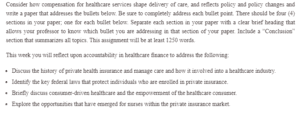
Consider how compensation for healthcare services shapes the delivery of care and reflects policy and policy changes, and write a paper that addresses the bullets below. Be sure to address each bullet point completely. There should be four (4) sections in your report, one for each shot below. Separate each area in your form with a clear, brief heading that allows your professor to know which shell you are addressing in that section of your report. Include a “Conclusion” section that summarizes all topics. This assignment will be at least 1250 words.
This week, you will reflect upon accountability in healthcare finance to address the following:
- Discuss the history of private health insurance and manage care and how it is involved in the healthcare industry.
- Identify the key federal laws that protect individuals who are enrolled in private insurance.
- Briefly discuss consumer-driven healthcare and the empowerment of the healthcare consumer.
- Explore the opportunities that have emerged for nurses within the private insurance market.