
Final Clinical Summative Self-Evaluation- ADNG 2200 Clinical III
| HUMAN FLOURISHING
Apply knowledge and skills learned in the program to uphold patients’ right of self-determination and promote holistic well-being of client and family. QSEN #1 – Provide patient-centered care |
|
| Expected Satisfactory Behaviors | Student Self-Evaluation |
| · Creates a therapeutic environment, consistently responding therapeutically to patients & family
· Protects patient autonomy, dignity, and rights while caring for patients. |
Patient-centered care remains my key strategy during this clinical practice aimed at fostering patient independence and enhancing her well-being. In all my encounters, I maintained a professional and caring attitude toward patients and relatives. For instance, while I was on duty administering post-operative care, a patient was anxious about pain control; hence, I empathized with her and educated her on her choices for pain control while respecting her choices: Final Clinical Summative Self-Evaluation- ADNG 2200 Clinical III.
Patient dignity and rights are preserved through advocating for informed consent as well as cultural beliefs about health care. For example, I encountered a patient who had limited ability to speak English—accordingly, I involved a translator to explain the details of the care plan to the patient. In the future, I plan on improving on education and evaluating myself on culturally sensitive care. |
| Objective Data: Reflective Journal x2, Process Recording, Case Studies, Daily Clinical Performance | |
| NURSING JUDGMENT
Make judgments in practice, supported by evidence, that integrate nursing science in the provision of safe, quality care. QSEN #2 – Safety, Patient and Healthcare Provider QSEN #3 – Informatics |
|
| Expected Satisfactory Behaviors | Student Self-Evaluation |
| · Develop a priority plan of care based on relevant, holistic data and adapt the plan when warranted.
· Employs effective judgment and available resources to provide evidence-based interventions in a safe, efficient manner to multiple patients · Utilize understanding of the pathophysiology of disease to predict priority evidence-based interventions · Apply knowledge of and appropriate use of asepsis to create a safe care environment that results in high-quality patient outcomes (medication administration, handwashing, invasive procedures, etc.) · Submit daily care plan to instructor for review post-clinical · Provides valid rationales for decisions and actions taken · Communicates significant patient information to the healthcare team in a timely manner · Employs delegation and supervision skills to organize and coordinate priority patient ca · Engages effectively when confronted with change, demonstrating the ability to adapt. · Navigates the EMR efficiently, documenting care provided in a timely manner. |
I have developed priority-based care plans that address patient needs holistically. In a patient with heart failure, I recognized early signs of fluid overload and adjusted care accordingly. I applied pathophysiological knowledge to anticipate complications and initiate timely interventions.
Additionally, I practiced standard precautions to avoid clients’ infection by maintaining aseptic techniques during the administration of medications and invasive procedures. I shared treatment details relevant to patients with the other members of the healthcare team to enhance the delivery of care. My learning objective includes improving the ways in which I chart through the electronic medical record (EMR) documentation. |
| Objective Data: Reflective Journal x2, Daily Clinical Care Plan, Case Studies, Daily Clinical Performance | |
| PROFESSIONAL IDENTITY
Implement one’s role as a nurse in a manner that reflects the ideals of the profession while developing an identity committed to evidence-based practice in the provision of compassionate, culturally sensitive, holistic care to a diverse population. QSEN #4 – Teamwork and Multi-disciplinary Collaboration |
|
| Expected Satisfactory Behaviors | Student Self-Evaluation |
| · Comports oneself professionally in interactions with multidisciplinary team members, peers, clients, and faculty in a variety of clinical settings.
· Accepts feedback professionally and utilizes it to make a plan for improvement · Exhibits a non-judgmental attitude toward all patients without regard to differences and the ability to support patients whose values differ from their own. · Takes the initiative and accepts responsibility for the learning process, incorporating feedback from mentors to continually improve practice. · Actively participate in post-clinical discussion and learning activities |
I have maintained professional conduct by collaborating with the healthcare team and seeking feedback to refine my skills.
I demonstrated cultural sensitivity by treating all patients with respect regardless of differences. I actively participated in post-clinical discussions, enhancing my critical thinking. Moving forward, I will strengthen my leadership and delegation abilities. |
| Objective Data: Reflective Journal x2, Process Recording, Staff Education Presentation, Daily Clinical Performance | |
| SPIRIT OF INQUIRY
Examine the evidence that underlies clinical nursing practice to challenge the status quo, question underlying assumptions, and offer new insights to improve the quality of care for patients, families, and communities (NLN, 2010). QSEN #5 – Quality Improvement QSEN #6 – Evidence-based practice |
|
| Expected Satisfactory Behaviors | Student Self-Evaluation |
| · Evaluate the patient, the environment, the team, and the self for opportunities to improve quality client care.
· Evaluate the evidence that underlies clinical nursing practice to ensure that best practice is employed. · Able to assertively express a point of view and support with evidence while respecting opposing views. |
I evaluated evidence-based practices to improve patient care, such as researching multimodal pain management and sharing findings with my team. I identified quality improvement opportunities, including reinforcing infection prevention protocols. I will continue developing my critical thinking and research skills by staying updated on best practices. |
| Objective Data: Staff Education Plan, Staff Education Presentation, Daily Clinical Performance | |
ORDER A PLAGIARISM-FREE PAPER HERE
We’ll write everything from scratch
Question 
Level 3: Final Clinical Summative Self-Evaluation- ADNG 2200 Clinical III
- Near the end of the semester, student will complete a self-evaluation of each student learning outcome below using the criteria on the left found under each outcome.
- Briefly summarize, either in bullet point or paragraph form, your own evaluation of performance in each. Be specific, give examples. In areas you identify as needing growth, provide specific strategies for improvement as you move into the world of nursing.
- Submit to the Clinical Performance Evaluation assignment folder in your clinical course by the assigned due date.
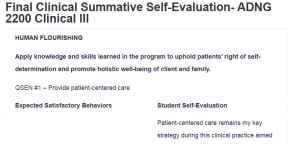
Final Clinical Summative Self-Evaluation- ADNG 2200 Clinical III
| HUMAN FLOURISHING
Apply knowledge and skills learned in the program to uphold patients’ right of self-determination and promote holistic well-being of client and family. QSEN #1 – Provide patient-centered care |
|
| Expected Satisfactory Behaviors | Student Self-Evaluation |
| · Creates a therapeutic environment, consistently responding therapeutically to patient & family
· Protects patient autonomy, dignity, and rights while caring for patients. |
|
| Objective Data: Reflective Journal x2, Process Recording, Case Studies, Daily Clinical Performance | |
| NURSING JUDGMENT
Make judgments in practice, supported by evidence, that integrate nursing science in the provision of safe, quality care. QSEN #2 – Safety, Patient and Healthcare Provider QSEN #3 – Informatics |
|
| Expected Satisfactory Behaviors | Student Self-Evaluation |
| · Develops a priority plan of care based on relevant, holistic data and adapts plan when warranted.
· Employs effective judgment and available resources to provide evidence-based interventions in a safe, efficient manner to multiple patients · Utilize understanding of pathophysiology of disease to predict priority evidence-based interventions · Apply knowledge of and appropriate use of asepsis to create a safe care environment that results in high quality patient outcomes (medication administration, handwashing, invasive procedures, etc.) · Submit daily care plan to instructor for review post-clinical · Provides valid rationales for decisions and actions taken · Communicates significant patient information to the health care team in a timely manner · Employs delegation and supervision skills to organize and coordinate priority patient ca · Engages effectively when confronted with change, demonstrating the ability to adapt. · Navigates the EMR efficiently, documenting care provided in timely manner. |
|
| Objective Data: Reflective Journal x2, Daily Clinical Care Plan, Case Studies, Daily Clinical Performance | |
| PROFESSIONAL IDENTITY
Implement one’s role as a nurse in a manner that reflects the ideals of the profession while developing an identity committed to evidence-based practice, in the provision of compassionate, culturally sensitive, holistic care to a diverse population. QSEN #4 – Teamwork and Multi-disciplinary Collaboration |
|
| Expected Satisfactory Behaviors | Student Self-Evaluation |
| · Comports oneself professionally in interactions with multidisciplinary team-members, peers, clients, and faculty in a variety of clinical settings.
· Accepts feedback professionally and utilizes it to make a plan for improvement · Exhibits non-judgmental attitude toward all patients without regard to differences, and the ability to support patients whose values differ from own. · Takes the initiative and accepts responsibility for the learning process, incorporating feedback from mentors to continually improve practice. · Actively participate in post-clinical discussion and learning activities |
|
| Objective Data: Reflective Journal x2, Process Recording, Staff Education Presentation, Daily Clinical Performance | |
| SPIRIT OF INQUIRY
Examine the evidence that underlies clinical nursing practice to challenge the status quo, question underlying assumptions, and offer new insights to improve the quality of care for patients, families, and communities (NLN, 2010). QSEN #5 – Quality Improvement QSEN #6 – Evidence based practice |
|
| Expected Satisfactory Behaviors | Student Self-Evaluation |
| · Evaluates the patient, the environment, the team, and self for opportunities to improve quality client care.
· Evaluates the evidence that underlies clinical nursing practice to ensure that best-practice is employed. · Able to assertively express point of view and support with evidence while respecting opposing views. |
|
| Objective Data: Staff Education Plan, Staff Education Presentation, Daily Clinical Performance | |
- Please do not use AI to write this assignment thanks.
- course outline