
Family Interview
I interviewed my sibling and my coworker. My coworker is a 40-year-old African-American and is married to one wife. Also, he is a father of two sons and one daughter, aged 12, 15, and 17, respectively. He is a documented immigrant who immigrated to the USA twelve years ago. I chose my interviewees based on their cultural differences. This difference would facilitate comparison and contrast between the Indian and African American cultures.
Summary of the Responses
The first question relates to family and gender roles. According to my coworker, his father and grandfather head the family. As such, the man is the provider and protector of his family. My coworker reported that his mother and grandmother were housewives. Similarly, my father is considered the primary provider for the family. Furthermore, sons play a crucial role in caring for their elderly parents. Women execute household chores and are critical stakeholders in caring for the children.
The second question relates to family goals. According to my coworker, education is prioritized by his family. Education is regarded as the equalizer that enables them to access various life opportunities. My family embraces a similar approach. Essentially, the focus is directed toward acquiring quality education. The third question relates to alternative lifestyles. According to my coworker, his culture prohibits living together before marriage, single parenting, and domestic partnerships. They believe more in official marriage and raising a family within the marriage. Similarly, my culture advocates for purity until marriage and prohibits cohabiting.
The fourth question relates to religious beliefs. My coworker is a Christian and reported that Roman Catholicism is the dominant religious belief among African Americans. On the other hand, Hinduism is a prominent religious belief among Indians. However, intermarriages have increased the incidences of non-denominational faith. The fifth question relates to spiritual beliefs around death and dying. Among African Americans, death is considered to be God’s will. Family members and friends hold vigils for the deceased. Additionally, prayers play a significant part during death and dying. On the other hand, reincarnation, the idea that after death, the soul reincarnates in a different body, lies at the heart of Hinduism (Indian culture).
The sixth question relates to education and occupational status. According to my coworker, his father was a medical doctor, whereas his mother was a high school instructor but mainly performed household chores. His siblings have embraced professional careers. One is a laboratory technician, whereas two are pursuing their master’s degrees in philosophy and nursing. Conversely, my father worked white-collar in the Caribbean, and my mother was an associate nurse. All of my siblings are nurses. The seventh question relates to the preferred communication methods. My coworker reported that his parents and grandparents embraced verbal and nonverbal communication cues. On the other hand, my family mainly welcomes verbal communication.
Regarding preferred family dynamics, my coworker’s culture embraces a collectivistic family structure. On the other hand, my family values an individualistic approach. The other question relates to health-seeking behavior. According to my coworker, unless a person fits the cultural definition of sickness, they are not considered unwell. In my culture, an individual plays a crucial role in identifying any variation from normal health. The final question relates to cultural beliefs around death and dying. My coworker reported that the dead become ancestors. People are, therefore, not permitted to declare their final wishes. In my culture, the soul remains reincarnated until it discovers its real essence.
Comparing and Contrasting the Findings
In both cultures, the father is the head of the family. Men are the primary providers and protectors of the family. Additionally, both cultures consider education a breathalizer, enabling them to access various life opportunities. Marriage is emphasized in both cultures. Alternative lifestyles, such as cohabiting and domestic partnerships, are prohibited. Both cultures believe in reincarnation for the dead.
Moreover, the African-American culture embraces both verbal and nonverbal communication cues. On the other hand, verbal communication is emphasized in Indian culture. A collectivistic culture is practiced among African Americans. As a result, unless a person fits the cultural definition of the sickness, they are not considered unwell. On the other hand, Indians embrace an individualistic culture. Individuals play a crucial role in identifying any variation from normal health. African Americans embrace Christianity, with Roman Catholicism being the dominant religious belief. On the other hand, Hinduism is a prominent religious belief among Indians.
Reflection
Bámaca-Colbert et al. (2019) report that family roles influence a person’s social life and cultural domains. They impact a person’s social skills, such as the capacity for flexibility, dispute resolution, and communication (HHS et al., n.d.). As such, their parents’ ideas and their parents’ ideations and practices significantly influence ions and practices; my coworker and my sibling believe that fathers are the head of the family and the primary providers. This stems from the family and gender roles embraced by both cultures.
References
Bámaca-Colbert, M. Y., Henry, C. S., Perez-Brena, N., Gayles, J. G., & Martinez, G. (2019). Cultural Orientation Gaps Within a Family Systems Perspective. Journal of Family Theory and Review, 11(4), 524–543. https://doi.org/10.1111/jftr.12353
COF.org. (n.d). The Effects of Family Culture on Family Foundations. https://cof.org/content/effects-family-culture-family-foundations
HHS, Acf, Ohs, & Pfce. (n.d.). Family Engagement and Cultural Perspectives: Applying Strengths-based Attitudes Building Partnerships Series. https://childcareta.acf.hhs.gov/sites/default/files/public/family_engagement_and_cultural- perspectives-508_2-20-18.pdf
ORDER A PLAGIARISM-FREE PAPER HERE
We’ll write everything from scratch
Question 
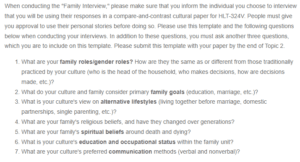
When conducting the “Family Interview,” please make sure that you inform the individual you choose to interview that you will be using their responses in a compare-and-contrast cultural paper for HLT-324V. People must give you approval to use their personal stories before doing so. Please use this template and the following questions below when conducting your interviews. In addition to these questions, you must ask another three questions, which you are to include on this template. Please submit this template with your paper by the end of Topic 2.
Family Interview
- What are your family roles/gender roles? How are they the same as or different from those traditionally practiced by your culture (who is the head of the household, who makes decisions, how are decisions made, etc.)?
- What do your culture and family consider primary family goals (education, marriage, etc.)?
- What is your culture’s view on alternative lifestyles (living together before marriage, domestic partnerships, single parenting, etc.)?
- What are your family’s religious beliefs, and have they changed over generations?
- What are your family’s spiritual beliefs around death and dying?
- What is your culture’s education and occupational status within the family unit?
- What are your culture’s preferred communication methods (verbal and nonverbal)?