
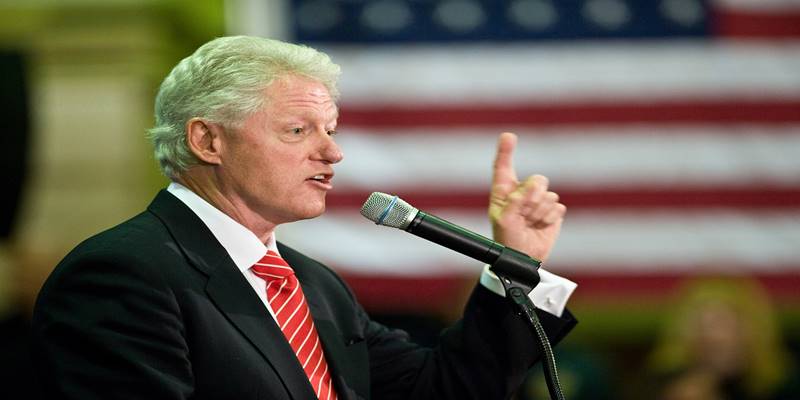
The domestic and foreign policy initiatives during Bill Clinton’s presidency in the 1990s are an important milestone in America’s history. On 21st January 1993, when President Bill Clinton conveyed his 1st inaugural address, he noted that differences between foreign and domestic affairs were confusing since the population globally was impacted by “a global economy, global AIDS crisis, global environment, [and a] global arms race.” Commerce and international communications, the Cold War ended, 24-hour media coverage dominance, and new technology were composing a new setting in which America together with its government will have to revisit its priorities and role, both abroad and at home.
“Your time’s urgent question is whether you could make change your friend and never your enemy,” Clinton quoted at the (DNC) Democratic National Convention in 1992. During his 8 years as the president, he dealt with the question directly while guiding the U.S. into the new millennium. This article is an in-depth summary of the domestic and foreign policy initiatives during Bill Clinton’s presidency in the 1990s and the legacy he left. Our assignment writing help is at affordable prices to students of all academic levels and academic disciplines.
The U.S. in the 1990 era
The History of the U.S. in the 1990 era will form the basis of your research paper writing. For majority of the American citizens, the 1990s could be a fast technological change, peace, and prosperity time. Some ascribed this to Cold War end and “Reagan Revolution”, others to the presidency Democrat return that were all impacted by the domestic and foreign policy initiatives during Bill Clinton’s presidency in the 1990s. During this era, most Americans – political affiliation aside – declared their help for the traditional values of families, often based on their faiths. David Brooks a (NYT) New York Times columnist suggested that America was undergoing “moral self-repair,” since” most social breakdown indicators, which elevated abruptly in the later 1970s and 1960s, and which in 1980s became constant at higher levels,” were now declining.
Improved crime levels and other sociology statistics aside, United States politics remained featured by extreme divisions, ideological, and emotional. Shortly after America entered the 21st century moreover, its security sense after the Cold War was shaken by a bizarre attack by terrorists that inaugurated it on an advanced and challenging international track.
Domestic and foreign policy initiatives during Bill Clinton’s presidency in the 1990s
1. Domestic Initiatives
When Clinton took office in January year 1993, the United States economy was staggering from the recession’s second wave following an unplanned collapse of stock in the 1980s, a crisis in savings and loans that saw a spike in oil prices, and various bank failures, due to Kuwait invading Iraq in 1990. U.S. crime rates and poverty were rising. Clinton promised national debt reduction and job growth: “You should do what the U.S. deems best –” he affirmed in his address during his inauguration “– provide extra opportunity to everyone and demand extra responsibility from everyone.”
The economic strategy of Clinton focused on education investment, fiscal discipline; technology and healthcare; and foreign markets opening. Over strong opposition by Republicans, the administration of Clinton approved budgets combining increases of tax on the rich with government reducing cuts, attaining the biggest debt reduction and budget surpluses in the history of the United States by 2000. The levels of poverty fell, over 20 million opportunities for jobs were created, and rates of unemployment decreased consistently over his 2 office terms, reaching their minimal levels since the year 1960. In 1993 with the support of the Republicans, he put into practice the (NAFTA) North American Free Trade Agreement, removing North American trade barriers, and in 1996 the sweeping bill on welfare reform that needed recipients to be employed and put lifetime benefits limit, fulfilling his promise during campaign to “complete welfare as you’ve come to be aware of it.”
Clinton also vowed to stop the military homosexual ban. Concentrating on that disputed matter earlier in his 1st term, in July, year 1993 he satisfied several of the argument’s either side when he publicized the ” Don’t Tell, Don’t Ask ” compromise.
An effort series to minimize crime involved gun safety and control as captured in many gun control essays, notably the Brady Law in 1993 enforcing handgun buyer’s background checks and assault weapons ban. He raised funding to advance community policing; and programs for preventing drug abuse and youth crime in 1994. The overall rate of crime reduced during the administration of Clinton to the generation’s lowest level. Clinton also condemned U.S. soil’s terrorist acts, most notably in 1993 during a bomb detonation in a car in New York’s World Trade Center (WTC), and the bombing of Oklahoma City in 1995, which caused legislation that fixed habeas corpus new limits intended to assist deter terrorism domestically.
The 1993 Family and Medical Leave Act (FMLA) offered job protection to family and medical reasons absence leave workers. Proposed to be the lasting legacy of Clinton, sweeping reform in healthcare proved beyond his administration’s reach, but the (SCHIP) State Children’s Health Insurance Plan, the commonwealth-funded health insurance’s major expansion, brought funding of states to cover uninsured children from limited-income families,. And in 1993 in significant educational initiatives, he supported the (FDLP) Federal Direct Loan program, giving low-interest loans to college students, and formed an AmeriCorps program, that guarantees community service volunteers awards on education. Under the administration of Clinton, college enrollments were elevated to high levels historically.
2. Foreign Initiatives
Clinton assumed office with minimal foreign affairs direct experience. In his address during the inauguration, he set a vision where the U.S. continued to be the world leader and outlined a new foreign policy’s beginnings in an era of post-Cold War: “When your essential interests are disputed, or the international community’s conscience and will is defied, you’ll act – with force if necessary, with quiet diplomacy if possible.”
Intensifying what would later be the”Clinton Doctrine” during his 1999 speech, he accented the significance of contemplating ” our letting conflicts spread and fester security consequences. You can’t, indeed, you shouldn’t, be everywhere or do everything. But where your interests and your values are in danger, and where you can cause a change, you must be well prepared to act.” As the Cold War’s Soviet threat doctrine successor, Clinton’s was an enlargement doctrine — of expanding and strengthening, market democracies world community, with intervention being a choice matter.
The choices will demonstrate to be challenging, and the doctrine of Clinton would be shaped and tested by several conflicts internationally, and by those conflicts, vivid images increasingly broadcasted by global news coverage. Somalia’s intervention initiated by President George Bush, the predecessor of Clinton, was determined to provide humanitarian relief’s temporary security following famine and civil war there. The conflicts increased rapidly after turning over the mission to the peacekeeping forces of the (UN) United Nations. After the battle that killed 18 American soldiers and wounded 84 soldiers, and Somalis desecrated American soldier bodies, Clinton was compelled to withdraw the American troops ultimately.
With Somalia’s unsuccessful intervention giving a strong example of warning, Clinton together with the United Nations decided not to intercede in another civil war in Africa, Rwanda, that caused a massacre of countless citizens. The horrific incidents made Clinton regret the decision and label it among his presidency’s worst (“The Wanderer,” New Yorker, David Remnick, September 18, year 2006.)
Meanwhile, the Balkan Peninsula’s ethnic and civil conflict was rising rapidly to genocide, because Bosnian Serbs massacred Muslim children, men, and women in their country. Hesitant to intercede at first, he finally took action after U.S international appeals to engage in a role in leadership, and with daily atrocities new images media projection. Clinton established a response plan in NATO, which was immediately triggered by the Serbian attack. Missions NATO ended the fight, and within a few months, Clinton chaired the Dayton Accords Peace Agreement, proving as a credible and competent global leader.
During the presidency of Clinton international terrorism also escalated. The 1996 deadly bombing of a truck outside Saudi Arabia’s military apartment complex, the 1998 devastating explosions aimed at Kenya and Tanzania American embassies, and the 2000 Yemen’s USS Cole suicide attack were all associated with al Qaeda militia and Osama bin Laden its leader. Responding to the bombings of the U.S. embassy, Clinton ordered Sudan’s al Qaeda affiliate and Afghanistan training camps missile strikes. He didn’t know that the response would probably evoke accusations of diverting the continual scandal that involved his extramarital affair with Monica Lewinsky an intern in White House attention. The strikes were defeated, but Clinton asserted that he made the correct decision for the sake of the national security of America.
He advocated for trade agreements internationally strongly that would create U.S. export markets. Additionally, to NAFTA, Clinton enacted the (GATT) General Agreement on Tariffs and Trade establishing the (WTO) World Trade Organization in 1995, a member states international group responsible for controlling nations trade rules. In 2000 by extending the status of normal trade to China, he supported its WTO’s admission. Clinton also lifted trade embargos in Vietnam, laying the foundation for Vietnam’s new cooperation era.
Legacy
Even though President Clinton aspired to be ” the breach repairer,” disregarding Congress during his address on the 2nd inauguration to surpass extreme partisanship but rather focus on the mission of America, the ongoing scandals and investigations that afflicted his 2nd term and caused his impeachment ultimately would refuse him the achievement. Reflecting on Clinton’s administration, some people will certainly continue to query what else might have been achieved. Nevertheless, the presidency of Clinton is also commemorated as amongst the 20th century successful — not just for its vast significant achievements in foreign policy and domestic accomplishments, but along for stronger nation creation at the new century’s beginning.
In summary
The administration of Clinton remained primarily narrow-minded, willing to deal with international challenges that couldn’t be evaded and also, in other circumstances, compelled by the whole world to do that. This article on domestic and foreign policy initiatives during Bill Clinton’s presidency in the 1990s will give you a better grasp of the presidency of Clinton.
Don’t let your domestic and foreign policy initiatives during Bill Clinton’s presidency in the 1990s assignment devastate while you can hire our services at eminencepapers.com. We also provide domestic and foreign policy initiatives during Bill Clinton’s presidency in the 1990s samples for free to boost your academic performance .Our case study writing services will save you the stress that comes with the adequate research and investigation required by case studies.