
Evidence-Based Practice Guideline
Hospital-acquired infections (HAIs) are infections acquired by patients while they’re in the hospital setting. Hospital-acquired infections (HAIs) are associated with death and disability among patients. Viral, bacterial, and fungal pathogens commonly cause these infections. The most common infections include pneumonia, bloodstream infections, urinary tract infections, and surgical site infections. It is estimated that hospital-acquired infections are witnessed in approximately two percent of all acute-care hospital admissions (Wunderink et al., 2020). Hospital-acquired infections are one of the most severe patient safety issues that must be promptly addressed. Risk factors predisposing patients to hospital-acquired infections are classified as iatrogenic, organizational, and patient-related. This essay analyzes an evidence-based practice guideline for hospital-acquired infections to formulate the best care measures.
Guideline Developers.
The European guidelines addressing hospital-acquired pneumonia (HAP) and ventilator-associated pneumonia (VAP) were developed mainly by the European Respiratory Society. This happened in 2017, with few randomized clinical trials being conducted following the emergence of new information (Martin-Loeches et al., 2018). Other societies that came in handy were the European Society of Intensive Care Medicine (ESICM) and the European Society of Clinical Microbiology and Infectious Disease (ESCMID). The Latin America Thoracic Association was also involved (ALAT). The Infectious Diseases Society of America/ ATS developed the American guidelines in 2016. The guidelines were established following the most recent evidence.
Were the developers of the guideline representative of key stakeholders in this specialty?
The developers of the guidelines represented the significant stakeholders within the healthcare sector with the overall aim of countering HAP and VAP. The developers involved physicians, microbiologists, and other medical experts knowledgeable about hospital-acquired infections. A total of fifteen experts and two methodologists comprised the panel tasked with the duty of developing the guidelines (Martin-Loeches et al., 2018).
Funding
The guideline developers received no financial support or sponsorship while developing these guidelines (Martin-Loeches et al., 2018).
Were any of the guideline developers funded researchers of the reviewed studies?
None of the guideline developers have funded researchers of the reviewed studies (Martin-Loeches et al., 2018).
Development Strategy
The development strategy of the team was sound and valid. The team looked at the previous guidelines. However, the earlier guidelines were flawed due to the oversimplification of the guidelines and the absence of a sound methodological approach (Martin-Loeches et al., 2018). The team analyzed the recent guidelines used in diagnosing and treating HAP and VAP to advance the guidelines to align advances witnessed in that field.
Was an explicit, sensible, and impartial process used to identify, select, and combine evidence?
The GRADE (grading of recommendations assessment, development, and evaluation) framework is critical in such a process. It is helpful in the evaluation of the quality of evidence gathered, ranking evidence from the highest to the lowest. This is vital in determining the strength and quality of the proposals. Existing scientific data, applicability, financial consequences, and theoretical rationale are used to group the various recommendations. The GRADE framework then sorts the recommendations from the strongest to the weakest (Martin-Loeches et al., 2018). This whole process ensures that evidence is identified and selected in an explicit, sensible, and impartial manner. All evidence is ranked about any existing scientific data. This is key in ensuring that no panel member imposes their ideas on the rest of the panelists and no one’s suggestions are dismissed.
Did its developers carry out a comprehensive, reproducible literature review within the past 12 months of its publication/revision?
Recent findings emphasize the importance of prompt and appropriate antimicrobial therapy for HAP and VAP. Research further indicated that the application of antimicrobial combinations is one of the major causes of the emergence of multidrug-resistant strains (Martin-Loeches et al., 2018).
Were all crucial options and outcomes considered?
In the development of the guidelines, essential options and outcomes were put into consideration. As highlighted in the introductory portion, HAP and VAP are severe, requiring prompt and appropriate antimicrobial therapy (Martin-Loeches et al., 2018). The developers, therefore, analyzed all the vital options and outcomes available.
Is each recommendation in the guideline tagged by the level/strength of evidence upon which it is based and linked to the scientific evidence?
The recommendation in this guideline is appropriately supported by scientific evidence. The treatment recommendation points out the risks leading to the development of drug resistance. Drug recommendations are also clearly outlined. The recommendation portrays that it is based upon well-researched scientific evidence. It provides data and well-laid-out protocols to follow that have been well-researched.
Do the guidelines make explicit recommendations?
These guidelines make explicit recommendations. The guidelines highlight the need for a seven-day course of antimicrobial therapy (Martin-Loeches et al., 2018). The recommendations analyze the significance of broad-spectrum drug therapy and a narrow spectrum and their importance to different categories of patients.
Has the guideline been subjected to peer review and testing?
The guideline presented has not been subjected to any peer review and testing. Peer review entails subjecting the work to the scrutiny of other experts within the same field (Melnyk & Fineout-Overholt, 2019). It is vital to ensure that authors achieve the expected high standards. Criticism against peer review has been raised due to biases by some reviewers.
Is the intent of use provided?
These guidelines aim to offer regional guidelines. Their main target is Europe and America. However, The guidelines may be adopted for use internationally if their effectiveness is proven.
Are the recommendations clinically relevant?
The recommendations provided regarding treatment are clinically relevant. The guidelines present the recommended durations of drug administration to increase effectiveness against HAP and VAP. They also provide the appropriate medication to use to avoid the development of drug-resistant strains. This is relevant in clinical practice as it will increase the quality of care delivered.
Will the recommendations help me in caring for my patients?
The provided recommendations will go a long way in helping me as a healthcare practitioner in caring for my patients. Knowledge about the best treatment for my patients dramatically reduces the risks associated with ineffective and delayed treatment (Houghton et al., 2020). Patient recovery is hastened while minimizing the risk of developing multidrug-resistant strains. This generally translates into improved care for my patients (Houghton et al., 2020).
Are the recommendations practical/feasible?
The recommendations suggested are pretty practical and workable. Education of health care practitioners regarding the recommended drugs to use in the management of HAP and VAP is an achievable feat. Highlighting the reduced risks and advantages of good comprehension is critical in furthering the practicability of the suggested recommendations.
Are the recommendations a significant variation from current practice?
The difference between the recommendations and the current practice is not quite significant. Differences are, however, brought about by the constant advances observed. Significant studies of epidemiology, diagnosis, empiric treatment, response to treatment, new forms of treatment, drug administration, and disease prevention have resulted in the alterations observed (Martin-Loeches et al., 2018). Current practice and the recommended guidelines note that a seven-day treatment with the appropriate antibiotics is required to treat HAP. Depending on the patient’s response to treatment, the duration may be extended or shortened for current practice. The European guidelines appear to be more flexible than the American guidelines. The American guidelines are more fixed at seven days, which can only be extended in the case of an active infection.
Conclusion
In conclusion, HAP and VAP are severe morbidities that require thorough consideration and intervention by experts. Despite apparent differences between the American and European guidelines for treating both conditions, several similarities are observed (Martin-Loeches et al., 2018). The primary aim of the guidelines is to reduce the extended use of antibiotics in the case of the two conditions. The primary aim is to minimize or ultimately reduce the occurrence of multidrug-resistant variants.
References
Houghton, C., Meskell, P., Delaney, H., Smalle, M., Glenton, C., Booth, A., Chan, X. H., Devane, D., & Biesty, L. M. (2020). Barriers and facilitators to healthcare workers’ adherence with Infection Prevention and Control (IPC) guidelines for respiratory infectious diseases: A rapid qualitative evidence synthesis. Cochrane Database of Systematic Reviews, 2020(8). https://doi.org/10.1002/14651858.cd013582
Martin-Loeches, I., Rodriguez, A. H., & Torres, A. (2018). New guidelines for hospital-acquired pneumonia/ventilator-associated pneumonia: USA vs. Europe. Current opinion in critical care, 24(5), 347–352. https://doi.org/10.1097/MCC.0000000000000535
Melnyk, B. M., & Fineout-Overholt, E. (2019). Chapter 5. In Evidence-based Practice in Nursing & Healthcare: a guide to best practice. essay, Wolters Kluwer.
Wunderink, R. G., Srinivasan, A., Barie, P. S., Chastre, J., Dela Cruz, C. S., Douglas, I. S., Ecklund, M., Evans, S. E., Evans, S. R., Gerlach, A. T., Hicks, L. A., Howell, M., Hutchinson, M. L., Hyzy, R. C., Kane-Gill, S. L., Lease, E. D., Metersky, M. L., Munro, N., Niederman, M. S., Restrepo, M. I., … Weiss, C. H. (2020). Antibiotic Stewardship in the Intensive Care Unit. An Official American Thoracic Society Workshop Report in Collaboration with the AACN, CHEST, CDC, and SCCM. Annals of the American Thoracic Society, 17(5), 531–540. https://doi.org/10.1513/AnnalsATS.202003-188ST
ORDER A PLAGIARISM-FREE PAPER HERE
We’ll write everything from scratch
Question 
Write a fully developed and detailed APA essay addressing the following points/questions. There is no required word count; be sure to answer all the questions for each question in detail completely. Separate each section in your paper with a clear heading that allows your professor to know which bullet you are addressing in that section of your paper. Sources are not required; however, if sources are used, make sure to cite using the APA writing style for the essay and complete a reference page. The cover page is required. Review the rubric criteria for this assignment.
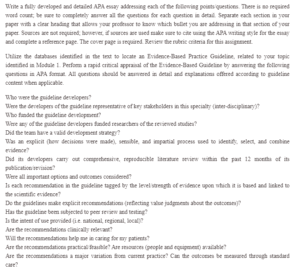
Evidence-Based Practice Guideline
Utilize the databases identified in the text to locate an Evidence-Based Practice Guideline related to your topic in Module 1. Perform a critical appraisal of the Evidence-Based Guideline by answering the following questions in APA format. All questions should be answered in detail and explained according to guideline content when applicable.
Who were the guideline developers?
Were the developers of the guideline representative of key stakeholders in this specialty (inter-disciplinary)?
Who funded the guideline development?
Were any of the guideline developers funded researchers of the reviewed studies?
Did the team have a valid development strategy?
Was an explicit (how decisions were made), sensible, and impartial process used to identify, select, and combine evidence?
Did its developers carry out a comprehensive, reproducible literature review within the past 12 months of its publication/revision?
Were all crucial options and outcomes considered?
Is each recommendation in the guideline tagged by the level/strength of evidence upon which it is based and linked to the scientific evidence?
Do the guidelines make explicit recommendations (reflecting value judgments about the outcomes)?
Has the guideline been subjected to peer review and testing?
Is the intent of use provided (i.e., national, regional, local)?
Are the recommendations clinically relevant?
Will the recommendations help me in caring for my patients?
Are the recommendations practical/feasible? Are resources (people and equipment) available?
Are the recommendations a significant variation from current practice? Can the outcomes be measured through standard care?