
Evaluating a Disaster Response and Developing Community Partnerships
Overview of the Natural Disaster
Hurricane Katrina was a devastating Category 5 hurricane that struck the southeastern United States in late August 2005. Making landfall on August 29, 2005, it primarily affected Louisiana, Mississippi, and Alabama, with the greatest devastation occurring in New Orleans due to the failure of levee systems. Over 1,800 people lost their lives, and more than one million residents were displaced, making it one of the deadliest and costliest natural disasters in U.S. history (Raker & Woods, 2023). Environmentally, Katrina caused extensive flooding, destroyed homes and infrastructure, contaminated water systems, and led to long-term public health hazards such as mold, toxic debris, and hazardous waste spills. Public services collapsed, and hospitals, nursing homes, and emergency systems were overwhelmed or incapacitated. The population impact was staggering, especially among low-income and minority communities that lacked access to evacuation resources and adequate shelter.
Positive Aspects of the Disaster Response
Despite the immense challenges posed by Hurricane Katrina, several aspects of the disaster response were commendable. Early warnings were accurately issued by the National Weather Service, and some emergency supplies were pre-positioned. The U.S. Coast Guard demonstrated exceptional readiness and saved more than 33,000 lives through rooftop rescues and flooded neighborhood evacuations. Public health agencies such as the Louisiana Department of Health worked swiftly to implement disease surveillance systems in shelters to prevent outbreaks (Blackburn, PhD & Shelke, BS, 2022). Nonprofit organizations like the American Red Cross, Salvation Army, and Feeding America mobilized quickly, providing essential relief, including food, shelter, and emotional support. Furthermore, many of the local hospitals kept trying to continue functioning — often under seriously stressed circumstances — in order to deliver emergency care. This actively involved multiple sectors engaging in response efforts despite strained conditions, which demonstrated the importance of having multiple sectors involved in response efforts.
Community Coalitions and Resource Partners Involved
Many community-based coalitions and resource partners were critically important in addressing the immediate and long-term needs of those affected. Shelter, food, and spiritual care were provided by faith-based organizations such as Catholic Charities and local churches. Support for displaced musicians, such as that provided by the New Orleans Musicians’ Clinic, tailored their services to musicians and grassroots efforts to maintain musicians’ access to health services and employment. Louisiana Public Health Institute partnered with the Centers for Disease Control and Prevention (CDC) to restore primary care access in areas that were damaged. Additionally, the National Voluntary Organizations Active in Disaster (NVOAD) was used by different nonprofit and faith-based disaster response entities as hub to work with one another to avoid duplication of work and achieve complete coverage.
Underserved Population: Individuals with Disabilities
Hurricane Katrina provided one of many examples of how critically underserved individuals with disabilities were. Insurmountable barriers to evacuation included lack of accessible transportation, lack of caregiver support and inadequate shelters that could accommodate physical and cognitive impairments for many. It also emerged that emergency responders were not adequately qualified or equipped to help the disabled, stranded people in flooded homes. There were few wheelchairs available, no oxygen, no accessible toilets, and no American Sign Language (ASL) interpreters for shelter staff. These oversights seriously imperiled the safety and chances for survival of this population and led to avoidable deaths and long-term trauma (Bivens & Miller, 2023). Additionally, emergency communications were not accessible—alerts and instructions were often not available in accessible formats like Braille, large print, or visual sign language, so many people were not informed about where and how to evacuate.
Improving the Response for Individuals with Disabilities
Integrating inclusive planning is needed to address these failures in disaster response systems. Before the storm, emergency management agencies should have collaborated with local disability advocacy organizations directly to identify needs, plan accommodations, and identify vulnerable residents. The Federal Emergency Management Agency (FEMA), working with local public health departments, could have deployed disability-trained staff to make sure that shelters had durable medical equipment and made the shelter facilities accessible. Emergency communication should have had incorporated a visual alerts, closed captioning and interpreter services across all reported news updates. Many of these improvements are predicated within the legal frameworks that exist such as the Americans with Disabilities Act (ADA) which means people with disabilities must have equal access to emergency services—a point that was not upheld by the response to Hurricane Katrina.
Recommended Coalition Partner: The Partnership for Inclusive Disaster Strategies
One such effective partner to serve the needs of people with disabilities in future disasters is the Partnership for Inclusive Disaster Strategies (PIDS). This is a national organization that is dedicated to providing the assurance to individuals with disabilities and older adults that they are included in emergency preparedness, emergency response and emergency recovery systems. In addition, PIDS offers technical assistance to shelters and first responders and has worked with local, state, and federal agencies to create disability-inclusive plans. Istiarsyah Istiarsyah et al. (2023) noted that their goals support the goals of public health nursing, that is, health equity, community safety, and protection of vulnerable populations. PIDS can work with public health nurses to enhance the performance of needs assessment, advocate for accessible shelter planning, and guarantee disability representation on emergency committees.
Dissemination of Information and Community Education
Through multiple inclusive channels, PIDS can disseminate critical disaster-related information to individuals with disabilities. It encompasses accessible online platforms, radio broadcasts complete with descriptive audio, ASL-interpreted public service announcements, materials in Braille, and large print. Individuals and caregivers can also create emergency kits, register with the special needs evacuation systems, and build personalized response plans in collaboration with local health departments and public health nurses through community workshops (Istiarsyah Istiarsyah et al., 2023). These efforts help to achieve broader public health nursing goals by improving disaster literacy, enhancing self-efficacy in disabled populations, and increasing community resilience through education and involvement.
Conclusion
Critical weaknesses in the nation’s disaster preparedness system, with regard to individuals with disabilities highlighted by Hurricane Katrina, are discussed. Some response efforts were laudable, but without inclusive planning, communication and infrastructure, tragic and preventable outcomes occurred for vulnerable populations. Public health nurses can help transform future disaster response to be equitable, effective and accessible by forming strategic partnerships with organizations such as the Partnership for Inclusive Disaster Strategies. They are important in the effort to make sure no one is left behind in crises and to build community preparedness.
References
Bivens, N. D., & Miller, D. S. (2023). Lessons Learned and Moving Forward from Hurricane Katrina. Routledge EBooks, 177–186. https://doi.org/10.4324/9781003140245-15
Blackburn, PhD, C. C., & Shelke, BS, S. (2022). The lingering impact of Hurricane Katrina: Examining the physical health, mental health, and racial equity impacts of disaster response. American Journal of Disaster Medicine, 17(3), 219–225. https://doi.org/10.5055/ajdm.2022.0436
Istiarsyah Istiarsyah, Kamarullah Kamarullah, Setiawan, R., & Amir Hasan Dawi. (2023). Improving Disaster Preparedness Services for People with Disabilities. Journal of ICSAR, 7(2), 248–248. https://doi.org/10.17977/um005v7i22023p248
Raker, E. J., & Woods, T. (2023). Disastrous Burdens: Hurricane Katrina, Federal Housing Assistance, and Well-Being. RSF: The Russell Sage Foundation Journal of the Social Sciences, 9(5), 122–143. https://doi.org/10.7758/RSF.2023.9.5.06
ORDER A PLAGIARISM-FREE PAPER HERE
We’ll write everything from scratch
Question 
Evaluating a Disaster Response and Developing Community Partnerships
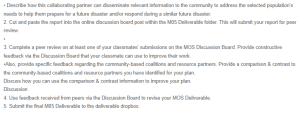
• Describe how this collaborating partner can disseminate relevant information to the community to address the selected population’s needs to help them prepare for a future disaster and/or respond during a similar future disaster.
2. Cut and paste the report into the online discussion board post within the M05 Deliverable folder. This will submit your report for peer review.
Evaluating a Disaster Response and Developing Community Partnerships
•
3. Complete a peer review on at least one of your classmates’ submissions on the MOS Discussion Board. Provide constructive feedback via the Discussion Board that your classmate can use to improve their work.
•Also, provide specific feedback regarding the community-based coalitions and resource partners. Provide a comparison & contrast to the community-based coalitions and resource partners you have identified for your plan.
Discuss how you can use the comparison & contrast information to improve your plan.
Discussion
4. Use feedback received from peers via the Discussion Board to revise your MOS Deliverable.
5. Submit the final M05 Deliverable to the deliverable dropbox.