
Enlightened Absolutism
| Did this country have an enlightened despot? | What was the enlightened despot’s name? | What policies/actions of the monarch were considered enlightened? | How did the monarch’s actions differ from their predecessors? | What characteristics of the policy identify it as enlightened? | |
|
France |
No |
||||
|
Great Britain |
No |
||||
|
The Netherlands |
No |
| Did this country have an enlightened despot? | What was the enlightened despot’s name? | What policies/actions of the monarch were considered enlightened? | How did the monarch’s actions differ from their predecessors? | What characteristics of the policy identify it as enlightened? | |
|
Prussia |
Yes |
Frederick II (1740–1786) | • Abolished torture (1740), streamlined courts via Corpus Juris Fridericianum (1747).
• Protected Catholics/Jews (1747. • Funded Berlin Academy; invited Voltaire (1750– 1753) |
Frederick William I (1713–
1740): Ignored judicial reform, persecuted religious minorities. Frederick II also reduced noble judicial privileges |
• Uniform legal procedures superseded arbitrary justice.
• Religious tolerance boosted economic immigration. • State-funded scientific research. |
|
The Austrian Empire |
Yes |
Maria Theresa (1740–1780)
and Joseph II (1780–1790) |
• Maria Theresa: State primary schools (Allgemeine Schulordnung, 1774); limited serf labor (Robotpatent, 1775).
• Joseph II: Abolished serfdom (1781); Edict of Toleration (1781) for Protestants/Jews; secularized more than 700 monasteries. |
Charles VI (1711–1740): No
social reforms; ignored serfdom. |
• Social Welfare: Education was aimed at creating skilled subjects.
• Secularization: Redirected Church wealth to state hospitals. • Centralization: Unified legal code (Constitution Criminalis Theresiana, 1768). |
|
Russia |
Yes |
Catherine II “The Great” (1762–1796) | • Legal Reform: Nakaz (1767) drafted with principles such as equality before law.
• Confiscated monastic lands (1764). • Funded state schools. • Promoted smallpox inoculation, which was imported from England. |
Elizabeth (1741–1762): No
structural reforms; lavish spending.
Peter III (1762) alienated nobility and the church |
• Modernization: Nakaz cited Montesquieu and Beccaria.
• Medical initiatives to boost population. • Cultural Westernization: Hermitage art collection/neocla ssical architecture. |
ORDER A PLAGIARISM-FREE PAPER HERE
We’ll write everything from scratch
Question 
Enlightened Absolutism
Enlightened Absolutism
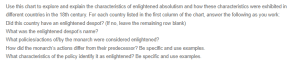
Use this chart to explore and explain the characteristics of enlightened absolutism and how these characteristics were exhibited in different countries in the 18th century. For each country listed in the first column of the chart, answer the following as you work:
Did this country have an enlightened despot? (If no, leave the remaining row blank)
What was the enlightened despot’s name?
What policies/actions of/by the monarch were considered enlightened?
How did the monarch’s actions differ from their predecessor? Be specific and use examples.
What characteristics of the policy identify it as enlightened? Be specific and use examples.