
Discussion – The Promise of Generative AI in Project Management
The incorporation of Generative AI (GenAI) technologies into the practices of project management has the transformative capability to solve the persistent problem of project underachievement. Rodriguez and Vargas (2023) observed that only 35% of projects are considered successful, basing their findings on the inefficiency of planning, execution, and risk management processes. Newer Generative AI tools enable task automation, improving communication, and resource management for projects to be completed on time. These tools include the more popular ones like ChatGPT and Microsoft CoPilot, as well as more advanced domain-specific ML models. This paper addresses the artificial intelligence (AI) impacts on project management by analyzing two recent large-scale infrastructure and technology projects: The Museum of the Future in Dubai and the Whitechapel Station rebuild in Crossrail project in London.
Case Study 1: Museum of the Future, Dubai
Completing MOTF (Museum of the Future) in Dubai is a landmark achievement in construction and architectural design innovation, which was finished in early 2022. It is described as a “living museum” showcasing innovation, which makes its construction and technology integration particularly challenging. For the museum to meet its project deadlines, the implementation of technology such as the 66 digital displays, the 333 speakers, scent systems, and the touchless displays needed to be completed within the year timeframe (Bains, 2019). The logistical precision comes from the coordination of over 30 technicians from three different continents within the bounds of a constantly active building site. Throughout this timeline, the museum continuously received international acclaim. Though wonders of technology could have simplified the process substantially through AI planning, achieving success through intensity and subjective risk only tells half the story.
Case Study 2: Whitechapel Station Rebuild (Crossrail), London
As one of the pieces of Crossrail work in London, the Whitechapel Station project illustrates the difficulties associated with the infrastructure enhancement in live environments. The spending was originally estimated at £110 million but ended at around 830 million after increased technical difficulties, changing stakeholder needs, and other scope alterations, accruing estimated recon costs of over 500 million (Balfour Beatty, n.d.). Managers of the project had to deal with the uniquely challenging problem of constructing the station with constant passenger traffic, dividing modern and vintage system features, and servicing nonstop operational requirements. The project met the expectations with regard to the combination of services and easiness of getting to the station, but the expected overspending and delay demonstrated the inadequate planning for budgets and timelines coupled with rough communications with stakeholders.
How Generative AI Could Have Transformed Project Management Outcomes
The textbook Contemporary Project Management notes that efforts toward planning, coordination of human resources, and agile risk mitigation strategies are vital to delivering project objectives (Kloppenborg et al., 2022). In both instances, GenAI possesses an opportunity that could span multiple domains. To start with, the efficiency of planning could have been improved greatly through AI-driven schedule optimization. Resources can be dynamically allocated in real time, and task durations can be forecasted accurately by machine learning models trained on similar infrastructure projects. This would have enhanced resource phasing and reduced redundancy within the MOTF and Crossrail projects concurrently.
Scope creep or engineering challenges could have been detected before Crossrail’s project managers had to deal with the costs through AI-based predictive risk management. Predictive analytics frameworks that utilize real-time data alongside historical data could enable project managers to change course at the right time instead of reacting post-factum to avoid the sharply rising cost Crossrail faced.
In varying degrees, most project management software incorporates GenAI. With the goal of saving time and money while enhancing project outcomes, that intelligence primarily operates in the background to assist project managers and their teams with several essential chores of their profession. Anything from automating basic administrative duties to carrying out intricate activities like resource allocation and modeling can be done by integrating GenAI with the above projects. Organizations are looking more and more into integrating AI into their project management processes due to its many applications and advantages.
Reporting together with stakeholder interaction could have been done at a higher level of efficiency with GenAI. Automated weekly progress reports, risk analysis, and meeting notes are generated from raw data, preserving information hierarchy and optimizing time consumption while enhancing transparency, which would allow for trust and swift decision-making in multi-stakeholder high-finesse projects.
Conclusion
The advantages of Generative AI are most evident in improving project prioritization, risk management, and execution. In infrastructure or technology projects like MOTF and Whitechapel Station, incorporating AI tools will mitigate uncertainty, lower costs, and enhance the probability of meeting objectives. As Kloppenborg et al. (2022) argue, contemporary project managers need to adopt both plan-driven and agile approaches. Employing GenAI in both paradigms facilitates responsive and real-time automated decision-making, which is an important advancement in the field of project management.
References
Bains, E. (2019, October 29). Museum of the future: The building designed by an algorithm. BBC. https://www.bbc.com/future/article/20191028-museum-of-the-future-the-building-designed-by-an-algorithm
Balfour Beatty. (n.d.). Whitechapel Station, Elizabeth line, London. https://www.balfourbeatty.com/what-we-do/projects/whitechapel-station-elizabeth-line-london/
Kloppenborg, T. J., Anantatmula, V., & Wells, K. (2022). Contemporary project management: Plan-driven and agile approaches (5th ed.). Cengage Learning.
ORDER A PLAGIARISM-FREE PAPER HERE
We’ll write everything from scratch
Question 
Discussion – The Promise of Generative AI in Project Management
Final Case Study Analysis.
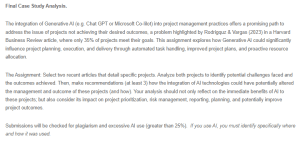
The integration of Generative AI (e.g. Chat GPT or Microsoft Co-Iilot) into project management practices offers a promising path to address the issue of projects not achieving their desired outcomes, a problem highlighted by Rodrigquz & Vargas (2023) in a Harvard Business Review article, where only 35% of projects meet their goals. This assignment explores how Generative AI could significantly influence project planning, execution, and delivery through automated task handling, improved project plans, and proactive resource allocation.
The Promise of Generative AI in Project Management
The Assignment: Select two recent articles that detail specific projects. Analyze both projects to identify potential challenges faced and the outcomes achieved. Then, make recommendations (at least 3) how the integration of AI technologies could have potentially altered the management and outcome of these projects (and how). Your analysis should not only reflect on the immediate benefits of AI to these projects; but also consider its impact on project prioritization, risk management, reporting, planning, and potentially improve project outcomes.
Submissions will be checked for plagiarism and excessive AI use (greater than 25%). If you use AI, you must identify specifically where and how it was used.