
Discussion Responses-Solution-Focused Model: Asking Questions
Responding to TY
Hello,
Thank you for your post. Effectively, you wrote about the power of solution-focused questions to help Marcus acknowledge his strengths. A possible obstacle that can hinder the application of the solution-focused model to Marcus is the issue of receptivity and low hopes for recovery. If he continues to view his past failures as proof that recovery is not realistic, he can hardly enter the discussions about solutions. Nonetheless, a social worker can assist by ensuring to keep Marcus focused on the present time, including his current strengths, however undefined they are at the time, like being in treatment or having a clean day. The shift in his perception can be done through the application of language aimed at determining what is working in the present, instead of what has gone wrong in the past. Paying attention to existing resources and strengths allows clients to see reasonable steps toward changes (Jerome et al., 2023). All in all, your post gives an essential insight into how these questions can be used to promote motivation and self-awareness.
References
Jerome, L., McNamee, P., Abdel-Halim, N., Elliot, K., & Woods, J. (2023). Solution-focused approaches in adult mental health research: A conceptual literature review and narrative synthesis. Frontiers in Psychiatry, 14. https://doi.org/10.3389/fpsyt.2023.1068006
Responding to LE
Hello,
Your example was thoughtful, wherein you directed the client who was diagnosed with Bipolar I Disorder and has the habit of compulsively spending money during their manic state to identify strengths and develop better behaviors through solution-focused questions. One of the possible obstacles to applying the solution-focused model to this client might be the irregularity of prescribed medication, which may make her more impulsive and lose concentration on the positive solutions.
A social worker could help the client to turn the eye toward the present and focus on small and immediate achievements, including regular medication intake over several days or saving even a small amount of money. When current achievements are noted, the client will be able to see concrete improvements and be motivated (Lakioti et al., 2025). Overall, this post has clearly shown how exception and change language questions may be used to empower and bring profound change to clients.
Reference
Lakioti, E., Pagonis, N., Flegkas, D., Itziou, A., Moustakas, K., & Karayannis, V. (2025). Social factors and policies promoting good health and well-being as a sustainable development goal: Current achievements and future pathways. Sustainability, 17(11), 5063. https://doi.org/10.3390/su17115063
ORDER A PLAGIARISM-FREE PAPER HERE
We’ll write everything from scratch
Question 
Discussion Responses-Solution-Focused Model: Asking Questions
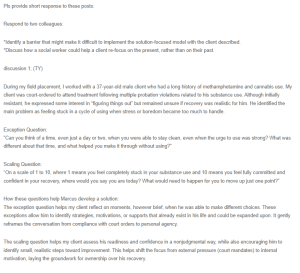
Pls provide short response to these posts:
Respond to two colleagues:
*Identify a barrier that might make it difficult to implement the solution-focused model with the client described.
*Discuss how a social worker could help a client re-focus on the present, rather than on their past.
Discussion Responses-Solution-Focused Model – Asking Questions
discussion 1; (TY)
During my field placement, I worked with a 37-year-old male client who had a long history of methamphetamine and cannabis use. My client was court-ordered to attend treatment following multiple probation violations related to his substance use. Although initially resistant, he expressed some interest in “figuring things out” but remained unsure if recovery was realistic for him. He identified the main problem as feeling stuck in a cycle of using when stress or boredom became too much to handle.
Exception Question:
“Can you think of a time, even just a day or two, when you were able to stay clean, even when the urge to use was strong? What was different about that time, and what helped you make it through without using?”
Scaling Question:
“On a scale of 1 to 10, where 1 means you feel completely stuck in your substance use and 10 means you feel fully committed and confident in your recovery, where would you say you are today? What would need to happen for you to move up just one point?”
How these questions help Marcus develop a solution:
The exception question helps my client reflect on moments, however brief, when he was able to make different choices. These exceptions allow him to identify strategies, motivations, or supports that already exist in his life and could be expanded upon. It gently reframes the conversation from compliance with court orders to personal agency.
The scaling question helps my client assess his readiness and confidence in a nonjudgmental way, while also encouraging him to identify small, realistic steps toward improvement. This helps shift the focus from external pressure (court mandates) to internal motivation, laying the groundwork for ownership over his recovery.
By using solution-focused questions in this way, the social worker creates space for the client to envision possibilities for change and recognize that he already holds part of the solution within himself, even if he was mandated to begin the process.
Reference:
Franklin, C., & Jordan, C. (Ed.). (2024). Turner’s social work treatment: Interlocking theoretical approaches (7th ed.). Oxford University Press
Chapter 34, “Solution-Focused Brief Therapy” (pp. H349–H358)
Chapter 23, “Task-Centered Social Work” (pp. H228–H238)
Discussion 2: (LE)
Case Experience
While employed at a mental health clinic, I worked with a client diagnosed with Bipolar I Disorder who experienced challenges with compulsive spending and shopping during manic episodes. The client’s symptoms were increased by periods that were induced by her failure to take her prescribed mood-stabilizing medication, which often led to heightened impulsivity, poor judgment, and financial instability. These behaviors created ongoing stressors, including debt accumulation, strained personal relationships, and difficulty maintaining stability in other areas of life, such as housing and employment.
Solution-focused questions
Exceptions Question: Can you think of a time in the past when you felt the urge to spend but were able to stop yourself? What was different about that moment, and how could we build on that?
Change Language: After you’ve been successful in saving $50 this week and staying on your medication, what do you think will be the best side effect in other areas of your life? How will things start to feel different?
How Do these Question Benefit the client?
According to Turner’s (2018), citing de Shazer (1985), exception questions inquire about times when the problem is either absent, less intense, or managed in a way that is acceptable to the client (P.491). In this case, exception questions help the client recognize their own strengths and past successes rather than focusing solely on failures. They also encourage the client to identify strategies that have been effective before, which brings about confidence and a sense of control. By building on her existing resources, the client is more likely to feel empowered to make and sustain positive behavioral changes.
In addition to exception questions, I used a change language to support this client in building motivation and self-awareness. Change language questions help her visualize the benefits of making progress and identify the strengths she can draw upon to create that change. These questions assist the client in seeing her abilities and resources, which can increase her confidence and investment in the process. These questions encourage the client to connect her short-term actions with meaningful improvements, such as reduced stress.
Reference
de Shazer, S. (1985). Keys to solution in brief therapy. W. W. Norton & Company.
Franklin, C., & Jordan, C. (Ed.). (2024). Turner’s social work treatment: Interlocking theoretical approaches (7th ed.). Oxford University Press.