
Discussion Response: Existential Questions and Post-Traumatic Growth
Responding to KR
Hello,
Thank you for your insightful post. Having a cogitation about aiding a young mother who has to pass through the trauma is very considerate and humane of you. Among the recommendations that can be applied to assist the client to make meaning of their trauma as part of their values and beliefs is the application of narrative therapy. The narrative therapy method enables clients to re-tell their stories in a manner that accords with their cultural, spiritual, and personal convictions, thus contributing toward empowerment and self-determination (Nelson et al., 2022). Social workers can redirect clients to process their trauma by developing a safe, nonjudgmental environment to respect their worldview, promoting healing and posttraumatic growth. It is also beneficial to integrate mindfulness and trauma-informed practices that adhere to a client-based approach to respect personal processes of making sense. In general, your post shows a clear grasp of the emotionally fraught landscape that clients face, while highlighting the importance of being empathetic, an advocate, and offering culturally cautious support.
Reference
Nelson, K., Lukawiecki, J., Waitschies, K., Jackson, E., & Zivot, C. (2022). Exploring the impacts of an art and narrative therapy program on participants’ grief and bereavement experiences. OMEGA – Journal of Death and Dying, 90(2), 726–745. https://doi.org/10.1177/00302228221111726
Responding to JA
Hello,
Thank you for your post. You have pointed out a very pertinent existential question that a number of clients have when they live in survival mode. Among the ways a social worker can assist clients in trying to make sense of their trauma in terms of a value system is through culturally sensitive, strengths-based modalities that acknowledge clients’ spiritual and cultural beliefs as avenues of healing. Developing a spiritual orientation, such as incorporating spiritual practices or traditions that are important to the client, will help to support their identity and bring the benefit of posttraumatic growth (Perry, 2024). Asking them to reflect either via journaling, sharing of stories, or through a state of mindfulness can enable them to relate their faith to a new sense of agency, even in distress. In general, your post is thoughtful regarding the path of the client as well as the path of the social worker with regard to trauma work, and it reflects the complexity of bearing in mind various belief systems.
Reference
Perry, S. (2024). Religious/spiritual abuse, meaning-making, and posttraumatic growth. Religions, 15(7), 824–824. https://doi.org/10.3390/rel15070824
ORDER A PLAGIARISM-FREE PAPER HERE
We’ll write everything from scratch
Question 
Discussion Response: Existential Questions and Post-Traumatic Growth
Question: Provide short responses to two colleagues:
Provide a suggestion for how a social worker could help clients to understand and make meaning of the trauma within the client’s values and belief framework.
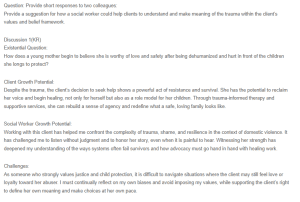
Discussion Response – Existential Questions and Post-Traumatic Growth
Discussion 1(KR)
Existential Question:
How does a young mother begin to believe she is worthy of love and safety after being dehumanized and hurt in front of the children she longs to protect?
Client Growth Potential:
Despite the trauma, the client’s decision to seek help shows a powerful act of resistance and survival. She has the potential to reclaim her voice and begin healing, not only for herself but also as a role model for her children. Through trauma-informed therapy and supportive services, she can rebuild a sense of agency and redefine what a safe, loving family looks like.
Social Worker Growth Potential:
Working with this client has helped me confront the complexity of trauma, shame, and resilience in the context of domestic violence. It has challenged me to listen without judgment and to honor her story, even when it is painful to hear. Witnessing her strength has deepened my understanding of the ways systems often fail survivors and how advocacy must go hand in hand with healing work.
Challenges:
As someone who strongly values justice and child protection, it is difficult to navigate situations where the client may still feel love or loyalty toward her abuser. I must continually reflect on my own biases and avoid imposing my values, while supporting the client’s right to define her own meaning and make choices at her own pace.
References
Franklin, C., & Jordan, C. (Eds.). (2024). Turner’s social work treatment: Interlocking theoretical approaches (7th ed.). Oxford University Press. https://mbsdirect.vitalsource.com/books/9780197678046
V is, J.-A. & Boynton, H. M. (2008). Spirituality and transcendent meaning making: Possibilities for enhancing posttraumatic growthLinks to an external site.. Journal of Religion & Spirituality in Social Work, 27(1/2): 69–86.
Discussion 2(JA)
Existential Question
How do you find hope when I have to fight to survive every day?
Client Growth
When clients experience traumatic events, there is also potential for them to grow as a result of that trauma. Vis and Boynton explore how traumatic experiences can shape a person’s worldview, altering their perspective on the world afterward. The traumatic event can challenge a person’s assumptions about the world, themselves, and others, potentially presenting a growing opportunity (Vis& Boynton, 2008).
Social Worker Growth
As a social worker, listening to a client’s story and bearing witness to their trauma can help us grow and improve in our practice. For me, listening to my client’s trauma has helped me practice boundaries, become more empathetic, and strengthen my understanding of other people’s experiences. It has also helped me to be more aware of others’ experiences and to be sensitive in my practices.
Challenges
Working with clients who have different belief frameworks from my personal beliefs may present some challenges. One significant challenge is putting my own beliefs aside to validate and honor their worldview, especially when their beliefs are used as a coping skill. Spirituality can provide feelings of support and help someone with problem-solving and self-care in times of anxiety and crisis. Validating a client’s beliefs, especially when they drastically differ from my own, can be challenging.
References
Franklin, C., & Jordan, C. (Eds.). (2024). Turner’s social work treatment: Interlocking theoretical approaches (7th ed.). Oxford University Press. https://mbsdirect.vitalsource.com/books/9780197678046
V is, J.-A. & Boynton, H. M. (2008). Spirituality and transcendent meaning making: Possibilities for enhancing posttraumatic growthLinks to an external site.. Journal of Religion & Spirituality in Social Work, 27(1/2): 69–86.