
Discussion: Pharmacokinetics versus Pharmaceutics: Key Concepts and Clinical Implications
Pharmacokinetics is the study of the rate and regimen of drug absorption, distribution, metabolism, and excretion. In contrast, pharmaceutics focuses on the formulation, preparation, and delivery of medications to achieve optimal therapeutic effects. Pharmacokinetics examines the movement and timing of drugs within the body. At the same time, pharmaceutics addresses the design of dosage forms such as tablets, capsules, and injectables to ensure proper drug release, stability, and patient adherence (Ernstmeyer & Christman, 2023).
Absorption is the mechanism through which a drug is taken into the systemic circulation, and this may be dependent on both the method and the systemic route, as well as the integrity of the gut. For instance, patients with celiac disease may have reduced oral drug absorption due to villous atrophy. Bioavailability, the proportion of the administered drug reaching systemic circulation unchanged, can be affected by first-pass metabolism; propranolol, for example, has reduced oral bioavailability because it undergoes extensive hepatic metabolism before reaching circulation (Alagga et al., 2024).
Drugs are converted into more water-soluble forms to be excreted primarily through metabolism in the liver via the cytochrome P450 enzyme system. Impaired liver function, such as cirrhosis, can reduce metabolic clearance, increasing the risk of drug toxicity. Excretion, mainly occurring through the kidneys, removes drugs or their metabolites from the body. Also, chronic kidney disease can impair the elimination of renally cleared medications, such as aminoglycosides, necessitating dosage adjustments to prevent accumulation and adverse effects (Vaja & Rana, 2020).
Half-life elimination is the time in which plasma concentration of a drug is cut in half. It is essential in determining dosing intervals and time to reach steady-state levels. Factors influencing half-life include age, organ function, and drug interactions. For example, diazepam has a prolonged half-life in older adults due to reduced hepatic clearance, increasing sedation risk. In contrast, enzyme inducers like rifampin can shorten half-life by accelerating metabolism. Understanding these principles allows clinicians to tailor therapy to individual patient needs, maximizing safety and efficacy (Wadhwa & Cascella, 2023).
References
Alagga, A. A., Pellegrini, M. V., & Gupta, V. (2024, February 27). Drug absorption. StatPearls – NCBI Bookshelf. https://www.ncbi.nlm.nih.gov/books/NBK557405/
Ernstmeyer, K., & Christman, E. (Eds.). (2023). Pharmacokinetics & pharmacodynamics. Nursing Pharmacology – NCBI Bookshelf. https://www.ncbi.nlm.nih.gov/books/NBK595006/
Vaja, R., & Rana, M. (2020). Drugs and the liver. Anaesthesia & Intensive Care Medicine, 21(10), 517–523. https://doi.org/10.1016/j.mpaic.2020.07.001
Wadhwa, R. R., & Cascella, M. (2023, March 6). Steady state concentration. PubMed; StatPearls Publishing. https://www.ncbi.nlm.nih.gov/books/NBK553132/
ORDER A PLAGIARISM-FREE PAPER HERE
We’ll write everything from scratch
Question 
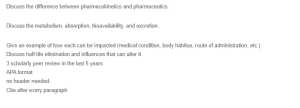
Discuss the difference between pharmacokinetics and pharmaceutics.
Discuss the metabolism, absorption, bioavailability, and excretion.
Key Concepts and Clinical Implications
Give an example of how each can be impacted (medical condition, body habitus, route of administration, etc.)
Discuss half-life elimination and influences that can alter it.
3 scholarly peer review in the last 5 years
APA format
no header needed.
Cite after every paragraph