
Discussion: OSHA Operations
The Occupational Health and Safety Administration’s (OSHA) mission is to ensure that employers provide safe and healthful work conditions for their employees. Among other things, OSHA provides training, outreach, education, and assistance. The administration also administers at least 22 whistleblower laws and protects employees’ rights to report violations without fear of retaliation from their employers. The administration’s authority extends to all employees across 50 states and all jurisdictions under the federal government.
Legal Authority and System for Scheduling Inspections
OSHA was established following the enactment of the Occupational Safety and Health (OSH) Act of 1970. The administration’s inspection process begins with physical on-site inspections, which are necessary for new entities before obtaining OSH compliance certification. One of the inspection programs is the Severe Violator Enforcement Program (SVEP), which targets employers who display indifference to their OSH commitments by repeated and willful violations. In such cases, OSHA undertakes follow-up physical inspections. Additionally, following an employee complaint, the administration undertakes a physical inspection within five days if necessary.
Process for Scheduling Construction Inspections on Multi-Employer Worksites
Given the mobility of the construction industry, the transitory nature of working sites, and the fact that most construction sites have more than one employer, such inspections are done per working site rather than per employer. OSHA’s national office provides the area or district office with a randomly selected list of active projects within the district. Also included in the list is the number of active projects that the office plans to visit within the next month. Given the resource constraints faced by the administration, inspections target only 5% of new construction sites started each year. The inspections provide a broad-based viewpoint of the level of safety in the construction industry within a given area.
Employee Rights Related to a Safe and Healthful Workplace
The federal law entitles employees the right to a safe working environment and the right to report violations without the fear of retaliation. One of the fundamental safety requirements is new employee training before they start working, while assuring that the machines that will be used at work are in the best safety conditions (OSHA, 2023). Also, employees have the right to refuse to work in conditions they deem unsafe. The law also guarantees employees access to safety equipment such as gloves or a harness and a lifeline in case of exposure to falls (OSHA, 2023). Employees also reserve the right to initiate an inspection by filing confidential complaints with the authority.
Employers’ Responsibilities and the Legalities to Provide a Safe and Healthful Workplace
According to the U.S. Department of Labor and OSHA (2024), the employer’s primary responsibility is to provide employees with a workplace that does not pose serious hazards and to follow OSHA safety and health standards. It is incumbent upon employers to investigate safety problems within their workplaces and offer corrective solutions as soon as possible. Among others, employees are required to make feasible changes to working conditions instead of relying on safety equipment. Additionally, the guidelines require employers to report any fatality to the administration within eight hours, whereas hospitalizations, amputations, and loss of an eye should be reported within 24 hours from the time of occurrence.
Employers’ Abilities to Reduce the Level of Citations and/or Penalties
According to the U.S. Department of Labor and OSHA (2024), a citation includes the methods an employer may use to correct a violation and the dates by which corrective actions must be implemented. To that end, employers reserve the right to contest any part of the citation, including whether a violation occurred. In the same breath, employees have the right to contest the deadlines by which safety issues raised must be resolved. Appeals of citations are heard and determined by the Occupational Safety and Health Review Commission.
Documentation Required to Respond to Citations and Penalties
Proper documentation can be enormously helpful for various reasons, since it offers evidence of an organization’s compliance programs and indicates continued and effective employee training. Among others, employers are required to retain documents that offer an insight into process safety management programs. Also, the company must retain documents detailing emergency action plans anticipated from employees in case an emergency occurs. Also, employers should retain documents detailing occupational noise exposure, including hearing loss reports, noise surveys, and exposure measurement records. These documents are valid for up to two years from the period they are initially generated. With these documents available, an employer can appeal wrongful citations. For instance, if a citation originates from an employee complaint due to a one-off incident, the employer can appeal by providing documentation detailing how the employer has complied with the guidelines consistently.
OSHA’s Citation and Penalty Processes
The law requires OSHA to post a citation and notification of penalty in the location where a violation occurs. However, if the nature of operations does not allow the notification to be posted in the precise location where a violation occurs, it should be posted in a location where it is observable to all employees. The posting will remain until the violations cited have been abated or for three working days, exclusive of weekends and federal holidays, whichever is longer. Subsequently, the employer can organize an informal conference with the area director to present their viewpoints regarding the citations. During the conference, the employer will provide evidence that may lead to an adjustment of the citation. Unless contested, the penalties imposed are payable within 15 days following the receipt of a penalty notification.
Steps to Be Undertaken by Employers upon Receipt of OSHA Citations and Proposed Penalties
One of an employer’s responsibilities following the receipt of an OSHA citation is to review the citation packet thoroughly. Given the fact that OSHA addresses multiple projects, mistakes are likely, hence the need to review a citation to ensure it is addressed to the specific employer. The review will offer an insight into the type of violation, whether it is serious, willful, repeat, or any other violation. Another key action is to inform internal stakeholders, such as staff and managers.
Conclusion
In summary, the OSH Act was created so that no employee has to choose between health and life. This act clarifies that the right to workplace safety is a fundamental human right. Since its establishment, OSHA has delivered remarkable progress in workplaces across the U.S. Today, workplace injuries, illnesses, and fatalities have reduced dramatically. The administration has also collaborated with state partners to alleviate safety hazards and health risks in the workplace. The OSHA guidelines have imparted the use of common sense in assuring employee safety at the workplace, whilst taking legal action for those who violate the guidelines. Also, OSHA’s training and educational initiatives have played a key role in preventing the occurrence of accidents, saving lives, and preventing injuries in the process.
References
OSHA. (2023). OSHA worker rights and protections. Occupational Safety and Health Administration. https://www.osha.gov/workers
U.S. Department of Labor & OSHA. (2024). All about OSHA. OSHA. https://www.osha.gov/sites/default/files/publications/OSHA3302.pdf
ORDER A PLAGIARISM-FREE PAPER HERE
We’ll write everything from scratch
Question 
Discussion: OSHA Operations
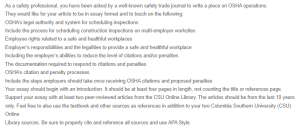
As a safety professional, you have been asked by a well-known safety trade journal to write a piece on OSHA operations.
They would like for your article to be in essay format and to touch on the following:
Discussion – OSHA Operations
OSHA’s legal authority and system for scheduling inspections
Include the process for scheduling construction inspections on multi-employer worksites
Employee rights related to a safe and healthful workplaces
Employer’s responsibilities and the legalities to provide a safe and healthful workplace
Including the employer’s abilities to reduce the level of citations and/or penalties
The documentation required to respond to citations and penalties
OSHA’s citation and penalty processes
Include the steps employers should take once receiving OSHA citations and proposed penalties
Your essay should begin with an introduction. It should be at least four pages in length, not counting the title or references page. Support your essay with at least two peer-reviewed articles from the CSU Online Library. The articles should be from the last 10 years only. Feel free to also use the textbook and other sources as references in addition to your two Columbia Southern University (CSU) Online
Library sources. Be sure to properly cite and reference all sources and use APA Style.