
Discussion – Mood Stabilizer
Carbamazepine
Mechanism of Action
Carbamazepine works mainly by inhibiting voltage-gated sodium channels and helps to regulate the neurons that are in a state of hyperactivity, as highlighted by (Maan et al., 2023). This is particularly true regarding the limbic system which is often said to be governing the moods of people. It also helps in preventing abnormal impulses from spreading through the brain, which is a feature that is vital in managing epilepsy and mood disorders. This is one of the restrictive behaviors that show that the stabilization of the neuron firing is mood stabilization, generally seen in mania.
Baseline Assessment and Laboratory Considerations
Carbamazepine requires extensive blood tests before administration due to the adverse effects that may occur. A routine complete blood count is necessary in order to rule out any possible but severe conditions like aplastic anemia or agranulocytosis (Maan et al., 2023). Liver function tests have to be performed to monitor hepatotoxicity, which is known to occur as a side effect. Electrolytes, especially sodium, should also be balanced due to the potential risk of hyponatremia in cases when ADH is inappropriately secreted. Close follow-ups need to be done, mainly in the initial six months.
Special Population Considerations
Carbamazepine has teratogenic effects, including neural tube disorders; therefore, it poses a significant threat to women who are pregnant or planning to conceive, as identified by (Panda et al., 2024). Women are advised to use reliable contraception and take folic acid. Due to the slower rates of metabolism and higher sensitivity to side effects, including drowsiness and dizziness, the elderly should use reduced doses. Also, elderly patients are more susceptible to developing drug-induced hyponatremia and, therefore, are more closely monitored for electrolyte imbalance.
FDA Approval and Indications
Carbamazepine is FDA-approved for the treatment of bipolar disorder, especially acute manic and mixed state (Maan et al., 2023). Indeed, patients starting a mood stabilizer treatment such as lithium or lamotrigine for maintenance treatment because of their side effects are also very little to be aromatic of bipolar depressive episodes.
Typical Dosing and Therapeutic Endpoints
Carbamazepine is often initiated at 200 mg twice daily for bipolar disorder and increased in dose to 800-1200 mg per day (Maan et al., 2023). The target concentration range of carbamazepine is 4 to 12 mcg/mL in the medical plasma. Thus, to avoid toxicity, it is necessary to monitor the level of drugs that can cause ataxia, dizziness and other severe reactions, including Stevens-Johnson syndrome.
Lamotrigine
Mechanism of Action
Lamotrigine use has been explored to mainly inhibit the release of pro-excitatory neurotransmitters like glutamate and aspartate through the stabilization of neuronal membranes and the inhibition of voltage-sensitive sodium channels, as postulated by Betchel et al. (2023). This current suppression plays a role in managing mood oscillations, particularly depressive states, making lamotrigine very useful in bipolar disorder maintenance treatment, focusing more on the prevention of depression than mania.
Baseline Assessment and Laboratory Considerations
Although lamotrigine does not have the need for routine monitoring like lithium or carbamazepine, monitoring of liver and renal function at the baseline level is advised since the drug is metabolized through the liver and excreted through the kidneys (Betchel et al., 2023). Most importantly, patients during the first few weeks of treatment moreover must be carefully monitored for rashes as lamotrigine is related to Stevens-Johnson syndrome, which is a deadly skin condition. This puts a patient at a higher risk, although slow introduction of the medication is due to health complications.
Special Population Considerations
Despite the fact that lamotrigine is considered to be the least toxic mood stabilizer during pregnancy, its fluctuating concentration requires monitoring. It rises during pregnancy, and dosing adjustments should be made to achieve the desired therapeutic concentrations (Betchel et al., 2023). Lamotrigine is also used in children and adolescents for treating mood disorders, with an increased risk of serious rash, so slow tapering of the drug is extremely important.
FDA Approval and Indications
According to Hashimoto et al. (2021), lamotrigine is only approved by the FDA for use during the maintenance phase of bipolar disorder to prevent depressive episodes. Compared to lithium, lamotrigine is deemed more suitable for maintenance treatment because of its adverse effect profile, such as the tendency to gain weight and impaired cognitive function.
Typical Dosing and Therapeutic Endpoints
To minimize the risk of rash, lamotrigine has to be started at a maintenance dosage of 25 mg per day and over weeks. The maintenance dose ranges from 100 to 200 milligrams per day. One of the therapeutic aims is to sustain recovery from depressives but at the same time avoid inducing mania.
Lithium
Mechanism of Action
Lithium is one of the first drugs used as a mood stabilizer, and its mechanisms of action include inhibition of inositol monophosphatase and changes in sodium transport in nerve and muscle cells, according to Chokhawala et al. (2024). These actions affect second messenger systems and neurotransmitter release, therefore assisting in minimizing manic symptoms and stabilizing mood.
Baseline Assessment and Laboratory Considerations
Since the therapeutic range for lithium is 0.6 to 1.2 mEq/L, the substance must be monitored in the blood from time to time. It is for this reason that lithium may cause hypothyroidism and nephrotoxicity; patients should undergo thyroid function tests and kidney function tests (Serum creatinine, BUN). These values should be maintained all the time, especially for the extended users.
Special Population Considerations
Lithium is clearly teratogenic and can cause Ebstein’s anomaly, a congenital heart disease, which makes it unsafe during pregnancy. Renal clearance decreases with age, and therefore, in elderly patients, the doses have to be reduced, and monitoring has to be done more frequently to avoid toxicity.
FDA Approval and Indications
Lithium is also FDA-approved for acute mania in bipolar disorder and for maintenance treatment to minimize the severity and frequency of episodes. Perhaps its most extensively documented positive aspect, and one of the most promising, is its ability to reduce suicide risk among bipolar patients.
Typical Dosing and Therapeutic Endpoints
To target a serum level of 0.6–1.2 mEq/L, the first dose of lithium is 300 mg divided into two to three doses (Chokhawala et al., 2024). Due to this, it is crucial to frequently control the level of lead within the serum due to toxicity that manifests symptoms such as tremors and gastrointestinal disorders and in extreme cases, cases of coma and death might be experienced.
Valproate
Mechanism of Action
Rahman et al. (2024) indicate that valproate affects sodium channels while at the same time increasing the levels of GABA, thus decreasing the excitability of neurons. These mechanisms render valproate suitable for managing acute mania and the maintenance phase of bipolar disorder since mood stabilizers become crucial in managing patients’ symptoms, such as aggression.
Baseline Assessment and Laboratory Considerations
Since valproate could cause hepatotoxicity and thrombocytopenia, one should consider recommending the basic hepatic and coagulation tests before starting the treatment. Therefore, it is recommended to closely monitor the platelet count and the liver enzymes, including those taking place in the first several months of the treatment process.
Special Population Considerations
As Ornoy et al. (2023) pointed out, valproate poses a high teratogenic effect that can lead to neural tube deficits; thus, its use should be discouraged during pregnancy. Pregnant and potentially pregnant women should take folic acid and practice safe sex. They have comparatively slower metabolic rates, and therefore, the risk associated with dose changes should be well managed among elderly patients.
FDA Approval and Indications
Valproate is FDA-approved as a therapeutic agent in migraine and epilepsy, manic symptoms of bipolar disorder.
Typical Dosing and Therapeutic Endpoints
Initial dosage for patients with bipolar disorder may include 250 to 500 mg per day with therapeutic plasma concentration metabolite level targeting 50 to 125 mcg/mL. Potential treatment goals are controlling manic episodes and preventing their recurrence.
Drug Interactions
Carbamazepine + Lurasidone: Carbamazepine increases the metabolism of lurasidone and thus reduces its efficacy. Co-administration may require higher doses of lurasidone.
Carbamazepine + Grapefruit juice: Interaction occurs because grapefruit juice inhibits CYP3A4, leading to higher carbamazepine than normal toxicity levels, as pointed out by (Khalili et al., 2023). Carbamazepine patients should not consume grapefruit products at all.
Lamotrigine + Valproate: Valproate acts as an inhibitor of Lamotrigine and thus increases Lamotrigine levels in the body and increases the probability of developing SJS. It is important to note that when both Lamotrigine and valproate are used, then the dosages of the two drugs have to be lowered.
Lamotrigine + Rifampin: Lamotrigine’s effectiveness is affected by rifampin because rifampin increases the rate of Lamotrigine’s metabolism. When taken alongside each other, dosage adjustments are often required in this case.
Lithium and Furosemide: There is a risk of increased blood-level lithium when used with furosemide, which is a diuretic. It is advised that when both medications are required, lithium levels should be closely watched.
Lithium + Lisinopril: The ACE inhibitor lisinopril may cause a reduction in renal lithium clearance and, thus an increase in toxicity, as highlighted by Mahli et al. (2020). Other antihypertensives or close dosages are recommended.
Valproate + Estrogen-containing birth control: The mechanism of action of valproate is compromised by estrogens that reduce its level, which affects its supposed measure of controlling mood swings (Rahman et al., 2024). The patient may need to change the dosage or the type of contraceptive used.
Valproate + Amitriptyline: When valproate is combined with amitriptyline, the level of amitriptyline is increased, which increases the side effects of sedation and toxicity. These drugs show add-on effects; thus, their coordination requires supervision and dosage regulation.
Ethical, Legal, and Social Implications
Mood stabilizers are mainly prescribed for the management of bipolar disorder, accompanied by challenging ethical, legal, and social issues (Nath & Gupta, 2023). Patients’ needs and expectations, risks, benefits, side effects, drug interactions and monitoring requirements have to be understood. From a legal point of view, it is essential to follow the guidelines provided by the FDA rigorously, especially due to the risks involved for lithium and valproate. The social prejudice of mood disorders continues to be a significant obstacle to people seeking treatment. Providers need to address this by engaging their respective patients and their families in educating and communicating regarding acceptation of mental health diagnoses and pharmacologic interventions.
References
Betchel, N. T., Fariba, K. A., & Saadabadi, A. (2023, February 13). Lamotrigine. StatPearls – NCBI Bookshelf. https://www.ncbi.nlm.nih.gov/books/NBK470442/
Chokhawala, K., Lee, S., & Saadabadi, A. (2024, January 14). Lithium. StatPearls – NCBI Bookshelf. https://www.ncbi.nlm.nih.gov/books/NBK519062/
Hashimoto, Y., Kotake, K., Watanabe, N., Fujiwara, T., & Sakamoto, S. (2021). Lamotrigine in the maintenance treatment of bipolar disorder. Cochrane Database of Systematic Reviews, 2021(9). https://doi.org/10.1002/14651858.cd013575.pub2
Khalili, Y. A., Sekhon, S., & Jain, S. (2023, July 24). Carbamazepine toxicity. StatPearls – NCBI Bookshelf. https://www.ncbi.nlm.nih.gov/books/NBK507852/
Maan, J. S., Duong, T. V. H., & Saadabadi, A. (2023, July 10). Carbamazepine. StatPearls – NCBI Bookshelf. https://www.ncbi.nlm.nih.gov/books/NBK482455/
Mahli, G. S., Bell, E., Outhred, T., & Berk, M. (2020). Lithium therapy and its interactions. Australian Prescriber, 43(3), 91–93. https://doi.org/10.18773/austprescr.2020.024
Nath, M., & Gupta, V. (2023, April 24). Mood stabilizers. StatPearls – NCBI Bookshelf. https://www.ncbi.nlm.nih.gov/books/NBK556141/
Ornoy, A., Echefu, B., & Becker, M. (2023). Valproic acid in pregnancy revisited: Neurobehavioral, biochemical and molecular changes affecting the embryo and fetus in humans and in animals: A narrative review. International Journal of Molecular Sciences, 25(1), 390. https://doi.org/10.3390/ijms25010390
Panda, S. K., M, N. K. H., & Takawale, P. (2024). Embryo-fetal developmental toxicity of carbamazepine administered orally in Wistar rat. Reproductive Toxicology, 129, 108665. https://doi.org/10.1016/j.reprotox.2024.108665
Rahman, M., Awosika, A. O., & Nguyen, H. (2024, March 19). Valproic acid. StatPearls – NCBI Bookshelf. https://www.ncbi.nlm.nih.gov/books/NBK559112/
ORDER A PLAGIARISM-FREE PAPER HERE
We’ll write everything from scratch
Question 
Discussion – Mood Stabilizer
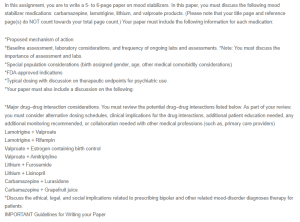
In this assignment, you are to write a 5- to 6-page paper on mood stabilizers. In this paper, you must discuss the following mood stabilizer medications: carbamazepine, lamotrigine, lithium, and valproate products. (Please note that your title page and reference page(s) do NOT count towards your total page count.) Your paper must include the following information for each medication:
Discussion – Mood Stabilizer
*Proposed mechanism of action
*Baseline assessment, laboratory considerations, and frequency of ongoing labs and assessments. *Note: You must discuss the importance of assessment and labs.
*Special population considerations (birth assigned gender, age, other medical comorbidity considerations)
*FDA-approved indications
*Typical dosing with discussion on therapeutic endpoints for psychiatric use
*Your paper must also include a discussion on the following:
*Major drug–drug interaction considerations. You must review the potential drug–drug interactions listed below. As part of your review, you must consider alternative dosing schedules, clinical implications for the drug interactions, additional patient education needed, any additional monitoring recommended, or collaboration needed with other medical professions (such as, primary care providers)
Lamotrigine + Valproate
Lamotrigine + Rifampin
Valproate + Estrogen containing birth control
Valproate + Amitriptyline
Lithium + Furosemide
Lithium + Lisinopril
Carbamazepine + Lurasidone
Carbamazepine + Grapefruit juice
*Discuss the ethical, legal, and social implications related to prescribing bipolar and other related mood-disorder diagnoses therapy for patients.
IMPORTANT Guidelines for Writing your Paper
Page 0: Title Page
Page 1: Discuss items 1-5 from above for carbamazepine. Label this section Carbamazepine.
Page 2: Discuss items 1-5 for lamotrigine. Label this section Lamotrigine.
Page 3: Discuss items 1-5 for lithium. Label this section Lithium.
Page 4: Discuss items 1-5 for valproate products. Label this section Valproate.
Page 5: Discuss item A from above. Label this section Drug Interactions.
Page 6: Discuss item B from above. Label this section Ethical, Legal, and Social Implications. If your paper is greater than six pages in length, points will be deducted in accordance with the grading rubric.
Page 6+: Begin your reference list. You must support your drug information with five evidence-based, peer-reviewed sources from the scholarly literature.