
Discussion: Frontal Lobe and Psychopathology
The human brain comprises four primary lobes: frontal, parietal, temporal, and occipital, each performing specific neurological functions. The frontal lobe controls executive functioning, motor behavior, language production (via Broca’s area), judgment, and emotional control. The parietal lobe deals with somatosensory input, spatial orientation, and bodily awareness and is essential for proprioception and tactile interpretation. The temporal lobe plays a key role in hearing, encoding memories, and language comprehension (via Wernicke’s area). Lastly, the occipital lobe primarily deals with visual processing and interpretation of visual stimuli. The functioning of these lobes is synergistic, and structural malfunction of one region can adversely affect cognitive and behavioral functioning (Jawabri & Sharma, 2023).
Adult psychopathology is heavily dependent on the development of the frontal lobe because it is the foundation of higher-order functions in cognition and emotion. Major psychiatric disorders like schizophrenia, major depressive disorder, and antisocial personality disorder have been closely associated with underdevelopment or structural abnormalities in this area. For example, smaller volume and hypoactivity of the prefrontal cortex are frequently seen in persons with schizophrenia and are associated with poor executive functioning, disorganized thought, and poor insight. Frontal lobe impairment in depression is also linked to a lack of motivation, apathy, and decision-making dysfunction. Moreover, impairments in the orbitofrontal cortex have been associated with antisocial behavior, affecting moral reasoning and inhibition (Matsumoto et al., 2023).
One of the best examples of the contribution of the frontal lobe to human functioning is that of impulse control and decision-making, which is mainly undertaken by the prefrontal cortex. Once this region becomes impaired, as in the case of traumatic brain injury, sustained substance abuse, or neurodegeneration, people will be prone to disinhibition, risk-taking, poor decision-making, and emotional volatility. The disruptions can replicate or worsen psychiatric disorders or take the form of a transition between neurologic events and psychiatric disease. Thus, maintaining the integrity of the frontal lobes is critical to ensure control of behavior and rational thinking (Friedman & Robbins, 2021).
References
Friedman, N. P., & Robbins, T. W. (2021). The role of prefrontal cortex in cognitive control and executive function. Neuropsychopharmacology, 47(47), 1–18. https://doi.org/10.1038/s41386-021-01132-0
Jawabri, K. H., & Sharma, S. (2023, April 24). Physiology, cerebral cortex functions. Nih.gov; StatPearls Publishing. https://www.ncbi.nlm.nih.gov/books/NBK538496/
Matsumoto, J., Fukunaga, M., Miura, K., Nemoto, K., Okada, N., Hashimoto, N., Morita, K., Koshiyama, D., Ohi, K., Takahashi, T., Koeda, M., Yamamori, H., Fujimoto, M., Yasuda, Y., Ito, S., Yamazaki, R., Hasegawa, N., Narita, H., Yokoyama, S., . . . Hashimoto, R. (2023). Cerebral cortical structural alteration patterns across four major psychiatric disorders in 5549 individuals. Molecular Psychiatry, 28(11), 4915–4923. https://doi.org/10.1038/s41380-023-02224-7
ORDER A PLAGIARISM-FREE PAPER HERE
We’ll write everything from scratch
Question 
Discussion: Frontal Lobe and Psychopathology
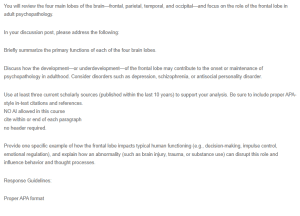
You will review the four main lobes of the brain—frontal, parietal, temporal, and occipital—and focus on the role of the frontal lobe in adult psychopathology.
Discussion – Frontal Lobe and Psychopathology
In your discussion post, please address the following:
Briefly summarize the primary functions of each of the four brain lobes.
Discuss how the development—or underdevelopment—of the frontal lobe may contribute to the onset or maintenance of psychopathology in adulthood. Consider disorders such as depression, schizophrenia, or antisocial personality disorder.
Use at least three current scholarly sources (published within the last 10 years) to support your analysis. Be sure to include proper APA-style in-text citations and references.
NO AI allowed in this course
cite within or end of each paragraph
no header required.
Provide one specific example of how the frontal lobe impacts typical human functioning (e.g., decision-making, impulse control, emotional regulation), and explain how an abnormality (such as brain injury, trauma, or substance use) can disrupt this role and influence behavior and thought processes.
Response Guidelines:
Proper APA format