
Discussion: Evaluating the Effectiveness of Mindfulness Interventions
During the breathing meditation guided by UCLA Health, I experienced a shift from restlessness to a state of stillness. My thoughts initially wandered, but focusing on my breath helped me regain control. This experience helped me understand the role of mindfulness in self-control and emotional calmness. As it is efficient and straightforward, I would be willing to apply this method to work with clients like Ella, especially regarding trauma healing.
My initial resistance during the mindfulness practice mirrors what clients like Ella might experience, especially when coping with trauma. Nonetheless, the calming effect I experienced after some time might make clients feel safer and in control. Although personal experience is valuable, evidence-based research supports the effectiveness of mindfulness interventions, particularly with adolescents like Ella. Mindfulness may provide a client with a nonjudgmental platform to observe their thoughts and feelings without being consumed by them, a vital aspect to trauma-informed care (Garland, 2013).
Gómez-Odriozola and Calvete (2021) conducted a randomized controlled trial (RCT), in which 300 Adolescents between the ages of 13 and 21 were randomized to either the wait-list control group or the intervention (Learning to Breathe). Before and after the intervention, data were gathered using the Self-Concept Form-5 Questionnaire and the Center for Epidemiologic Studies Depression Scale (CES-D). According to the study, older teenagers’ depression significantly decreased and their social self-concept improved, but younger adolescents’ depressed symptoms increased after the intervention (Gómez-Odriozola & Calvete, 2021).
The research is highly valid due to its large sample, validated measures, and randomized nature (Gómez-Odriozola & Calvete, 2021). Such strengths can aid in the use of mindfulness interventions with clients, such as Ella, who is 16 and thus in the age category that responds better. Mindfulness can decrease her levels of depression and enhance her self-concept. Nevertheless, mindfulness should be applied carefully and be trauma-informed to take care of Ella’s emotional security because of her trauma history.
References
Garland, E. L. (2013). Mindfulness research in social work: Conceptual and methodological recommendations. Social Work Research, 37(4), 439–448. https://sci-hub.se/10.1093/swr/svt038
Gómez-Odriozola, J., & Calvete, E. (2021). Effects of a mindfulness-based intervention on adolescents’ depression and self-concept: The moderating role of age. Journal of Child and Family Studies, 30(6), 1501–1515. https://doi.org/10.1007/s10826-021-01953-z
ORDER A PLAGIARISM-FREE PAPER HERE
We’ll write everything from scratch
Question 
Discussion: Evaluating the Effectiveness of Mindfulness Interventions
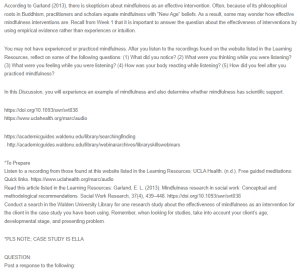
According to Garland (2013), there is skepticism about mindfulness as an effective intervention. Often, because of its philosophical roots in Buddhism, practitioners and scholars equate mindfulness with “New Age” beliefs. As a result, some may wonder how effective mindfulness interventions are. Recall from Week 1 that it is important to answer the question about the effectiveness of interventions by using empirical evidence rather than experiences or intuition.
Discussion – Evaluating the Effectiveness of Mindfulness Interventions
You may not have experienced or practiced mindfulness. After you listen to the recordings found on the website listed in the Learning Resources, reflect on some of the following questions: (1) What did you notice? (2) What were you thinking while you were listening? (3) What were you feeling while you were listening? (4) How was your body reacting while listening? (5) How did you feel after you practiced mindfulness?
In this Discussion, you will experience an example of mindfulness and also determine whether mindfulness has scientific support.
https://doi.org/10.1093/swr/svt038
https://www.uclahealth.org/marc/audio
https://academicguides.waldenu.edu/library/searchingfinding
. http://academicguides.waldenu.edu/library/webinararchives/libraryskillswebinars
*To Prepare
Listen to a recording from those found at this website listed in the Learning Resources: UCLA Health. (n.d.). Free guided meditations: Quick links. https://www.uclahealth.org/marc/audio
Read this article listed in the Learning Resources: Garland, E. L. (2013). Mindfulness research in social work: Conceptual and methodological recommendations. Social Work Research, 37(4), 439–448. https://doi.org/10.1093/swr/svt038
Conduct a search in the Walden University Library for one research study about the effectiveness of mindfulness as an intervention for the client in the case study you have been using. Remember, when looking for studies, take into account your client’s age, developmental stage, and presenting problem.
*PLS NOTE; CASE STUDY IS ELLA
QUESTION:
Post a response to the following:
Describe your experience practicing this technique and how this experience influences your choice on whether to use it with a client during practice.
Connect your own reaction to the mindfulness exercise with how a client might respond.
Provide the reference for the study you found, and be sure to use citations in the body of your post using APA guidelines.
In 1–2 sentences, briefly summarize the methodological context (i.e., research method, how data was collected, and the instruments used) of the studies and the findings.
Analyze the findings in terms of their validity and applicability for the client.