
Discussion – Comparative Advantage
The idea of comparative advantage is a basic starting point in international trade theory. It posits that if a nation produces a good more efficiently than foreign nations, it should specialize in making it and trade with them to obtain others. Real trade results, however, are subject to much more than concerns over production efficiency. In his article, Robert Parry examines the fundamental macroeconomic and policy factors underlying trade deficits and competitiveness. He presents key insight into why the U.S. does not necessarily export more pharmaceuticals even if it has a comparative advantage.
Why Comparative Advantage Does Not Guarantee U.S. Pharmaceutical Exports
If the United States has a comparative advantage in pharmaceutical production, there is no direct implication that it will be an exporter of pharmaceuticals. As Robert Parry contends in this speech, numerous factors influence international trade patterns in addition to comparative advantage. Whereas comparative advantage refers to prospective efficiency in production, actual trade flows are highly subject to macroeconomic fundamentals like levels of saving and investment, exchange rates, and international market forces. A nation’s potential to be an exporter of a product, even a product that it produces efficiently, is thus contingent upon much more than its productivity.
Parry stresses that trade balances are closely associated with national saving and investment patterns. He clarifies, “A country’s trade balance is the mirror image of its pattern of saving and investment” (Parry, 1994). This indicates that even when the U.S. has a comparative advantage in pharmaceuticals, a low savings rate at the national level with excess domestic investment can result in a trade deficit. Such a deficit can result from high imports compared to exports, even if the nation is competitive in some pharmaceutical industries. Therefore, comparative advantage could be overridden by general macroeconomic patterns.
Also, the relative strength or weakness of the U.S. dollar can have a considerable influence on the sustainability of pharmaceutical exports. Parry explains that “the appreciation of the dollar in the early 1980s led to U.S. manufacturers becoming less price-competitive to foreign producers” (Parry, 1994). Even with highly efficient U.S. pharmaceutical firms, a strong dollar would render their goods more costly overseas and restrict exporting. This illustrates that measuring a nation’s currency can reverse comparative advantage by rending even competitively manufactured goods less appealing to foreign markets.
In addition, trade policies and non-tariff barriers affect international trade. Parry says, “The evidence is clear that virtually all countries, including the U.S., impose at least some restrictions on imports and provide government support for exports” (Parry, 1994). In the pharmaceutical industry, regulations, patent legislation, and foreign subsidies would limit market entry and make exporting harder since the U.S. is efficient. These external barriers further complicate the assumption that comparative advantage guarantees export success.
Therefore, even if the U.S. has a comparative advantage in the production of pharmaceuticals, this will not guarantee that this will be a top exporting sector. As Robert Parry’s discussion indicates, macroeconomic conditions, exchange rate fluctuations, and international trade policies must all interact to set trade patterns. He asserts, “The continued existence of U.S. trade deficits reflects an imbalance of national savings below investment, not any fundamental decline in U.S. international competitiveness” (Parry, 1994). Hence, exporting pharmaceuticals is determined by a multi-faceted mix of economic considerations, not solely productive efficiency.
Conclusion
In conclusion, comparative advantage in pharmaceuticals is not enough to ensure that the U.S. will export them. Robert Parry indicates that economic forces of a wider nature, like saving-investment imbalances, exchange rates, and trade policies, influence trade flows. The U.S. can efficiently produce pharmaceuticals, but there could be limiting factors to its exporter status. The route to becoming a leading exporter is not guaranteed with comparative advantage; it is determined by a nation’s economic strategy and worldwide market conditions.
References
Parry, R. T. (1994). U.S. trade deficits and international competitiveness. Business Economics, 20-23.
ORDER A PLAGIARISM-FREE PAPER HERE
We’ll write everything from scratch
Question 
Discussion – Comparative Advantage
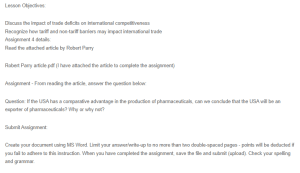
Lesson Objectives:
Discuss the impact of trade deficits on international competitiveness
Recognize how tariff and non-tariff barriers may impact international trade
Discussion – Comparative Advantage
Assignment 4 details:
Read the attached article by Robert Parry
Robert Parry article.pdf (I have attached the article to complete the assignment)
Assignment – From reading the article, answer the question below:
Question: If the USA has a comparative advantage in the production of pharmaceuticals, can we conclude that the USA will be an exporter of pharmaceuticals? Why or why not?
Submit Assignment:
Create your document using MS Word. Limit your answer/write-up to no more than two double-spaced pages – points will be deducted if you fail to adhere to this instruction. When you have completed the assignment, save the file and submit (upload). Check your spelling and grammar.