
Differentiating Between Diverticular Disease and Diverticulitis
Thank you for your post. Differentiating between closely related diseases that affect the same part of the human, such as diverticular disease (diverticulosis) and diverticulitis, can lead to the wrong diagnosis and treatment if attention is not paid during the diagnosis process. However, the diagnosing officer can always base their decisions on the clinical symptoms manifested, the patient’s health history with regard to the suspected diseases, physical examinations, and objective diagnosis. These are essential for the development of an effective treatment plan. As noted, the pathophysiology of either diverticular disease or diverticulitis is a major differentiating factor that can aid in making carrying out an easier diagnosis. Knowledge of pathophysiology is important in clinical settings as it helps understand how diseases impact normal bodily functions at the cellular level, thus knowing which treatments will be effective for the particular disease (Hall et al., 2019). As per the presentations of the pathophysiology of diverticular disease and diverticulitis, a major differentiation is that diverticular disease may have hard-to-notice symptoms or pain that can be easily dismissed. However, in cases of diverticulitis, the diseases include inflammation, infections, and severe symptoms that require professional medical attention. The severity of the diverticulitis may lead to hospital admission and specialized care and observation. More arguably, based on the pathophysiology of both diseases, it can be concluded that diverticulitis results from the progression of the diverticular disease as it involves the inflammation and infection of the existing diverticula, leading to congestion and developing obstruction. When diverticulitis is diagnosed, the dosage given should be progressively adjusted to improve symptoms. The physician should also consider the patient’s tolerance to the medications provided and regular.
References
Ashelford, S., Raynsford, J., & Taylor, V. (2019). Pathophysiology and Pharmacology in Nursing. Learning Matters.
ORDER A PLAGIARISM-FREE PAPER HERE
We’ll write everything from scratch
Question 
Differentiating Between Diverticular Disease and Diverticulitis
Can you respond to 2 paragraphs with 1 reference to this discussion?
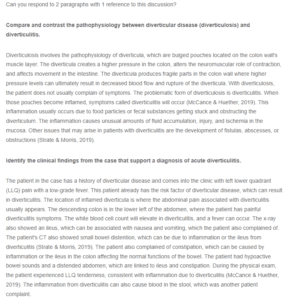
Compare and contrast the pathophysiology between diverticular disease (diverticulosis) and diverticulitis.
Diverticulosis involves the pathophysiology of diverticula, which are bulged pouches located on the colon wall’s muscle layer. The diverticula creates a higher pressure in the colon, alters the neuromuscular role of contraction, and affects movement in the intestine. The diverticula produces fragile parts in the colon wall where higher pressure levels can ultimately result in decreased blood flow and rupture of the diverticula. With diverticulosis, the patient does not usually complain of symptoms. The problematic form of diverticulosis is diverticulitis. When those pouches become inflamed, symptoms called diverticulitis will occur (McCance & Huether, 2019). This inflammation usually occurs due to food particles or fecal substances getting stuck and obstructing the diverticulum. The inflammation causes unusual amounts of fluid accumulation, injury, and ischemia in the mucosa. Other issues that may arise in patients with diverticulitis are the development of fistulas, abscesses, or obstructions (Strate & Morris, 2019).
Identify the clinical findings from the case that support a diagnosis of acute diverticulitis.
The patient in the case has a history of diverticular disease and comes into the clinic with left lower quadrant (LLQ) pain with a low-grade fever. This patient already has the risk factor of diverticular disease, which can result in diverticulitis. The location of inflamed diverticula is where the abdominal pain associated with diverticulitis usually appears. The descending colon is in the lower left of the abdomen, where the patient has painful diverticulitis symptoms. The white blood cell count will elevate in diverticulitis, and a fever can occur. The x-ray also showed an ileus, which can be associated with nausea and vomiting, which the patient also complained of. The patient’s CT also showed small bowel distention, which can be due to inflammation or the ileus from diverticulitis (Strate & Morris, 2019). The patient also complained of constipation, which can be caused by inflammation or the ileus in the colon affecting the normal functions of the bowel. The patient had hypoactive bowel sounds and a distended abdomen, which are linked to ileus and constipation. During the physical exam, the patient experienced LLQ tenderness, consistent with inflammation due to diverticulitis (McCance & Huether, 2019). The inflammation from diverticulitis can also cause blood in the stool, which was another patient complaint.
List 3 risk factors for acute diverticulitis.
Some diverticulitis risk factors are nonsteroidal anti-inflammatory drugs (NSAIDs), genetics, and diet (McCance & Huether, 2019). Medications place patients at higher risk for diverticulitis, such as the use of NSAIDs, which are associated with complicated diverticulitis or perforation (Strate & Morris, 2019). NSAIDs have been shown to cause bleeding in the colon and increase the risk of perforation or abscess growth (Zullo et al., 2019). Another risk factor is genetics, where some genes are associated with a 40-50% greater risk of developing diverticular disease. Some of these genes were prone to increased inflammation and phagocyte activity. A third risk factor is a diet where four or more servings of red meat daily, low fiber, high fat, refined grains, and low intake of fruits, vegetables, and whole grains are associated with diverticulitis (Strate & Morris, 2019).
Discuss why antibiotics and IV fluids are indicated in this case.
Intravenous (IV) antibiotics are recommended for complicated diverticulitis cases (Hall et al., 2020). This patient has a more severe case of diverticulitis based on the ileus, decreased oral intake, and the other multiple signs and symptoms presented. Ordered antibiotics should be administered intravenously over three to five days before switching to by-mouth antibiotics. During this time, the white blood cell count should be monitored. Due to dehydration, nausea, and vomiting, the patient must be administered intravenous fluids. Bowel rest should take place (Linzay & Pandit, 2021).
References
Hall, J., Hardiman, K., Lee, S., Lightner, A., Stocchi, L., Paquette, I. M., … & Feingold, D. L. (2020). The American Society of Colon and Rectal Surgeons clinical practice guidelines for treating left-sided colonic diverticulitis. Diseases of the Colon & Rectum, 63(6), 728-747. doi: 10.1097/DCR.0000000000001679
Linzay, C. D., & Pandit, S. (2021). Acute diverticulitis. In StatPearls [Internet]. Treasure Island (FL): StatPearls Publishing. https://www.ncbi.nlm.nih.gov/books/NBK459316/
McCance, K.L. & Huether, S.E. (2019). Pathophysiology: The biological basis for disease in adults and children. (8th ed.). Elsevier Health Sciences.
Strate, L. L., & Morris, A. M. (2019). Epidemiology, pathophysiology, and treatment of diverticulitis. Gastroenterology, 156(5), 1282-1298. DOI: https://doi.org/10.1053/j.gastro.2018.12.033
Zullo, A., Gatta, L., Vassallo, R., De Francesco, V., Manta, R., Monica, F., … & Vaira, D. (2019). Paradigm shift: The Copernican revolution in diverticular disease. Annals of Gastroenterology, 32(6), 541. doi: 10.20524/aog.2019.04