
Diagnostic Tests and Care Plans for COPD and BPH
Introduction
Chronic obstructive pulmonary (COPD) disease affects most people across the world; it is primarily brought on by tobacco use and is characterized by coughing, sputum production, and dyspnoea when exerted (Park et al., 2020). Chan et al. (2021) reported that prostate enlargement increased steadily with the number of cigarettes smoked per day. Several reports suggest that modifiable factors, like increasing prostate volume, diet, alcohol, and smoking, besides aging, also contribute to benign prostatic hyperplasia (BPH) development (Park et al., 2020).
Differential Diagnosis for the Patient
Chronic Obstructive Pulmonary Disease (COPD): The patient has been experiencing frequent coughing, a major symptom associated with COPD, for the last two months. Other symptoms may also include shortness of breath, wheezing, and chest tightness (Gredic et al., 2021).
Benign Prostatic Hyperplasia (BPH): Frequent urination urge is insufficient to identify the patient with BPH. A prostate-specific antigen (PSA) test is recommended to confirm that it is BPH. BPH is one of the most popular conditions in aging men, not necessarily those who smoke. It causes lower urinary tract symptoms (LUTS), which are characterized by frequent and urgent urination. BPH cases rise after the age of 40, with a prevalence of 8%-60% at the age of 90 years (Park et al., 2020).
Diagnostic Tests and Plan Care for the Patient
A chest X-ray is needed to determine whether emphysema is one of the main causes of COPD. CT scans can also be necessary to screen for lung cancer. Also, arterial blood gas analysis is required to determine how well the lungs bring oxygen and remove carbon dioxide from the blood. Management plans include guiding a patient on when to contact a physician and try to find emergency care. Doctors and researchers have recommended that antidepressants are presently the most supportive of reducing the symptoms of COPD (Gredic et al., 2021).
The patient is advised to void whenever an urge is felt every 2-4 hours, as this may reduce urine retention and excessive bladder pressure. Administration of Alpha-adrenergic antagonists, doxazosin and terazosin (Hytrin) is also essential. Research suggests that these medications may have fewer negative effects on sexual function while being just as effective for outflow blockage as Proscar (Park et al., 2020).
References
Chan, S. M. H., Bernardo, I., Mastronardo, C., Mou, K., De Luca, S. N., Seow, H. J., Dobric, A., Brassington, K., Selemidis, S., Bozinovski, S., & Vlahos, R. (2021). Apocynin prevents cigarette smoking‐induced loss of skeletal muscle mass and function in mice by preserving proteolytic signaling. British Journal of Pharmacology, 178(15), 3049–3066. https://doi.org/10.1111/bph.15482
Gredic, M., Blanco, I., Kovacs, G., Helyes, Z., Ferdinandy, P., Olschewski, H., Barberà, J. A., & Weissmann, N. (2021). Pulmonary hypertension in chronic obstructive pulmonary disease. British Journal of Pharmacology, 178(1), 132–151. https://doi.org/10.1111/bph.14979
Park, S., Ryu, J., & Lee, M. (2020). Quality of Life in Older Adults with Benign Prostatic Hyperplasia. Healthcare, 8(2), 158. https://doi.org/10.3390/healthcare8020158
ORDER A PLAGIARISM-FREE PAPER HERE
We’ll write everything from scratch
Question 
Diagnostic Tests and Care Plans for COPD and BPH
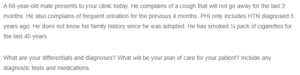
A 68-year-old male presents to your clinic today. He complains of a cough that will not go away for the last two months. He also complains of frequent urination for the previous four months. PHI only includes HTN, diagnosed five years ago. He does not know his family history since he was adopted. He has smoked ½ pack of cigarettes for the last 40 years.
What are your differentials and diagnoses? What will be your plan of care for your patient? Include any diagnostic tests and medications.