
Diagnosing and deciding on Effective Treatment for Diseases of Unclear Causes
Responding to Cindy
Hello,
Thank you for your post. Diagnosing and deciding on effective treatment for diseases of unclear causes, such as diverticular disease and diverticulitis, is a common challenge in healthcare settings. The major in such a case is to develop an accurate diagnosis that can enable the development of effective therapy for the disease and achieve better patient outcomes. Attending to a patient who manifests diseases like diverticular disease and diverticulitis creates an opportunity to learn about the disease and attempt to determine any possible causes that have not been identified from previous cases or in research. As observed in the case of the patient presenting diverticulitis, following the standard path of diagnosis can help develop an objective diagnosis that can support decisions on the type of treatment to prescribe for the patient.
The first step is to identify the patient’s history and the disease. The history may consider the previous diagnosis, if any, and the patient’s previous lifestyle may be a relatable risk factor for developing diverticular disease in the first place. The history may highlight any exposures that may suggest disease-cause factors besides the identified risk factors. To improve the diagnosis, the physician or nurse can consider other non-specific symptoms and red flags of the development of diverticular disease and diverticulitis, then a physical examination. The findings at this level can guide the clinical testing, including clinical sample tests and imaging tests. Treatment can focus on medications that help with the rapid reduction of the symptoms. However, the treatment approach should always be individualized and based on the severity of the diverticulitis diagnosed (Peery, 2021).
References
Peery, A. F. (2021). Management of colonic diverticulitis. BMJ, 372. https://doi.org/10.1136/BMJ.N72
ORDER A PLAGIARISM-FREE PAPER HERE
We’ll write everything from scratch
Question 
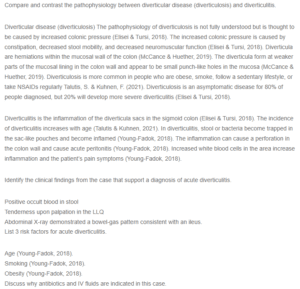
Diagnosing and deciding on Effective Treatment for Diseases of Unclear Causes
Compare and contrast the pathophysiology between diverticular disease (diverticulosis) and diverticulitis.
Diverticular disease (diverticulosis) The pathophysiology of diverticulosis is not fully understood but is thought to be caused by increased colonic pressure (Elisei & Tursi, 2018). The increased colonic pressure is caused by constipation, decreased stool mobility, and decreased neuromuscular function (Elisei & Tursi, 2018). Diverticula are herniations within the mucosal wall of the colon (McCance & Huether, 2019). The diverticula form at weaker parts of the mucosal lining in the colon wall and appear to be small punch-like holes in the mucosa (McCance & Huether, 2019). Diverticulosis is more common in people who are obese, smoke, follow a sedentary lifestyle, or take NSAIDs regularly Talutis, S. & Kuhnen, F. (2021). Diverticulosis is an asymptomatic disease for 80% of people diagnosed, but 20% will develop more severe diverticulitis (Elisei & Tursi, 2018).
Diverticulitis is the inflammation of the diverticula sacs in the sigmoid colon (Elisei & Tursi, 2018). The incidence of diverticulitis increases with age (Talutis & Kuhnen, 2021). In diverticulitis, stool or bacteria become trapped in the sac-like pouches and become inflamed (Young-Fadok, 2018). The inflammation can cause a perforation in the colon wall and cause acute peritonitis (Young-Fadok, 2018). Increased white blood cells in the area increase inflammation and the patient’s pain symptoms (Young-Fadok, 2018).
Identify the clinical findings from the case that support a diagnosis of acute diverticulitis.
Positive occult blood in stool
Tenderness upon palpation in the LLQ
Abdominal X-ray demonstrated a bowel-gas pattern consistent with an ileus.
List 3 risk factors for acute diverticulitis.
Age (Young-Fadok, 2018).
Smoking (Young-Fadok, 2018).
Obesity (Young-Fadok, 2018).
Discuss why antibiotics and IV fluids are indicated in this case.
The 84-year-old lady presented with a temperature of 100.2 F, indicating an active infection. The presentation on the x-ray of an ileus, positive occult stool, and LLQ pain are all indications of acute diverticulitis (Young-Fadok, 2018). The most common treatment for an inpatient is intravenous antibiotics that cover gram-negative and anaerobic bacteria, especially when the patient cannot tolerate anything by mouth (Young-Fadok, 2018). When the patient presented to the ER, she had pale mucosa, hypotension, tachycardia, poor skin turgor, and complained of nausea and vomiting. These clinical symptoms point to dehydration, along with her intolerance to taking fluids by mouth, which indicates the use of IV fluids (Young-Fadok, 2018).
References
Elisei, W. & Tursi, A. (2018). The Pathophysiology of Colonic Diverticulosis: Inflammation versus Constipation? Inflammatory Intestinal Diseases, 3(2), 55–60. https://doi.org/10.1159/000489173
McCance, K. & Huether, S. (2019). Pathophysiology: The biologic basis for disease in adults and children (8th ed.). Elsevier Health Sciences.
Talutis, S. & Kuhnen, F. (2021). Pathophysiology and Epidemiology of Diverticular Disease. Clinics in Colon and Rectal Surgery, 34(2), 081–085. https://doi.org/10.1055/s-0040-1716698
Young-Fadok, T. (2018). Diverticulitis. The New England Journal of Medicine, 379(17), 1635–1642. https://doi.org/10.1056/NEJMcp1800468
Reply