
Diabetes Case Study Analysis
Pathophysiology & Clinical Findings of the Disease
- Based on the history, physical, and lab findings review, what is the most likely diabetes diagnosis for this patient?
The most likely diabetes diagnosis is Type 2 Diabetes Mellitus.
-
Explain the pathophysiology associated with the chosen diabetes diagnosis.
Type 2 diabetes is caused by a combination of insulin resistance and inadequate secretion of insulin by pancreatic beta cells (Goyal & Jialal, 2022). Insulin resistance causes increased hepatic glucose production, decreased transport of glucose into muscle cells, and increased breakdown of fats. Every individual who is obese or overweight has insulin resistance but does not necessarily have type 2 diabetes. The inadequate secretion of insulin added to insulin resistance results in the occurrence of type 2 diabetes.
-
Identify at least three subjective findings from the case that support the chosen diagnosis.
Subjective findings include chief complaint, history of presenting illness, past medical history, family history, social history, allergies, medications, and review of systems. Type 2 diabetes mellitus mostly begins in adulthood, while type 1 diabetes mellitus begins in childhood (Syed, 2022). The patient is a 48-year-old adult newly diagnosed with diabetes; therefore, the diabetes diagnosis is type 1 diabetes mellitus. Patients diagnosed with type 2 diabetes usually have the classic symptoms of weight loss, polyuria, polyphagia, and polydipsia. Other signs and symptoms include blurred vision, yeast infection, and paraesthesias in the lower extremities (Goyal & Jialal, 2022). J.T.’s chief complaints include increased appetite, extreme thirst (polydipsia), fatigue, and weight loss, which are signs and symptoms of type 2 diabetes mellitus. Risk factors of type 2 diabetes mellitus seen in J.T. include hypertension, family history of type 2 diabetes mellitus in a first-degree relative, age above 45 years, and weight 120% more than the desired body weight (Goyal & Jialal, 2022). J.T. is obese; therefore, his weight is more than the desired body weight. His brother, a first-degree relative, is a known type 2 diabetes mellitus patient. J.T. is a 48-year-old known hypertensive, increasing his risk for type 2 diabetes mellitus.
-
Identify at least three objective findings from the case that support the chosen diagnosis.
Objective findings include physical examination, vital signs, and laboratory results. The patient’s blood pressure of 136/80 signifies stage 1 hypertension, a risk factor for type 2 diabetes mellitus. A BMI of 36.5 signifies obesity, a risk factor for type 2 diabetes mellitus. J.T. has fruity breath, a sign of diabetic ketoacidosis (Goyal & Jialal, 2022). His respiratory breath is deep, 20 breaths per minute, which is higher than the normal range of respiration. The breathing pattern suggests Kussmaul respirations, a sign of metabolic acidosis in type 2 diabetes mellitus. J.T. has a fasting glucose level of 132mg/dL. The normal range for fasting glucose is 60 to 120 mg/dL; therefore, J.T. has a high glucose level, which signifies diabetes (Goyal & Jialal, 2022). In addition, J.T.’s oral glucose tolerance test (O.G.T.T.) is 220mg/dL. Notably, O.G.T.T. above 200mg/dL signifies diabetes. Lastly, urinalysis is positive for glucose.
Management of the Disease
- Utilizes the required Clinical Practice Guideline (C.P.G.) to support the chosen treatment recommendations.
J.T.’s medication includes Lisinopril 20mg O.D.O.D. indicated for hypertension. Lisinopril is an angiotensin-converting enzyme inhibitor (A.C.E.I.). Administration of A.C.E.I.s in diabetes is appropriate since A.C.E.I.s decrease cardiovascular events in diabetes (Goyal & Jialal, 2022). Adequate management of the patient’s underlying conditions, such as hypertension and obesity, is beneficial to type 2 diabetes mellitus. Treatment recommendations for J.T.’s type 2 diabetes mellitus include a combination of pharmacological and non-pharmacological treatment and management of underlying conditions. J.T. continues taking his current medications and begins taking metformin 500mg O.D.O.D. to manage hyperglycemia.
- Identify two (2) “Evidence A” recommended medication classes for the treatment of this condition and provide an example (drug name) for each.
Medication classes for type 2 diabetes mellitus include biguanides and sulfonylureas. Biguanides include metformin (Di Magno et al., 2022), while sulfonylureas include glipizide, glyburide, and glimepiride (Costello et al., 2022).
-
Describe the mechanism of action for each of the medication classes identified above.
Biguanides are the drug of choice and oral antihyperglycemic agents for managing type 2 diabetes mellitus. Biguanides act through primary and secondary acts. The primary act is the decrease in hepatic gluconeogenesis, leading to a decrease in hyperglycemia, while the secondary action is the increase in sensitivity to insulin (Di Magno et al., 2022). Biguanides do not cause weight gain and are therefore highly beneficial in obese type 2 diabetes mellitus patients. Biguanides such as metformin are used as monotherapy or in combination with other antihyperglycemic agents such as insulin and sulfonylureas. Sulfonylureas stimulate the pancreatic beta cells to release insulin, decreasing blood glucose concentration by about 20% and decreasing HbA1c by about 2% (Costello et al., 2022). Sulfonylureas such as glyburide are used as monotherapy or in combination with other antihyperglycemic agents such as metformin and insulin.
-
Identify two (2) “Evidence A” recommended non-pharmacological treatment options for this patient.
Non-pharmacological management of type 2 diabetes mellitus appropriate for this patient includes dietary modifications, weight loss, and activity modifications. J.T. has a BMI of 36.5, which signifies obesity, a risk factor for type 2 diabetes mellitus. Weight loss can occur through activity modifications and dietary modifications. The patient is educated on the benefits of increased activity. Aerobic exercises decrease hyperglycemia by improving insulin sensitivity. J.T. is experiencing fatigue and is advised to begin with light exercises such as walking. Combining exercise and dietary modifications is more beneficial than applying exercise or dietary modifications singularly. The patient is educated on the Mediterranean diet. Mediterranean diet includes a low carbohydrate diet that ensures weight loss and glycemic control. If J.T. cannot lose weight through exercise and dietary modifications, bariatric surgery can be recommended for weight loss in obesity. Self-monitoring blood glucose is essential to determine the patient’s response to treatment and prevent hypoglycemia.
References
Costello, R. A., Nicolas, S., & Shivkumar, A. (2022). Sulfonylureas. StatPearls Publishing. https://www.ncbi.nlm.nih.gov/books/NBK513225/
Di Magno, L., Di Pastena, F., Bordone, R., Coni, S., & Canettieri, G. (2022). The Mechanism of Action of Biguanides: New Answers to a Complex Question. Cancers, 14(13), 3220. https://doi.org/10.3390/cancers14133220
Goyal, R., & Jialal, I. (2022). Diabetes Mellitus Type 2. StatPearls Publishing. https://www.ncbi.nlm.nih.gov/books/NBK513253/
Syed F. Z. (2022). Type 1 Diabetes Mellitus. Annals of internal medicine, 175(3), ITC33–ITC48. https://doi.org/10.7326/AITC202203150.
ORDER A PLAGIARISM-FREE PAPER HERE
We’ll write everything from scratch
Question 
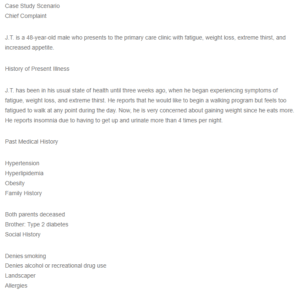
Diabetes Case Study Analysis
Case Study Scenario
Chief Complaint
J.T. is a 48-year-old male who presents to the primary care clinic with fatigue, weight loss, extreme thirst, and increased appetite.
History of Present Illness
J.T. has been in his usual state of health until three weeks ago, when he began experiencing symptoms of fatigue, weight loss, and extreme thirst. He reports that he would like to begin a walking program but feels too fatigued to walk at any point during the day. Now, he is very concerned about gaining weight since he eats more. He reports insomnia due to having to get up and urinate more than 4 times per night.
Past Medical History
Hypertension
Hyperlipidemia
Obesity
Family History
Both parents deceased
Brother: Type 2 diabetes
Social History
Denies smoking
Denies alcohol or recreational drug use
Landscaper
Allergies
No Known Drug Allergies
Medications
Lisinopril 20 mg once daily by mouth
Atorvastatin 20 mg once daily by mouth
Aspirin 81 mg once daily by mouth
Multivitamin once daily by mouth
Review of Systems
Constitutional: – fever, – chills, – weight loss.
Neurological: denies dizziness or disorientation
HEENT: Denies nasal congestion, rhinorrhea, or sore throat.
Chest: (-)Tachypnea. Denies cough.
Heart: Denies chest pain, chest pressure, or palpitations.
Lymph: Denies lymph node swelling.
General Physical Exam
Constitutional: Alert and oriented male in no acute distress
Vital Signs: BP-136/80, T-98.6 F, P-78, RR-20
Wt. 240 lbs., Ht. 5’8″, BMI 36.5
HEENT
Eyes: Pupils equal, round, and reactive to light and accommodation, normal conjunctiva.
Ears: Tympanic membranes intact.
Nose: Bilateral nasal turbinates without redness or swelling. Nares patent.
Mouth: Oropharynx clear. No mouth lesions. Teeth are present and intact; oral mucous membranes and lips are dry.
Neck/Lymph Nodes
Neck supple without JVD.
No lymphadenopathy, masses, or carotid bruits.
Lungs
Bilateral breath sounds clear throughout lung fields. Breathing quality deep with fruity breath odor
Heart
S1 and S2 regular rate and rhythm; – tachycardia; no rubs or murmurs.
Integumentary System
Skin is warm and dry; nail beds are pink without clubbing.
Labs
Test Patient’s Result Reference
Glucose (fasting)
132
60-120 mg/dL
BUN
20
7-24 mg/dL
Creatinine
0.8
0.7-1.4 mg/dL
Sodium
141
135-145 mEq/L
Potassium
3.7
3.5-5.0 mEq/L
Chloride
97
95-105 mEq/L
HCO3
24
22-28 mEq/L
A1C
7.2
Urinalysis
Protein
Glucose
Ketones
Negative
Positive
Negative
Oral glucose tolerance test (OGTT)
220 mg/dL
J.T. is diagnosed with diabetes. Review all information provided in the case to answer the following questions.
Case Study Questions
Pathophysiology & Clinical Findings of the Disease
Review the lab findings and decide if the diagnosis is Type 2 or Type 1 Diabetes Mellitus.
Explain the pathophysiology associated with your chosen diagnosis
Identify at least three subjective findings from the case that support the chosen diagnosis.
Identify at least three objective findings from the case that support the chosen diagnosis.
Management of the Disease
*Utilize the required Clinical Practice Guideline (CPG) to support your treatment recommendations.
Identify two (2) “Evidence A” recommended medication classes for the treatment of this condition and provide an example (drug name) for each.
Describe the mechanism of action for each of the medication classes identified above.
Identify two (2) “Evidence A” recommended non-pharmacological treatment options for this patient.
Utilizes the required Clinical Practice Guideline (CPG) to support the chosen treatment recommendations