
Developing Strategic Alliances with Key Internal and External Stakeholders
The recent merger between the hospital and medical center aimed to consolidate the hospital’s systems and infrastructure to facilitate a higher operating volume and operational efficiency. The economies of scale after an increase in a hospital’s operating volume and resources consolidation after a hospital merger improves the hospital’s productivity and lowers costs of operations, hence having a notable reduction of costs of access to care to patients as well as the quality of care (Freeman et al., 2020). However, the operational efficiency and improvement of health outcomes after a hospital merger can only be achieved by creating strategic alliances with both internal and external stakeholders. In this paper, I will describe the healthcare sector where I work, key internal and external stakeholders impacted by the merger, strategies used to develop relationships with internal and external stakeholders, and guidelines for networking as a healthcare professional.
A Description of the Healthcare Sector in Which I Work
I am currently working in the private healthcare sector. The hospital is fully owned by various investors and shareholders as a form of business in the healthcare sector. As a privately owned health system, the hospital is focused on providing healthcare services to the populations served and meeting the investors’ expectations in terms of returns on their investments. Therefore, the hospital is fully profit-motivated. Although privately owned, the hospital operates in line with the existing national regulations in the health care sectors and ensures that it protects and meets the expectations of both the investors and the patients. The private healthcare sector is also the most regulated by the government in order to protect consumers and workers and ensure that organizations in the private sector compete fairly. The advantages of being in the for-profit sector are the increased opportunities for career and personal development as organizations in this sector continuously invest in their staff and healthcare technologies to achieve a competitive edge in the market. Remarkably, the for-profit healthcare sector is driving major developments and innovations in the healthcare system as it seeks to continuously cover its unique challenges (Dumalanede et al., 2020). The for-profit sector, in general, also adopts various high-performance work practices to improve employee performance and improve stakeholder and consumer satisfaction, including performance incentives, rewards, and recognitions (Guerci et al., 2019). Additionally, to remain competitive in the healthcare sector and provide value to their shareholders, healthcare organizations such as my hospital tend to acquire or merge with other providers, whether for-profit or non-profit.
Key Internal and External Stakeholders
The merger between the hospital and medical center has various stakeholders. Key stakeholders are critical for the success of the hospital merger. The key stakeholders are categorized as either internal and external. The internal stakeholders include the stakeholders working inside the hospital and supporting its operations. These stakeholders are directly impacted by the merger and provide expert input to the success of the merger. The key internal stakeholders include the physicians, the nursing staff, the hospital and medical center’s management, the chief finance officer, and other executives.
On the other hand, the external key stakeholders are the stakeholders impacted by the merger but are not employed or a part of the internal operations of the hospital. The key external hospital stakeholders include the patients, the community, suppliers such as insurance providers, medical equipment manufacturers, pharmaceutical companies, and special interest groups directly influencing the merger’s direction, such as the government. Although not a part of the merger’s internal team, they influence the merger as they determine the direction of the services the hospital will provide after the merger and must be considered for all service and product decisions made during and after the merger.
Strategies for Developing Relationships with Internal and External Stakeholders
Various strategies were used to develop strategic and working relationships with the internal and external stakeholders. The major strategy used was timely and open communication. Communication was ensured at all levels throughout the merger process, including from the point the merger was initiated through the announcement of the merger deals and closure of the merger deal. Different strategies were also employed and tailored to meet the needs of each stakeholder group as well as the stage during the merger process. The overall communication ensured that it captured the important details related to the merger, including the importance of the merger, expected benefits for each stakeholder group, and how the merger would impact each stakeholder group. The communication methods adopted also allowed the receiving and giving of feedback with regard to the merger. The use of feedback allowed the hospital’s executives to understand the stakeholders’ position on the merger and their motivation after the merger. The timely and open communication with internal and external stakeholders was also facilitated by using modern technology to support the sharing of information, including emails, social media platforms, and groups, and the sharing of short code messages to targeted recipients. Notably, the use of new communication tools, such as the Internet and social networking, has been found to help corporations effectively manage stakeholders online while easing communication (Pedrini & Ferri, 2019).
Guidelines on Networking through Different Venues
Networking is beneficial to one’s career as a healthcare professional. Whether in online events, conferences, social media, professional meetings, or social events, networking can provide new opportunities for learning, work, better-paying jobs, and people to exchange career experiences with. Successful networking can be achieved in three different stages. First, one needs to get ready for the event fully. This includes understanding the objectives of the networking event, dressing up for the theme, and having ready contact information. The second stage includes meeting up with people and getting to connect with them at a personal and professional level. It is important for healthcare professionals to share contact information with the ones they connect with. Finally, after the event, the professional can take time to contact the people they had connected with and planned to communicate with during the event.
References
Dumalanede, C., Hamza, K., & Payaud, M. (2020). Improving healthcare services access at the bottom of the pyramid: the role of profit and non-profit organizations in Brazil. Society and Business Review, 15(3), 211–234. https://doi.org/10.1108/SBR-10-2018-0118/FULL/XML
Freeman, M., Savva, N., & Scholtes, S. (2020). Economies of Scale and Scope in Hospitals: An Empirical Study of Volume Spillovers. Management Science, 67(2), 673–697. https://doi.org/10.1287/MNSC.2019.3572
Guerci, M., Hauff, S., & Gilardi, S. (2019). High-performance work practices and their associations with health, happiness, and relational well-being: are there any tradeoffs? The International Journal of Human Resource Management, 33(2), 329–359. https://doi.org/10.1080/09585192.2019.1695647
Pedrini, M., & Ferri, L. M. (2019). Stakeholder management: a systematic literature review. Corporate Governance (Bingley), 19(1), 44–59. https://doi.org/10.1108/CG-08-2017-0172/FULL/XML
ORDER A PLAGIARISM-FREE PAPER HERE
We’ll write everything from scratch
Question 
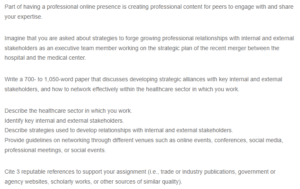
Developing Strategic Alliances with Key Internal and External Stakeholders
Part of having a professional online presence is creating professional content for peers to engage with and share your expertise.
Imagine that you are asked about strategies to forge growing professional relationships with internal and external stakeholders as an executive team member working on the strategic plan of the recent merger between the hospital and the medical center.
Write a 700- to 1,050-word paper that discusses developing strategic alliances with key internal and external stakeholders, and how to network effectively within the healthcare sector in which you work.
Describe the healthcare sector in which you work.
Identify key internal and external stakeholders.
Describe strategies used to develop relationships with internal and external stakeholders.
Provide guidelines on networking through different venues such as online events, conferences, social media, professional meetings, or social events.
Cite 3 reputable references to support your assignment (i.e., trade or industry publications, government or agency websites, scholarly works, or other sources of similar quality).