
Data Collection Method-Asian American Population
Description of the Asian American Population
According to Mental Health America, Inc. (2021), more than 20 million people identify as Asian Americans in the U.S., including those of Chinese descent, Filipino descent, Indian descent, Japanese descent, Korean descent, and Vietnamese descent. In 2018, Mental Health America (2021) found that 10.8% of this social group lived below or at the poverty level, with 6.2% without health insurance. Myriads of research studies show that Asian American young adults, youth, and even adolescents have higher rates of suicidal thoughts, depression, and anxiety, as well as other mental disorders, than their European and American counterparts (Choi et al., 2020; SAMHSA 2021; Miller et al., 2011; Murphy-Shigematsu, Wakimoto & Wang, 2012; Nishi, 2012). In the U.S., the rate at which Asian Americans access mental health treatment is less than half that of their other racial-ethnic counterparts (Yang et al., 2020). Therefore, across the racial-ethnic minority populations, Asian Americans are arguably rated the lowest when it comes to having mental health care. One key reason for the high rates of mental disorders among this social group is acculturation, which affects their cultural orientation, relationships, values, language, personality, cognition, attitudes, and behaviors (Hwang & Ting, 2008). This and a lower perceived need for health treatment among Asian Americans pose a need for culturally sensitive interventions to enhance mental health treatment among this social group.
Data Collection Method
The most appropriate data collection method would be a survey that would include recruiting Asian Americans over the age of 18 through professional organizations, communities, universities, and associations across the United States. Participants would be asked to complete an electronic informed consent document and an anonymous web-based questionnaire. This method is used in order to reach as many populations of this social group as possible without wasting too much time with physical interactions. Besides, participants from various places, including communities, universities, associations, and professional organizations, are targeted in this survey to capture the experiences deemed relevant to the strategies of coping with stress and the perceived sources of stress.
Type of Data to be Collected
The type of data that would be collected would entail both quantitative and qualitative. For quantitative, this is because the survey will entail numbers of people who identify as Asian Americans, including Chinese descent people, Filipino descent, Indian descent, Japanese descent, Korean descent, and Vietnamese descent. Moreover, data about those who have bachelor’s degrees will be collected, and the numbers of those who live below the poverty level, those employed, those with employed parents/guardians, their income level, and those with or without health insurance. For qualitative data collection, the attitudes of this social group will be considered, including their mental health needs knowledge, their family decision-making, languages spoken, those that speak English and those that do not, as well as the gender roles in their families.
Health Indicators
The health indicators that will be used for Asian Americans include medical insurance coverage, drug/alcohol use problems, suicidal thinking, and eating habits. In addition to work schedules, coping with daily stress, sleeping patterns, adaptability to the new environment, cultural beliefs, mood changes, feelings of sadness, finding it difficult to make decisions, and ability to concentrate at work or in class.
Example Questions Used in Data Collection and Rationale
- What is your age category? (Below 18; 18-25; 25-30; 30-45; over 45)
This will help in identifying the age of the respondents so that they qualify for the study. This is because it is assumed that those below the age of 18 are probably under the care of their parents and may not really comprehend mental health issues.
- What ethnic group do you identify with? (Chinese, Indian, Filipino, Japanese, Korean, Vietnamese, Black/African, White, Other- specify)
This will help in categorizing the sample so that the study sticks to Asian Americans only.
- Who is the main decision-maker in your family?
This question will help the researcher identify gender roles in the family, especially when it comes to matters such as health.
- Is any member of your family diagnosed or was considered mentally ill in the past and present? If so, how did you address it? Did you seek any mental health treatment or interventions? What kind? Why/why not?
These questions will help in identifying if the respondent has any encounter experience with mental illness and understand how they handle problems associated with mental illness. This will also help know if the respondent and their families have sought any medical attention in regards to the problem.
- Do you and your family have any medical insurance coverage?
This will be used as a determinant factor for mental healthcare intervention reasons.
- Where do you live? Are there any mental healthcare institutions and services available in your community?
This will help in understanding the role of mental healthcare services availability in seeking mental health interventions. This will also measure the proximity of Asian Americans to healthcare services institutions.
- When did you and your family establish residency in America? Are you a citizen? How did you find your interaction with the rest of the community?
These questions will help the researcher to understand the period that the respondent has spent in the U.S. and how they have coped with the other population groups. This will help in understanding their process of acculturation.
- Have you ever been admitted to a hospital, and for what reasons?
Conclusion
In conclusion, a proper understanding of the culture and beliefs of Asian Americans is required to help the community seek mental health interventions competently. This is because the community has strong cultural values, and this is partly why they have difficulties assimilating into the general population. Besides, it is also important to collect data on the other factors that may contribute to their reluctance or low rate of seeking mental health care, including their proximity to healthcare institutions, their education level, their perceptions towards mental health, the availability of healthcare centers in their residential places, if or not they have medical insurance cover and their length of stay in the United States.
References
Choi, Y., Park, M., Noh, S., Lee, J. P., & Takeuchi, D. (2020). Asian American mental health: Longitudinal trend and explanatory factors among young Filipino-and Korean Americans. SSM-population health, 10, 100542.
Hwang, W. C., & Ting, J. Y. (2008). Disaggregating the effects of acculturation and acculturative stress on the mental health of Asian Americans. Cultural Diversity and Ethnic Minority Psychology, 14(2), 147.
Mental Health America, Inc. (2021). Asian American/Pacific Islander Communities and Mental Health. Retrieved 20/9/2021 from https://www.mhanational.org/issues/asian-americanpacific-islander-communities-and-mental-health
Miller, M. J., Yang, M., Farrell, J. A., & Lin, L. L. (2011). Racial and cultural factors affecting the mental health of Asian Americans. American Journal of Orthopsychiatry, 81(4), 489.
Murphy-Shigematsu, S., Sein, K., Wakimoto, P., & Wang, M. (2012). Asian American student stress: The other side of achievement.
Nishi, K. (2012). Mental Health among Asian-Americans. American Psychological Association.
Substance Abuse and Mental Health Services Administration- SAMHSA (2021). Asian American, Native Hawaiian, and Pacific Islander (AANHPI). Retrieved 20/9/2021 from https://www.samhsa.gov/behavioral-health-equity/aanhpi
Yang, K. G., Rodgers, C. R., Lee, E., & Lê Cook, B. (2020). Disparities in mental health care utilization and perceived need among Asian Americans: 2012–2016. Psychiatric Services, 71(1), 21-27.
ORDER A PLAGIARISM-FREE PAPER HERE
We’ll write everything from scratch
Question 
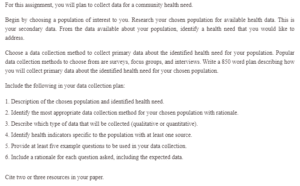
For this assignment, you will plan to collect data for a community health need.
Data Collection Method-Asian American Population
Begin by choosing a population of interest to you. Research your selected population for available health data. This is your secondary data. From the data available about your people, identify a health need that you would like to address.
Choose a data collection method to collect primary data about the identified health needs of your population. Popular data collection methods to choose from are surveys, focus groups, and interviews. Write an 850-word plan describing how you will collect primary data about the identified health needs of your selected population.
Include the following in your data collection plan:
- Description of the chosen population and identified health needs.
- Identify the most appropriate data collection method for your selected population with rationale.
- Describe which type of data that will be collected (qualitative or quantitative).
- Identify health indicators specific to the people with at least one source.
- Provide at least five example questions to be used in your data collection.
- Include a rationale for each question asked, including the expected data.
Cite two or three resources in your paper.