
Crossover Artists – Luther Vandross and Elvis Presley
Essay 1: Luther Vandross “Dance with My Father” 2003
Introduction
Luther Vandross’s “Dance with My Father” (2003) is a powerful ballad that blends soul, R&B, and emotional storytelling. The song reflects Vandross’s longing for his late father and is a poignant tribute to love, loss, and family connections. It showcases his vocal talent and reflects on nostalgia themes while also making a significant cultural impact. This analysis explores the social and political context, musical influences, and connections to earlier rock and roll styles.
Social/Political Context
Released in 2003, “Dance with My Father” came at a time when R&B and soul music were experiencing a resurgence in mainstream popularity. The early 2000s were a cultural shift towards introspection and personal narratives within music, a yearning for stability, home, and emotional attachment (Hunke et al., 2025). The song centers on familial love, nostalgia, and grief, touching on the universal experience of losing a loved one. In the context of the early 2000s, when the world was still reeling from the 9/11 tragedy and its aftermath, “Dance with My Father” resonated as a heartfelt message of healing and memory, offering solace through music. Vandross’s sincere performance and the song’s reflective nature made it not just a personal tribute but also a larger reflection of the emotional and cultural landscape of the time.
Musical Styles and Influences
Musically, “Dance with My Father” is a classic soul ballad with elements of R&B and soft pop. It showcases Vandross’s vocal prowess, with his smooth tenor voice guiding the song’s heartfelt lyrics. The instrumental arrangement features lush orchestration, a soft piano melody, and a gentle rhythm section. The song’s blend of soul, jazz, and orchestral elements reflects the influence of classic 1960s and 1970s soul music, while the production style nods to the smooth, polished sound of 1980s R&B. The song was influenced by Vandross’s experiences growing up in a musical environment and the iconic soul music of artists like Stevie Wonder and Marvin Gaye. The ballad’s orchestral feel also recalls the work of other R&B legends such as Otis Redding, whose emotional delivery and blend of soul and blues helped shape Vandross’s musical identity.
Connections to Past Rock and Roll Styles
While “Dance with My Father” is not traditionally categorized as rock and roll, it draws upon many elements from earlier rock and roll styles, particularly those rooted in rhythm and blues. Rock and roll, particularly in the 1950s and 1960s, was known for its emotional depth and the use of powerful vocals (Aquila, 2024). Artists like Ray Charles and Sam Cooke blended soulful melodies with bluesy undertones, creating a foundation for Vandross’s vocal approach. Additionally, the orchestration in “Dance with My Father” refers to the lush arrangements of late-1960s soul and pop, which was influenced by the broader rock and roll landscape. In this sense, Vandross’s song can be seen as an evolution of the soul and rhythm and blues sounds integral to the rock and roll genre, showcasing how rock’s emotional authenticity continued to resonate through generations.
Conclusion
Luther Vandross’s “Dance with My Father” poignantly reflects love, loss, and family, resonating with audiences through its emotional depth and musical sophistication. The song’s blend of classic soul influences and contemporary R&B production creates a timeless sound that connects with the rich history of rock and roll. Vandross’s ability to convey personal experience through his music underscores his role as a key figure in the evolution of soul and R&B.
Essay 2: Elvis Presley’s “Heartbreak Hotel” (1956)
Introduction
“Heartbreak Hotel,” released in 1956, is one of Elvis Presley’s greatest songs, a turning point for the rock and roll genre. “Heartbreak Hotel” was penned by Mae Boren Axton, Tommy Durden, and Elvis Presley. It is a melancholic tale with Elvis’s heart-wrenching voice. Its innovative style combines rockabilly, blues, and country, a sound that inspired thousands of artists. This analysis will discuss the songwriters, music style, and history, demonstrating how “Heartbreak Hotel” helped solidify its place in rock history through its creator.
Songwriters and Significance
“Heartbreak Hotel” was penned by Mae Boren Axton, Tommy Durden, and Elvis Presley. Axton, a former schoolteacher and music promoter, played a key role as a mentor to Presley’s early career and brought the Heartbreak Hotel song to him (Kosser, 2022). Inspiration was provided by Durden, who was inspired by the suicide of a man, from a news story. Presley’s delivery of the song gave it life, with the somber and melancholic melody of the music at the time a precursor to its huge success. Its emotional appeal, with additional depth provided by Presley’s delivery while interpreting the song, marked a turning point regarding rock and roll history.
Musical Style and Classification
Heartbreak Hotel represents rockabilly, a mix of rock and roll, country, and blues. Presley’s passionate and soulful vocals were matched with a minimalist but forceful arrangement, with a walking bass line and reverb-rich guitar (McParland, 2022). Melancholic mood is juxtaposed with the energetic rock songs of the day, making it stand apart from the rest. Rock music would later be shaped by the emotional intensity of the song as well as the innovative mixing of genres, with Presley being one of the leading pioneers of rock development.
Historical Significance
Heartbreak Hotel represents a turning point in the evolution of rock and roll. The song was issued in 1956 as Presley’s first No. 1 hit single on the Billboard Pop chart (Covach & Flory, 2018). Its success was a turning point for rock and roll, introducing a more emotional, introspective sound. Presley’s versatility, through incorporating a wide range of musical styles with raw, open emotions, paved the way for more diversity in rock music. It also secured his place as the King of Rock and Roll, making him a legend for decades to come while creating a pivotal point in the history of popular music. “Heartbreak Hotel” marked a transition from the jubilant, lighthearted rockabilly hits of the time to a heavier, more emotionally charged songwriting style. Its success proved that rock music could tackle themes of despair, heartbreak, and vulnerability, expanding the genre’s emotional reach. Consequently, the song was a career-defining milestone for Presley and a benchmark for rock music, paving the way for rock as a genre capable of incorporating raw emotion with musical creativity.
Conclusion
In summary, “Heartbreak Hotel” is a landmark rock and roll history moment. Authored by Mae Boren Axton, Tommy Durden, and Elvis Presley, the song’s blend of genres and emotional intensity distinguished it from the music of its time. Its success and Presley’s performance assuredly reshaped rock and roll while establishing him as a cultural legend. “Heartbreak Hotel” continues to be a seminal song for comprehending the development of popular music and its impact on artists of subsequent generations.
References
Aquila, R. (2024). That Old-Time Rock & Roll: A Chronicle of an Era, 1954-63. University of Illinois Press.
Covach, J. & Flory, A. (2018). What’s that sound? An introduction to rock and its history. (4th Ed.) W.W. Norton & Company, New York, NY.
Hunke, T., Huber, F., & Steffens, J. (2025). The Evolution of Song Lyrics: An NLP-Based Analysis of Popular Music in Germany from 1954 to 2022. Music & Science, 8. https://doi.org/10.1177/20592043251331155
Kosser, M. (2022). How Nashville Became Music City, USA: A History of Music Row, Updated and Expanded. Rowman & Littlefield.
McParland, R. (2022). Singer-songwriters of the 1970s: 150+ Profiles. McFarland.
ORDER A PLAGIARISM-FREE PAPER HERE
We’ll write everything from scratch
Question 
Crossover Artists – Luther Vandross and Elvis Presley
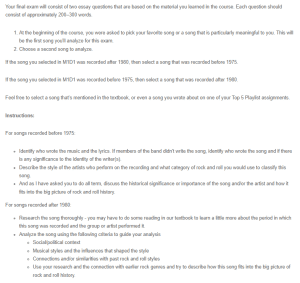
Your final exam will consist of two essay questions that are based on the material you learned in the course. Each question should consist of approximately 200–300 words.
Crossover Artists – Luther Vandross and Elvis Presley
- At the beginning of the course, you were asked to pick your favorite song or a song that is particularly meaningful to you. This will be the first song you’ll analyze for this exam.
- Choose a second song to analyze.
If the song you selected in M1D1 was recorded after 1980, then select a song that was recorded before 1975.
If the song you selected in M1D1 was recorded before 1975, then select a song that was recorded after 1980.
Feel free to select a song that’s mentioned in the textbook, or even a song you wrote about on one of your Top 5 Playlist assignments.
Instructions:
For songs recorded before 1975:
- Identify who wrote the music and the lyrics. If members of the band didn’t write the song, identify who wrote the song and if there is any significance to the identity of the writer(s).
- Describe the style of the artists who perform on the recording and what category of rock and roll you would use to classify this song.
- And as I have asked you to do all term, discuss the historical significance or importance of the song and/or the artist and how it fits into the big picture of rock and roll history.
For songs recorded after 1980:
- Research the song thoroughly – you may have to do some reading in our textbook to learn a little more about the period in which this song was recorded and the group or artist performed it.
- Analyze the song using the following criteria to guide your analysis
- Social/political context
- Musical styles and the influences that shaped the style
- Connections and/or similarities with past rock and roll styles
- Use your research and the connection with earlier rock genres and try to describe how this song fits into the big picture of rock and roll history.