
Critique of Quantitative Article-Family Contexts and Sleep During Adolescence
Healthy People 2020 highlights the significance of sleep health in promoting the health of communities. It focuses on increasing communities’ knowledge of the importance of sleep adequacy in health maintenance and preservation. These provisions form the basis of the arguments by Schmeer et al. (2019) in the article “Family Contexts and sleep during Adolescence.” This article explores inter-individual sleep variations among adolescents as a factor in their family environment. According to the article, adolescents living in families with low socioeconomic status, unmarried parents, low economic security, and high caregiver stress are more likely to demonstrate intra-individual sleep variation. The authors conclude that family, economic, and social contexts are contributory to sleep disorders among adolescents. This paper critiques this article.
Statistical Power
The article’s findings and documentation revealed that there was adequate statistical power. The authors hypothesized that teenagers living in unmarried-parent and low socioeconomic families have high variability in their night sleep duration. The study utilizes a large sample size and effectively determines that unmarried parenthood and low socioeconomic status are drivers of sleep-associated problems among teenagers. In the study, the independent variables were marital status and socioeconomic status. The operationalization of the independent variable created a contrast in the statistical power. Per the study, marital status and socioeconomic status were found to have a predilection on the nature of sleep adolescents had. The study also utilized confounding variables to enhance its precision. The control variables employed include the gender and age of the participants. The study outcomes supported the hypothesis, thereby reinforcing the statistical validity of the study.
Intervention Fidelity
Intervention fidelity is integral to all research studies. An et al. (2020) note that intervention fidelity is an essential methodologic consideration in randomized and non-randomized studies as it ensures reliability and stamps the validity of the findings. A research is said to have observed intervention fidelity if it employs a protocol or a guideline in its executions, identifies the study methodology to be used, and identifies a standardized plan to measure and assess its outcomes (An et al., 2020). The study of focus, in this case, utilized the Adolescent Health and Development in Context (AHDC) study protocol in executing its research approach. Schmeer et al. (2019) also clearly define the protocol in their study. Additionally, the authors indicate the methodology utilized in the study along with a standardized plan to analyze the research findings. The article can thus be said to have observed intervention fidelity.
Eliminating Selection Biases
Selection biases are the leading causes of validity compromises in primary research. These biases affect the external validity of the research findings and may result in inaccurate representations and estimations of the relationships between the variables used in the study (Enzenbach et al., 2019). The study by Schmeer et al. (2019) utilized human participants in its execution. Ecological momentary assessments were randomly used to obtain the sleep patterns of the participants. While the study report indicates how it minimized biases among the study participants, it does not indicate how biases were eliminated during the selection of the participants. Notwithstanding, random ecological momentary assessments were adequate in minimizing confounding participants’ characteristics that may have affected the equivalence of the group being compared.
Internal Validity
Internal validity seeks to verify the cause-and-effect relationship between the research outcome and the test situations. The research design in the article ruled out the plausibility of other threats to internal validity by using a large sample size and including a control group in the study. Overall, the study demonstrated internal validity. Using a large sample size coupled with the control variable ensured that the findings were accurate representations of intra-individual variability in the sleep patterns among adolescents.
Construct Validity
Construct validity details the extent to which a test in research measures what it was meant for. The study findings were mainly based on ecological momentary assessments (EMA). EMA can be impacted negatively by the participant’s history, emotions at the time of assessment, and other intraindividual factors affecting an individual’s behaviours. These may have a bearing on what the research measures. In the intervention studies, there was a good match between the underlying conceptualization and the operationalization of the study. The study was founded on theoretical postulates on sleep behaviour and other studies’ findings on factors affecting sleep behaviors among adolescents. It was also confounded with extraneous content, such as the researcher’s expectations, as evident in the working hypothesis and the assumptions made during the study. The study setting was the community, which allowed for a more accurate representation of adolescent sleep behaviour.
The Context of the Study
The context of the study allowed for external validity. The study was conducted in a community setting. The participants selected all fell within the study parameters and were subjected to near similar environmental influences. These gave the researchers a good insight into the relationship between the research variables and the outcomes. Additionally, a large sample size was used for the study. These factors enhanced the external validity of the study. Findings from these studies can thus be generalized.
Overall, the researcher balanced the validity concerns of the study. Due considerations were given to internal validity threats such as maturation, history, and instrumentation. In the study, all participants were notified of the study. The study was also administered within similar time frames, with each participant allowed to give their results within a week. These enhanced the accuracy of the information they provided to the researcher. External validity concerns were also taken care of. The utilization of a large sample size adequately addressed the external validity concerns.
References
An, M., Dusing, S. C., Harbourne, R. T., & Sheridan, S. M. (2020). What works in intervention? Using fidelity measures to support optimal outcomes. Physical Therapy, 100(5), 757–765. https://doi.org/10.1093/ptj/pzaa006
Enzenbach, C., Wicklein, B., Wirkner, K., & Loeffler, M. (2019). Evaluating selection bias in a population-based cohort study with low baseline participation: The life-adult-study. BMC Medical Research Methodology, 19(1). https://doi.org/10.1186/s12874-019-0779-8
Schmeer, K. K., Tarrence, J., Browning, C. R., Calder, C. A., Ford, J. L., & Boettner, B. (2019). Family contexts and sleep during adolescence. SSM – Population Health, 7, 100320. https://doi.org/10.1016/
ORDER A PLAGIARISM-FREE PAPER HERE
We’ll write everything from scratch
Question 
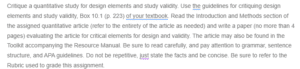
Critique a quantitative study for design elements and study validity.
Critique of a Quantitative Article-Family Contexts and Sleep During Adolescence
Use the guidelines for critiquing design elements and study validity.