
Comprehensive Focused SOAP Psychiatric Evaluation
Subjective:
CC (chief complaint): The patient reports constantly worrying about his mom and brother. Additionally, he experiences recurrent nightmares in which he is lost and cannot find his brother and mother.
HPI: The patient (Dev Cordoba) is a seven-year-old male. He presents with a chief complaint of worrying about his mom and brother. Additionally, he experiences recurrent nightmares in which he is lost and cannot find his brother and mother. According to him, he is ever worried about everything. Dev Cordoba is afraid that, just like his dad, his mother will not return home. This has affected his academics significantly. He reports that this condition (worry) has affected his concentration, as evidenced by regular complaints from his teacher. He rarely focuses while in class and is always looking out the window.
Furthermore, the patient has a bad relationship with his peers at school. He has been nicknamed Mr Smelly, and he reports that he threw his book at Billy. Miss Cordoba says that Dev is always worried and anxious about her.
Additionally, Dev feels he loves his little brother more than he does. Dev has difficulty sleeping and sleeps with the lights on and open the door. According to Miss Cordoba, Dev has poor nutritional habits and has shed approximately three pounds over three weeks. Additionally, the patient is on medication for nocturnal enuresis. The patient denies any suicidal ideations and thoughts of harming others.
Substance Current Use: None
Medical History:
- Current Medications: Desmopressin (DDVAP) for nocturnal enuresis.
- Allergies: No known drug and food allergies.
- Reproductive Hx: No pertinent history
ROS:
- GENERAL: The patient has lost three pounds over the last three weeks—no chills, weakness, or fever.
- HEENT: Normal visual acuity, no blurred vision, conjunctivitis, or diplopia. Normal hearing function. No running nose or rhinitis. No pharyngitis or mucosal inflammation.
- SKIN: No pruritus, rashes, ulcers, pallor, or bruises.
- CARDIOVASCULAR: No tachycardia, bradycardia, or heart gallop.
- RESPIRATORY: No difficulty breathing, orthopnea, dyspnea, or sputum production.
- GASTROINTESTINAL: The patient reports frequent stomachaches—no nausea, vomiting, constipation, diarrhea, or melena.
- GENITOURINARY: No dysuria, polyuria, lesions, or anuria. Nocturnal enuresis was reported.
- NEUROLOGICAL: The patient claims to have headaches frequently—no drowsiness, syncope paresthesia, or ataxia.
- MUSCULOSKELETAL: No myalgia, spasms, arthralgia, or myositis.
- HEMATOLOGIC: No anemia, polycythemia, or bleeding.
- LYMPHATICS: Normal lymphatic drainage
- ENDOCRINOLOGIC: No polyphagia, polydipsia, hyperhidrosis, or cold intolerance.
Objective:
Diagnostic results: The patient manifests adequate orientation to time and place. His thoughts and speech are organized, and he responds to all questions objectively. He demonstrates signs and symptoms of anxiety and stress-related disorder.
Assessment:
Mental Status Examination: The patient reported the patient’s previous physical appearance. He is cooperative and responds to the psychiatrist’s questions with adequate use of verbal and non-verbal communication cues. His speech and thoughts are organized.
Diagnostic Impression: The patient’s possible patients include separation anxiety disorder (SAD), generalized anxiety disorder, and post-traumatic stress disorder. The patient’s signs and patients involve worrying, anxiety, nightmares, and difficulty sleeping. According to the DSM-5-TR, a patient with SAD should fulfill at least three components of the diagnostic criteria (Lavallee & Schneider, 2019). Firstly, the patient experiences periodic distress when they anticipate or are separated from their homes or attachment figures. Secondly, the patient is worried about losing people they are attached to or concerned that these people may get hurt (Lavallee & Schneider, 2019). Thirdly, the patient is concerned about facing a disastrous event that can separate them from the people they are attached to. An example of such a devastating event is getting lost. Fourthly, the patients are reluctant to leave their homes since they fear separation from the people they are attached to (Edwards, 2021). Fifthly, the patient is afraid of sleeping without a critical attachment figure. According to the DSM-5-TR diagnostic criteria, patients with separation anxiety disorder experience nightmares entailing separation from key attachment figures (Edwards, 2021).
Furthermore, patients with SAD present with manifestations such as headaches and stomachaches when they anticipate separation from close relatives (Edwards, 2021). In the context of Dev Cordoba, he fulfills at least three DSM-5 diagnostic criteria for SAD. Notably, he reports headaches and stomach when he anticipates separation from his mom, he has nightmares entailing separation from his mom and brother, and he is always worried about losing his mom and brother. As such, Dev Cordoba has a separation anxiety disorder.
According to the DSM-5-TR diagnostic criteria for generalized anxiety disorder (GAD), a patient presents with three significant manifestations. Firstly, the patient is excessively anxious and worried about various issues (Glasofer, 2022). The patient is usually worried overly for at least six months. Secondly, the patient’s worry is patient and shifts from one issue to another (Glasofer, 2022). Thirdly, a patient’s fear and anxiety are comopatient’s at least three other manifestations. These manifestations include restlessness, fatigue, irritability, and difficulty sleeping (Glasofer, 2022). This diagnosis is ruled out by the fact that the patient (Dev Cordoba) worries and is due to a specific reason (fear of separation) rather than a variety of themes.
According to the DSM-5-TR diagnostic criteria for post-traumatic stress disorder, a definitive diagnosis is made when a patient fulfills specific provisions. Firstly, the patients should have been exposed to a traumatic event (Rothbaum, 2021). Secondly, a patient should present with at least one intrusion symptom (Rothbaum, 2021), and thirdly, patients should contribute with at least one avoidance symptom (Rothbaum, 2021). Fourthly, patients should contribute with at least two negative symptoms (Rothbaum, 2021). Fifthly, a patient should present with at least two symptoms that signify a change in arousal or reactivity (Rothbaum, 2021). This diagnosis is ruled out by the fact that the patient (Dev Cordoba) lacks prior exposure to a traumatic event.
I selected separation anxiety disorder as the primary diagnosis because Dev Cordoba’s presenting complaints are consistent with the DSM-5-TR diagnostic criteria. He reports headaches and stomach when he anticipates separation from his mom; he has nightmares entailing separation from his mom and brother and is always worried about losing his mom and brother. As such, Dev Cordoba has a separation anxiety disorder.
Reflections: If I could conduct the session again, I could take a more comprehensive history of presenting complaints. Firstly, I would have sought to know when the patient’s anxiety and worry startpatient’sinformation can help to rule out other differential diagnoses, such as generalized anxiety disorder. Furthermore, I would probe the patient to rule out the possibility of selective mutism. If I followed up with the patient, I would assess his adherence to the treatment plan and prognosis. Notably, I would evaluate the presence of any adverse events, the progress of the patient’s anxiety and worry, and the patient’s symptoms associated with the patient’s separation anxiety. disopatient’sitionally, I would evaluate the patient’s social functioning. I wrote the principles of healthcare ethics: autonomy, beneficence, non-maleficence, and justice when dealing with the patient and his family (mother). I would also uphold the provisions of the Health Insurance Portability and Accountability Act of 1996 during the electronic transmission of patient information. The patient’s mother should be educated on pharmaceutical and non-pharmaceutical treatment plan compliance.
Case Formulation and Treatment Plan:
Both pharmaceutical and non-pharmaceutical treatment plans can be used to manage this patient. Relevant non-pharmaceutical approaches include relaxation techniques, cognitive therapy, psychological therapy, and social therapy (Creswell et al., 2020). Findings indicate that cognitive behavioral therapy shortens the course of treatment and is associated with the best prognosis (Creswell et al., 2020). Psychological treatment targets both the patient and family members. Social therapy helps identify other issues that could worsen the patient’s signs and symptoms. Social treatment will help the patient determine whether the school environment impacts the patient significantly. The only US Food and Drug Administration (FDA) approved pharmacological approach is using fluoxetine, a selective serotonin reuptake inhibitor (Lavallee & Schneider, 2019). Fluoxetine is the only FDA-approved agent for patients below 18 years old (Lavallee & Schneider, 2019). Other Non-FDA-approved medications include beta-adrenergic antagonists, alpha-adrenergic antagonists, and nonbarbiturate medications such as buspirone (Creswell et al., 2020). Patient follow-up will be conducted after every three weeks. This will facilitate monitoring of the patient’s response to the treatment plan. Patient education is achieved via various strategies. Firstly, the patient’s mother will be educated on the importance of a patient’s treatment plan. Secondly, the patient will be educated on the significance of non-pharmaceutical approaches such as social therapy.
References
Creswell, C., Waite, P., & Hudson, J. (2020). Practitioner Review: Anxiety disorders in children and young people – assessment and treatment. Journal of Child Psychology and Psychiatry and Allied Disciplines, 61(6), 628–643. https://doi.org/10.1111/jcpp.13186
Edwards, R. (2021). How Separation Anxiety Is Diagnosed. https://www.verywellhealth.com/separation-anxiety-diagnosis-tests-screening-and-criteria-5184476
Glasofer, R. D. (2022). Generalized Anxiety Disorder: Symptoms and DSM-5 Diagnosis. https://www.verywellmind.com/dsm-5-criteria-for-generalized-anxiety-disorder-1393147
Lavallee, K. L., & Schneider, S. (2019). Separation anxiety disorder. In Pediatric Anxiety Disorders (Vol. 5). Elsevier Inc. https://doi.org/10.1016/B978-0-12-813004-9.00008-6
Rothbaum, B. (2021). Understanding DSM-5 Criteria for PTSD: A Disorder of Extinction. https://psychotherapyacademy.org/pe-trauma-training-ptsd/understanding-dsm-5-criteria-for-ptsd-a-disorder-of-extinction/
ORDER A PLAGIARISM-FREE PAPER HERE
We’ll write everything from scratch
Question 
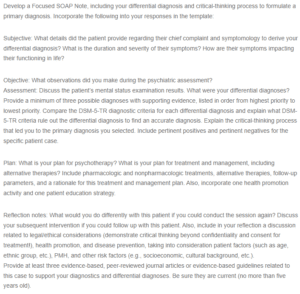
Develop aWe’llsed SOAP Note, including your differential diagnosis and critical-thinking process to formulate a primary diagnosis. Incorporate the following into your responses in the template:
Subjective: What details did the patient provide regarding their chief complaint and symptomology to derive your differential diagnosis? What is the duration and severity of their symptoms? How are their symptoms impacting their functioning in life?
Comprehensive Focused SOAP Psychiatric Evaluation
Objective: What observations did you make during the psychiatric assessment?
Assessment: Discuss the patient’s mental status examination results. What were the patient’s recent diagnoses? Provide a minimum of three possible diagnoses with supporting evidence, listed in order from highest priority to lowest priority. Compare the DSM-5-TR diagnostic criteria for each differential diagnosis and explain what DSM-5-TR criteria rule out the differential diagnosis to find an accurate diagnosis. Explain the critical-thinking process that led you to the primary diagnosis you selected. Include pertinent positives and pertinent negatives for the specific patient case.
Plan: What is your plan for psychotherapy? What is your plan for treatment and management, including alternative therapies? Include pharmacologic and nonpharmacologic treatments, alternative therapies, follow-up parameters, and a rationale for this treatment and management plan. Also, incorporate one health promotion activity and one patient education strategy.
Reflection notes: What would you do differently with this patient if you could conduct the session again? Discuss your subsequent intervention if you could follow up with this patient. Also, include in your reflection a discussion related to legal/ethical considerations (demonstrate critical thinking beyond confidentiality and consent for treatment!), health promotion, and disease prevention, taking into consideration patient factors (such as age, ethnic group, etc.), PMH, and other risk factors (e.g., socioeconomic, cultural background, etc.).
Provide at least three evidence-based, peer-reviewed journal articles or evidence-based guidelines related to this case to support your diagnostics and differential diagnoses. Be sure they are current (no more than five years old).