
Complementary and Alternative Medicine (CAM)
Define CAM
Complementary and alternative medicine describes practices and medicinal products not used in standard medical care. Complementary medicine is used with traditional care practices (NIH, 2021). An example is acupuncture, which is used to lessen cancer treatment side effects. On the other hand, alternative medicine is utilized instead of standard care practices (NIH, 2021). An example is using herbs to cure cancer.
Describe the patient who uses CAM the most.
Individuals from all backgrounds use CAM. It is, however, used by more women compared to men (NIH, 2021). Individuals with higher income and educational levels also prefer using CAM (NIH, 2021). Even though it is popular among all ages, most people who utilize CAM are aged thirty-five years and above. CAM is also commonly used in hospice and palliative care settings (NIH, 2021).
List some common misconceptions about CAM.
- Alternative medicine practices are the only alternative- Most doctors and other Western medicine healthcare professionals work with alternative medicine practitioners to coordinate care.
- Holistic medicine is not practiced as mainstream medicine
- Natural doctors do not utilize conventional medical practices
- Alternative medicine is not effective
- Big and established medical organizations are against alternative medicine (Cohen, 2015).
Identify methods of including the use of CAM in patient education.
Before initiating a patient on CAM, the healthcare professional should give the patient all the necessary information. The clinician should advise the patient of safety issues related to CAM. In addition to this, the clinician should inform the patient that CAM should not be substituted with contemporary medicine. These two can be integrated. Finally, the clinician should educate the patient on the possible side effects of CAM therapies, such as herbal preparations.
Discuss the safe use of CAM.
As with any therapy, it is essential to consider the safety of complementary services and products. Security is related to specific treatments and products. Herbal and nutritional supplements are available for users, but the information concerning their protection is limited since manufacturers are not required to prove the safety and efficacy of their products (NIH, 2021). The safety issues related to these supplements include interactions with contemporary medicine and the possibility of product contamination, resulting in serious health issues (NIH, 2021). Individuals should thus be advised to buy these products from reputable companies and sources
List ways in which conventional medicine and CAM can be integrated
There is increased CAM and contemporary medicine integration in many healthcare organizations (Singer & Adams, 2014). These two medical practices can be combined in the following ways:
- Establishing policies and guidelines on how to integrate the two (Singer & Adams, 2014)
- Incorporating CAM into the healthcare curriculum
- Understand the shortcomings of conventional medicine
- Validate the integration process
- Ensure standardization of herbal products to ensure quality.
Define ethical theories, ethical principles, and values.
Ethical theories are the basis of ethical analysis since they are the reference point that guides healthcare professionals on their ethical obligations (Rodger & Blackshaw, 2017). On the other hand, ethical principles are general judgments that justify moral actions taken by healthcare professionals (Haddad & Geiger, 2020). Ethical values guide how the decision-making process is done (Haddad & Geiger, 2020)
Provide examples of ethical issues in patient education and compliance, and describe how an effective professional/patient relationship and a poor health professional/patient relationship can impact these issues.
Healthcare professionals may be faced with conflicts during patient education. They must act as patient advocates. Healthcare professionals should not ignore these ethical dilemmas but instead meet them and identify ways to solve them. The patient’s right to autonomy and dignity should always be the priority. Healthcare professionals should not share patient information without consent or withhold patient education.
An effective patient-healthcare professional relationship allows for effective and open communication, improving the quality of healthcare services (Birkhäuer et al., 2017). A poor relationship, on the other hand, creates mistrust and thus negatively impacts the quality of healthcare services (Birkhäuer et al., 2017)
Explain what is meant by “ethical patient education practices.”
Ethical patient education practices are the proper ways in which patients, through their own accord and after effective patient education, make decisions concerning compliance and acceptance of the proposed treatment plan (Reach, 2016). This is a way of convincing patients to take part in the treatment plan by doctors after an open and honest discussion.
Explain the purpose of informed consent.
Informed consent is the patient’s right to be informed about the medical treatment being proposed and make the autonomous decision to take part in the procedure (Haddad & Geiger, 2020). The healthcare professional should inform the patient of the medical practice and obtain consent after a meaningful and honest discussion. Informed consent protects patient autonomy.
Discuss what factors determine the patient’s ability to give informed consent.
Several factors determine the ability of the patient to make an informed decision, and they include:
- Age – Individuals under 18 are minors and, hence, cannot make informed medical decisions independently.
- Medical conditions- Individuals with debilitating medical conditions such as schizophrenia may not make informed decisions.
- Level of disclosure of information- The clinician should give the patient all the information required to help them make an informed decision.
Compose a sample informed consent form.
Patient Consent Form
Procedure: Craniotomy
I understand that if this surgery is not taken, my condition could worsen, leading to death.
The possible complications that have been clearly explained to me are :
- Memory loss
- Brain death
- Loss of speech
- Infections
- Death
I have discussed all the information I need to know with the operating surgeon, and I consent to the surgery.
Patient/parent/guardian……………………………………………………
Surgeon…………………………………………………………..
Witness………………………………………………………….
Date…………………………………………
Discuss the communication process with the patient and the family when obtaining informed consent.
Open discussion with patients and family members of what is expected of them. The physician should establish a good therapeutic relationship with the patient and have a good setting for the discussion. The physician must make the patient comfortable and use simple terms that the patient can easily understand. The physician should discuss the procedure, the benefits, the risks, and how it will be done. He should answer any questions the patient has and seek verbal consent. If the patient consents, he should be given a consent form to sign.
References
Birkhäuer, J., Gaab, J., Kossowsky, J., Hasler, S., Krummenacher, P., Werner, C., & Gerger, H. (2017). Trust in the health care professional and health outcome: A meta-analysis. PLOS ONE, 12(2), e0170988. https://doi.org/10.1371/journal.pone.0170988
Cohen, D. (2015, June 28). Common misconceptions about alternative medicine. Edzard Ernst. https://edzardernst.com/2015/06/common-misconceptions-about-alternative-medicine/
Haddad, L. M., & Geiger, R. A. (2020, September 1). Nursing ethical considerations. National Center for Biotechnology Information. https://www.ncbi.nlm.nih.gov/books/NBK526054/
NIH. (2021, April). Complementary, alternative, or integrative health: What’s in a name? NCCIH. https://www.nccih.nih.gov/health/complementary-alternative-or-integrative-health-whats-in-a-name
NIH. (2021). Safe use of complementary health products and practices. NCCIH. https://www.nccih.nih.gov/health/safety
Reach, G. (2016). Patient education, nudge, and manipulation: Defining the ethical conditions of the person-centered model of care. Patient Preference and Adherence, 459. https://doi.org/10.2147/ppa.s99627
Rodger, D., & Blackshaw, B. (2017). An introduction to ethical theory for healthcare assistants. British Journal of Healthcare Assistants, 11(11), 556-561. https://doi.org/10.12968/bjha.2017.11.11.556
Singer, J., & Adams, J. (2014). Integrating complementary and alternative medicine into mainstream healthcare services: the perspectives of health service managers. BMC Complementary and Alternative Medicine, 14(1). https://doi.org/10.1186/1472-6882-14-167
ORDER A PLAGIARISM-FREE PAPER HERE
We’ll write everything from scratch
Question 
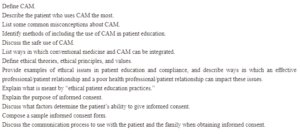
Define CAM.
Complementary and Alternative Medicine (CAM)
Describe the patient who uses CAM the most.
List some common misconceptions about CAM.
Identify methods of including the use of CAM in patient education.
Discuss the safe use of CAM.
List ways in which conventional medicine and CAM can be integrated.
Define ethical theories, ethical principles, and values.
Provide examples of ethical issues in patient education and compliance, and describe how an effective professional/patient relationship and a poor health professional/patient relationship can impact these issues.
Explain what is meant by “ethical patient education practices.”
Explain the purpose of informed consent.
Discuss what factors determine the patient’s ability to give informed consent.
Compose a sample informed consent form.
Discuss the communication process with the patient and the family when obtaining informed consent.