
Comparing Humanistic-Existential Psychotherapy with Cognitive Behavioral Therapy
Understanding the features of different therapy methods is vital for a psychiatric mental Health Nurse Practitioner (PMHNP). It enables them to properly care for their patients (Brown et al., 2021). There are different therapy methods, such as cognitive-behavioral therapy, psychodynamic therapy, and family therapy. Each has its advantages in addressing specific mental health illnesses. By comprehending these advantages, a PMHNP can match the appropriate therapy approach to an individual’s diagnosis. This knowledge empowers the PMHNP to enhance treatment outcomes, promote client engagement, and create a therapeutic alliance. Ultimately, understanding therapy strengths enables PMHNPs to deliver patient-centered care, enhancing mental well-being.
Need help with your assignment ? Reach out to us. We offer excellent services.
Humanistic-existential psychotherapy
Humanistic-existential psychotherapy is a therapeutic method that highlights each individual’s natural worth and potential for growth. It combines humanistic and existential philosophies to address the subjective experience of being human (Binder, 2020). It also searches for the meaning and authenticity of life. The main principles of this approach include personal fulfillment and responsibility. Moreover, there is an exploration of philosophical matters such as death, freedom, and the search for meaning. The therapist provides an understanding, non-judgmental environment. Here the client can explore their thoughts, emotions, and values. Practices commonly used in humanistic-existential psychotherapy include empathic listening, reflection, and clarification. This allows the patient to gain self-awareness and insight into their own experiences. Personal growth, self-discovery, and the development of a more authentic and fulfilling life are encouraged.
Cognitive Behavioral Therapy
Cognitive Behavioral Therapy (CBT) is a widely utilized therapeutic approach. It centers on the connection between thoughts, emotions, and behaviors. It aims to help individuals identify and alter negative thoughts and beliefs contributing to problematic behavior. The key principles of CBT include the understanding that our thoughts influence our feelings and actions (Borza, 2022). Furthermore, changing maladaptive thoughts can lead to constructive changes in emotions and behaviors. CBT practices include cognitive restructuring and behavioral experiments. Exposure therapy and problem-solving techniques are also commonly employed. CBT is time-limited and structured. There is a joint therapist-client relationship. It stresses active participation and assignments to practice new skills in real-life situations.
Differences between the therapies
Humanistic-existential psychotherapy and CBT differ in several ways. First, their theoretical foundations differ. Humanistic-existential therapy focuses on self-actualization and meaning, while CBT emphasizes the relationship between thoughts, emotions, and behaviors. Second, their objectives differ. While humanistic-existential therapy aims for personal growth and exploration of existential concerns, CBT aims at specific symptoms and maladaptive thought patterns. Finally, the techniques employed vary. Humanistic-existential therapy applies empathic listening and reflection, while CBT involves cognitive reformation and behavioral experiments. As a PMHNP, understanding these differences is essential. It allows for the selection of the most appropriate approach for individual clients based on their needs and goals. Familiarity with both approaches enhances flexibility and the ability to provide tailored and evidence-based care. This ultimately improves treatment outcomes.
Application of Humanistic-Existential Psychotherapy in the Video
Based on the video featuring James Bugental, Humanistic-existential psychotherapy was used because it aligns with the therapeutic goals and needs presented. This approach emphasizes the exploration of philosophical concerns, personal growth, and self-realization (Binder, 2022). These are evident in the patient’s struggles. The video shows the patient struggling with questions of meaning, purpose, and sense of self. Humanistic-existential therapy provides an understanding and non-judgmental environment. Here the patient could freely express their thoughts, emotions, and values. The therapist used techniques such as empathic listening and reflection, which created self-awareness and insight. By utilizing humanistic-existential psychotherapy, the therapist aims to help the patient better understand themselves. They also understand their values and their search for meaning.
Outcomes of a Different Approach
If CBT had been used with the patient in the video, the expected potential outcome would likely be symptom reduction. Additionally, there would be improved coping skills and a change in maladaptive thought patterns. CBT focuses on identifying and modifying negative thoughts that contribute to problematic behaviors (Bilbrey et al., 2022). The therapist would work with the patient to challenge and reframe these thoughts. The patient would develop new coping strategies and problem-solving skills to manage their challenges effectively. As a result, the patient may experience decreased anxiety, improved mood, and enhanced functioning in their life. Conclusively, CBT aims to empower individuals to take an active role in their mental health.
Scholarly articles
The sources used are considered scholarly because they meet several criteria typical of scholarly literature. Firstly, they are published in reputable academic journals like, The Journal for Nurse Practitioners, Frontiers in Psychology, Dialogues in Clinical Neuroscience, and Cognitive and Behavioral Practice. These journals typically have an extensive peer-review process. This ensures the quality and credibility of the published research. Secondly, the authors of the articles are professionals in their respective fields. They possess the qualifications and expertise to conduct research and contribute to the academic discussion. Thirdly, the articles follow a structured format. They have organized sections such as abstract, introduction, methods, results, and discussion. They include citations and references to other relevant scholarly works. This shows that the authors have engaged with current literature in the field.
Conclusion
Understanding the different psychotherapeutic approaches is vital for a PMHNP. The choice of therapy approach should match the individual needs and goals of the client. Subsequently, humanistic-existential psychotherapy emphasizes personal growth, self-discovery, and the exploration of existential concerns, while CBT focuses on symptom reduction and modifying maladaptive thoughts. The video employed humanistic-existential psychotherapy due to the patient’s struggles with philosophical questions. If CBT had been used, the expected outcome would involve symptom reduction and improved coping skills. Notably, recognizing the scholarly nature of the provided articles is important for it ensures their credibility and contribution to the academic discussion.
References
Bilbrey, A. C., Laidlaw, K., Cassidy-Eagle, E., Thompson, L. W., & Gallagher-Thompson, D. (2022). Cognitive behavioral therapy for late-life depression: evidence, issues, and recommendations. Cognitive and Behavioral Practice, 29(1), 128-145. https://doi.org/10.1016/j.cbpra.2020.02.003
Binder, P. E. (2022). The call of the unlived life: On the psychology of existential guilt. Frontiers in Psychology, 13, 6208. https://doi.org/10.3389/fpsyg.2022.991325
Borza, L. (2022). Cognitive-behavioral therapy for generalized anxiety. Dialogues in clinical neuroscience. https://doi.org/10.31887/DCNS.2017.19.2/lborza
Brown, M., Moore, C. A., MacGregor, J., & Lucey, J. R. (2021). Primary care and mental health: an overview of integrated care models. The Journal for Nurse Practitioners, 17(1), 10-14. https://doi.org/10.1016/j.nurpra.2020.07.005
ORDER A PLAGIARISM-FREE PAPER HERE
We’ll write everything from scratch
Question 
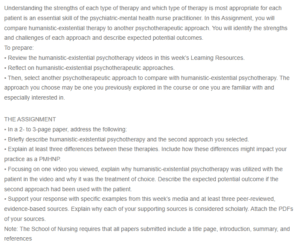
Comparing Humanistic-Existential Psychotherapy with Cognitive Behavioral Therapy
Understanding the strengths of each type of therapy and which type of therapy is most appropriate for each patient is an essential skill of the psychiatric-mental health nurse practitioner. In this Assignment, you will compare humanistic-existential therapy to another psychotherapeutic approach. You will identify the strengths and challenges of each approach and describe expected potential outcomes.
To prepare:
• Review the humanistic-existential psychotherapy videos in this week’s Learning Resources.
• Reflect on humanistic-existential psychotherapeutic approaches.
• Then, select another psychotherapeutic approach to compare with humanistic-existential psychotherapy. The approach you choose may be one you previously explored in the course or one you are familiar with and especially interested in.
THE ASSIGNMENT
• In a 2- to 3-page paper, address the following:
• Briefly describe humanistic-existential psychotherapy and the second approach you selected.
• Explain at least three differences between these therapies. Include how these differences might impact your practice as a PMHNP.
• Focusing on one video you viewed, explain why humanistic-existential psychotherapy was utilized with the patient in the video and why it was the treatment of choice. Describe the expected potential outcome if the second approach had been used with the patient.
• Support your response with specific examples from this week’s media and at least three peer-reviewed, evidence-based sources. Explain why each of your supporting sources is considered scholarly. Attach the PDFs of your sources.
Note: The School of Nursing requires that all papers submitted include a title page, introduction, summary, and references
Required Media
• Grande, T. (2019, January 9). Theories of counseling – Existential therapyLinks to an external site. [Video]. YouTube. https://www.youtube.com/watch?v=YvAvc2aWup0
• PsychotherapyNet. (2009, June 29). James Bugental’s live case consultation psychotherapy video links to an external site. [Video]. YouTube. https://www.youtube.com/watch?v=Zl8tVTjdocI
• ThinkingallowedTV. (2010, September 20). James Bugental: Humanistic psychotherapy (excerpt) – A thinking-allowed DVD w/ Jeffrey MishloveLinks to an external site. [Video]. YouTube. https://www.youtube.com/watch?v=mjDNKGIvWPQ
Optional Resources
• Biophily2. (2016, October 4). Abraham Maslow, Rollo May, Carl Rogers – Existential psychology II (1962)Links to an external site. [Video]. YouTube. https://www.youtube.com/watch?v=oTTqKNI7wDo
• Bugental, J. (2008). Existential-humanistic psychotherapyLinks to an external site. [Video]. https://waldenu.kanopy.com/video/existential-humanistic-psychotherapy
Optional Media
• The Psychology Podcast. (2021, Aug 30). Irvin Yalom- Existential psychotherapy. [Video]. YouTube. https://www.youtube.com/watch?v=G2vef8W1a0k