
Chronic Knee Pain
Kristelle,
Thank you for sharing your post. Indeed, the patient’s chronic knee pain could be because of her excessive weight. If that is the case, then a balanced, low-calorie, healthy diet would be effective in helping her lose weight. On the other hand, if the chronic pain is due to arthritis, she will need to consider non-pharmacological options such as acupuncture. Acupuncture has been shown to be effective in managing chronic pain. Acupuncture targets the sources of pain and stimulates the production of endorphins that cause relief in pain (Ramos et al., 2018). Our assignment writing help is at affordable prices to students of all academic levels and academic disciplines.
The fact that she is overweight excludes her from starting on hormonal birth control. The option of an IUD copper implant is a viable option as this does not involve any hormones. Hormonal birth control pills will expose the aptote to the risk of gaining more weight, blood clots, stroke, and heart attack.
Regarding patient education, she should be advised on the side effects to look out for after the IUD insertion. These side effects include cramps, backache, or pain for a few days. Other side effects include heavy bleeding, irregular bleeding, spotting between periods, and worse menstrual cramps than usual. The side effects often go away after a few months, though sometimes it could last longer. If the side effects fail to improve or if they continue for several weeks or months, the patient will need to come back to the clinic for assessment. There is a possibility that an IUD can result in pelvic infection that could be due to bacteria entering the uterus when the IUD is inserted (Coles, 2019).
References
Coles, M. S. (2019). Follow-up after IUD insertions: managing IUD expectations, addressing side effects, and providing post-insertion counseling. Optimizing IUD Delivery for Adolescents and Young Adults, pp. 133–148.
Ramos, A., Domínguez, J., & Gutiérrez, S. (2018). Acupuncture for rheumatoid arthritis. Medwave, 18(06).
ORDER A PLAGIARISM-FREE PAPER HERE
We’ll write everything from scratch
Question 
-I NEED TO RESPOND ON THIS TOPIC
-Length: A minimum of 150 words per post, not including references
Citations: At least one high-level scholarly reference in APA per post from within the last five years
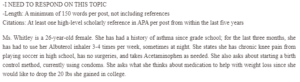
Chronic Knee Pain
Ms. Whitley is a 26-year-old female. She has had a history of asthma since grade school; for the last three months, she has had to use her Albuterol inhaler 3-4 times per week, sometimes at night. She states she has chronic knee pain from playing soccer in high school, has no surgeries, and takes Acetaminophen as needed. She also asks about starting a birth control method, currently using condoms. She asks what she thinks about medication to help with weight loss since she would like to drop the 20 lbs she gained in college.
1. What medication recommendations will you make? Include the drug class, generic and trade name, and starting dose range. Provide a Rationale for your choices.
Asthma is distinguished by airway inflammation and hyper-responsiveness to different triggers. Acute asthma attacks are due to bronchoconstriction and airway edema, which may cause wheezing, chest tightness, worsening cough, shortness of breath, and fast breathing (Ramphul & Gaillard, 2021). A metered dose inhaler is the first method of choice for mild to moderate asthma, but nebulizers may also be used. There are two types of medications used to relieve asthma symptoms – Short-acting beta2agonists (SABAs) and long-acting beta2agonists (LABAs). SABAs include terbutaline (Brethine) and albuterol (Proventil, Ventolin), which works immediately when inhaled. The patient may use two puffs every 4-6 hours as needed, not to exceed 12 breaths/day. The medication lasts between three to five hours, and patients should be referred to their practitioner for changes in dosage if the symptom is not relieved within three hours (Stewart, 2016). LABAs include salmeterol and formoterol (Perforomist); these medications take 10-20 minutes to take effect but have a longer duration of 12 hours. LABAs are not used for acute asthma attacks but act as an additive therapy for patients with asthma that is not well controlled (Stewart, 2016). Formoterol is used as a nebulizer treatment of 20 mcg twice daily and is contraindicated for patients with COPD. Since the patient needs to use her inhaler 3-4 times per week, the patient will require prophylaxis with an inhaled corticosteroid (Stewart, 2016). I would recommend beclomethasone (QVAR) 1-2 sprays inhaled orally twice daily. Inhaled corticosteroids are effective at reducing lung inflammation and preventing edema and mucous production in the airways (Stewart, 2016).
Ms. Whitley is also complaining of chronic knee pain and is taking Acetaminophen (Tylenol) as needed. I would recommend an x-ray of her knee to determine the cause of the pain. If Tylenol helps relieve the pain, I would have her keep taking Acetaminophen as needed for the pain; she can start at 250mg-1000mg PO every four hours, not to exceed 4,000mg/day. If Acetaminophen does not work to relieve her pain, I would recommend that she take Ibuprofen (Motrin, Advil) 400-800mg PO 3-4 times a day as needed, not to exceed 3,400mg/day.
For birth control, I would present and offer to her the different types of contraceptives and educate her on each one so that she may make an educated decision. If she is in a monogamous relationship, I would offer the copper IUD (Paragard) since this is the only form of contraception without hormones. Since she is dealing with weight gain, this would be the best option for her. If she is not in a monogamous relationship, I would have to recommend that she stick to using condoms as a form of contraceptive since using condoms appropriately and consistently is an effective sexually transmitted infection prevention (Ferrand et al., 2021). There are different types of contraceptives – from pills, patches, IUDs, condoms, spermicides, diaphragm, vaginal rings, injections, and the implant (Barr, 2020). Based on what the patient chooses, I will educate her regarding the risks and benefits of each one before prescribing any contraceptives.
The patient is also concerned about her weight gain. I would need her BMI, current weight, and height to be able to determine if the weight gain is significant enough for pharmacological interventions. I would recommend nonpharmacological interventions first, like changing her diet and exercise and maybe adding aerobic exercise, such as swimming for at least 30 minutes a day for five days a week. Her weight loss should also help with the knee pain she is experiencing. If non-pharmacological interventions have failed, and she is obese, I would recommend phentermine hydrochloride (Adipex-P, Lomaira). Phentermine is an amphetamine-like medication indicated as an appetite suppressant for weight loss (Phentermine for weight loss, 2020). The recommended dose is 15 to 37.5mg PO once a day for twelve weeks.
2. Discuss any potential side effects and drug interactions for this patient.
There are no drug interactions for this patient. Side effects of the inhaler for asthma include tremors, anxiety, headache, muscle cramps, and dry mouth (Stewart, 2016). For Ibuprofen, gastrointestinal upset and kidney toxicity/failure is the most common type of adverse effects. If she chooses to take a hormonal contraceptive, side effects would include blood clots and weight gain. For phentermine hydrochloride, the most common side effects are tachycardia, dry mouth, constipation, insomnia, anxiety, and paresthesia (Phentermine for weight loss, 2020).
3. What non-pharmacological interventions would you suggest?
I would suggest diet and exercise for the patient to aid in weight loss. In addition, stretching and therapy would also benefit the patient for her knee pain. If the patient is smoking, I would encourage her to stop or to use nicotine patches. Further, I would also educate the patient on different types of weight loss programs.
4. What patient education would you provide?
After using her QVAR, rinse her mouth to prevent the patient from developing thrush. Discuss with the patient the importance of a medication regimen, especially with her asthma. Recognize the signs and symptoms of an acute asthma attack and have her rescue inhaler with her at all times for emergency purposes. Discuss the different types of contraceptives and their advantages and disadvantages so that she is able to make an informed choice. Educate the patient regarding safe sex if she is not in a monogamous relationship and recognize the signs and symptoms of STIs. If she is prescribed phentermine, I would educate her on the risk of being pregnant while on this medication and how important it is to use her contraceptive.
References
Barr, S. (2020). All the different types of contraception, from the pill to the implant. Independent Digital News & Media.
Ferrand, J. L., Blashill, A. J., Corliss, H. L., & Walsh-Buhi, E. R. (2021). Condom application skills and self-efficacy in youth: A systematic review and meta-analysis. PLoS ONE, 16(4), 1–22. https://doi.org/10.1371/journal.pone.0249753
Phentermine for weight loss (2020). Tribune Content Agency LLC.
Ramphul, M., & Gaillard, E. A. (2021). Diagnosis and management of acute asthma in children. Practitioner, 265(1849), 17–21.
Stewart, K. (2016). Asthma: management and treatment. Chemist & Druggist, 285(6980), 14–16.