
Change Implementation and Management Plan – Presentation
Hello, my name is __. Today, I will be presenting on Change Implementation and Management Plan. Welcome.
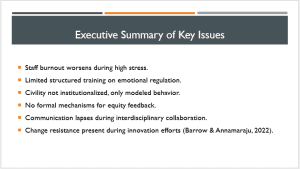
Currently, our organization faces several challenges that impact workplace health and team performance. Current staff burnout, especially during periods of increased stress, is still a problem. While leadership comes with the practice of civility, no practice enhances civility systematically. Workers do not receive special training in the process of controlling their own emotions or managing conflicts. Also, communication during interdisciplinary collaboration is not effective, which results in frustration and slowed progress. Another area that is lacking is the feedback mechanism through which staff may raise concerns or voice their ideas over matters of diversity, equity, and inclusion. Continued opposition persists when there is a need to implement change since most change management processes are not well-defined or openly communicated (Barrow & Annamaraju, 2022). Our organization performed highest in terms of being civil when assessed informally; the lack of a formal mechanism means that there are holes that, if addressed, will strengthen organizational resilience, improve patient care outcomes, and improve the job satisfaction of members of the healthcare teams.
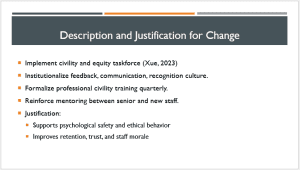
The proposed change to address the identified issues involves introducing a formalized Civility and Equity task force in our organization. This multiprofessional committee will be in charge of establishing highly structured feedback mechanisms and providing professional civility training at least once per quarter with regard to mentoring programs to increase cultural competence and emotional regulation skills among staff (Xue, 2023). Thus, transitioning from informal leadership modeling to policy enshrinement, we establish a system within which the employees have complex support and civility, diversity, and psychological safety are progressively enhanced. This change is necessary because continual and purposeful nurturing of such positive values will reduce instances of burnout, improve communications, and promote team resilience. Transformational leadership is the key to success when change initiatives are part of the organizational culture, not a matter of chance. This will be in line with the organization’s goal of offering accessible, equitable, and efficient patient care while creating an environment that fosters professional growth and well-being among the practitioners.
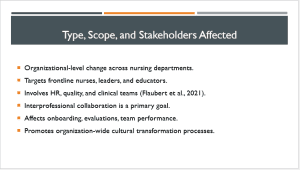
The proposed change is at the organizational level, and it will affect all the nursing departments, allied practitioners, administrators, and leadership. It is not limited to one unit alone but targets the modification of the whole organizational culture. Based on this perspective, the key stakeholders are frontline nurses, nurse managers, educators, and human resource personnel, as well as members of the quality improvement team (Flaubert et al., 2021). This initiative is primarily centered on constructing team cohesion, with an emphasis on interprofessional collaboration, interpersonal communication, and, more importantly, ensuring a culture of cultural competence integration in practice. The methods of onboarding new employees and the usual performance review will also be modified to address civility and inclusiveness. All current leaders in the institution will also be coached on civility to ensure the best standard is met. This way, the broad perspective adopted by the initiative accounts for each member of staff and, by extension, guarantees no one is left out of the change experience, which consequently increases the overall satisfaction and retention as well as enhances the delivery of health care services to diverse departments.
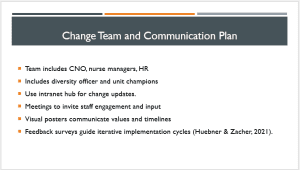
A strong and diverse change management team is crucial for success. The stakeholders involved in the implementation of the project will include the CNO, human resources, managers of nurses at different units, the champions per unit, and the organizational diversity officer. Together, they will be in charge of planning, implementing, and evaluating the designed solution. The change communication shall involve the following platforms: updates on the organizational website, newsletters, or internal emails, formal discussion during company meetings, bulletin boards, or office posters. This will provide staff with structured ways in which they can raise their concerns, provide feedback and have early achievements appreciated (Huebner & Zacher, 2021). The open loops of communication will enhance the overall amount of trust that will be created in the organization. This means that transparency in all communications will be effective in avoiding any misuse of information and resistance. It also means diligent and truthful communication with regard to improving organizational performance with the purpose of developing and maintaining stakeholder ownership.
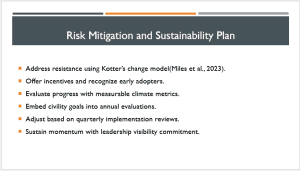
Anticipating risks and proactively mitigating them will be essential for sustaining this cultural transformation. Managing resistance to change will utilize Kotter’s 8-Step Change Model, which emphasizes establishing change’s sense of urgency, assembling the right coalition and seeking and celebrating short-term wins (Miles et al., 2023). Incentives include staff recognition awards for demonstration of professional performance, which shall increase participation and adoption. Progress will be assessed in the form of official workplace climate surveys and quarterly performance indicators. Changes are taken periodically to foster coping mechanisms for emergency issues. In order to ensure this civility initiative’s continuity and success, it will be incorporated into annual performance evaluations, onboarding curriculum, and leaders’ development plans. Sustainability will also entail consistent leadership and consistent reminders about the position adopted on civility by frequent storytelling and acknowledgment of additional civility champions in the organizations. To maintain progress in change, it is expected that organizational changes are introduced and supported by the organizational structure, processes, and identity.
That’s all for today. Thank you!
Barrow, J. M., & Annamaraju, P. (2022). Change management in health care. National Library of Medicine; StatPearls Publishing. https://www.ncbi.nlm.nih.gov/books/NBK459380/
Flaubert, J. L., Menestrel, S. L., Williams, D. R., & Wakefield, M. K. (2021). Nurses leading change. In www.ncbi.nlm.nih.gov. National Academies Press (US). https://www.ncbi.nlm.nih.gov/books/NBK573918/
Huebner, L.-A., & Zacher, H. (2021). Following up on employee surveys: A conceptual framework and systematic review. Frontiers in Psychology, 12(12). Frontiersin. https://pmc.ncbi.nlm.nih.gov/articles/PMC8696015/
Miles, M. C., Richardson, K. M., Wolfe, R., Hairston, K., Cleveland, M., Kelly, C., Lippert, J., Mastandrea, N., & Pruitt, Z. (2023). Using Kotter’s change management framework to redesign departmental GME recruitment. Journal of Graduate Medical Education, 15(1), 98–104. https://doi.org/10.4300/JGME-D-22-00191.1
Xue, P. (2023). Advancing workplace civility: A systematic review and meta-analysis of definitions, measurements, and associated factors. Frontiers in Psychology, 14(1277188), 1–20. https://doi.org/10.3389/fpsyg.2023.1277188
ORDER A PLAGIARISM-FREE PAPER HERE
We’ll write everything from scratch
Question 
Change Implementation and Management Plan – Presentation
It is one of the most cliché of clichés, but it nevertheless rings true: The only constant is change. As a nursing professional, you are no doubt aware that success in the healthcare field requires the ability to adapt to change, as the pace of change in healthcare may be without rival.
Change Implementation and Management Plan
As a professional, you will be called upon to share expertise, inform, educate, and advocate. Your efforts in these areas can help lead others through change. In this Assignment, you will propose a change within your organization and present a comprehensive plan to implement the change you propose.
Resources
- Broome, M., & Marshall, E. S. (2021). Transformational leadership in nursing: From expert clinician to influential leader (3rd ed.). New York, NY: Springer.
- Chapter 4, “Practice Model Design, Implementation, and Evaluation” (pp. 99–154)
- Boustani, M., Azar, J., & Solid, C. A. (2020). Agile implementation: A model for implementing evidence-based healthcare solutions into real-world practice to achieve sustainable changeLinks to an external site.. Morgan James Publishing.
- Campbell, R. J. (2020). Change management in health careLinks to an external site.. Health Care Manager, 39(2), 50–65.
- National Institute of HealthLinks to an external site.. (n.d.). https://www.nih.gov/health-information
- Reinhardt, A. C., Leon, T. G., & Summers, L. O. (2022). The transformational leader in nursing practice — An approach to retain nursing staffLinks to an external site.. Administrative Issues Journal: Education, Practice, and Research, 12(1), 1–12. https://doi.org/10.5929/2022.12.1.1
To Prepare:
- Review the Resources and identify one change that you believe is called for in your organization/workplace.
- This may be a change necessary to effectively address one or more of the issues you addressed in the Workplace Environment Assessment you submitted in Module 4. It may also be a change in response to something not addressed in your previous efforts. It may be beneficial to discuss your ideas with your organizational leadership and/or colleagues to help identify and vet these ideas.
- Reflect on how you might implement this change and how you might communicate this change to organizational leadership.
The Assignment (5-6-minute narrated PowerPoint presentation):
Change Implementation and Management Plan
Create a 5- or 6-slide narrated PowerPoint that presents a comprehensive plan to implement changes you propose.
Your narrated presentation should be 5–6 minutes in length.
Your Change Implementation and Management Plan should include the following:
- An executive summary of the issues that are currently affecting your organization/workplace (This can include the work you completed in your Workplace Environment Assessment previously submitted, if relevant.)
- A description of the change being proposed
- Justifications for the change, including why addressing it will have a positive impact on your organization/workplace
- Details about the type and scope of the proposed change
- Identification of the stakeholders impacted by the change
- Identification of a change management team (by title/role)
- A plan for communicating the change you propose
- A description of risk mitigation plans you would recommend to address the risks anticipated by the change you propose
Alternate Submission Method
You may also use Kaltura Personal Capture to record your narrated PowerPoint. This option will require you to create your PowerPoint slides first. Then, follow the Personal Capture instructions outlined on the Kaltura Media UploaderLinks to an external site. page. This page will walk you through downloading the tool and help you become familiar with the features of Personal Capture. When you are ready to begin recording, you may turn off the webcam option so that only “Screen” and “Audio” are enabled. Start your recording and then open your PowerPoint to slide show view. Once the recording is complete, follow the instructions found on the “Posting Your Video in the Classroom Guide” found on the Kaltura Media page for instructions on how to submit your video. For this option, in addition to submitting your video, you must also upload your PowerPoint file which must include your speaker notes.