
Case Study-Patient with Diabetic Ketoacidosis
The case presented is of a 21-year-old female presenting for urgent care with complaints of nausea, vomiting, diarrhea, and fever. She has type 1 diabetes with a poorly controlled disease. Assessment findings on the patient are highly suggestive of diabetic ketoacidosis (DKA). DKA is an acute life-threatening complication of diabetes characterized by marked hyperglycemia, increased ketone concentration, and metabolic acidosis. DKA is usually seen in type 1 diabetes. Known trigger factors for this condition include infections, trauma, injuries, and surgery. New onset diabetes and non-compliance with antidiabetic medications are also known precipitants of the disease.
In DKA, there is an absolute deficiency of insulin deficiency with reflex increases in counter-regulatory hormones. These hormones will activate gluconeogenesis and glycogenolysis and cause impairment in glucose utilization. The resultant hyperglycemia accounts for the marked elevation of blood glucose in DKA. These counter-regulatory hormones also cause lipolysis, leading to increased circulation of free fatty acids. These free fatty acids undergo hepatic oxidation to form ketone bodies with resultant ketonemia and metabolic acidosis. The fruity breath observed in DKA is a result of ketone formation. Hyperglycemia-induced diuresis, dehydration, hyperosmolality, and electrolyte imbalance lower glomerular filtration with consequent deterioration of renal functionalities. Potassium utilization is also impaired due to hyperosmolarity and impaired insulin function, resulting in hyperkalemia.
Assessment findings revealed high blood glucose and a history of non-compliance to antidiabetic medications. According to Shahid et al. (2020), non-compliance to medications among type 1 diabetics is a known trigger factor for diabetic ketoacidosis. Other findings on the patients that had a positive correlation with DKA include symptoms of fruity-odored breath suggestive of ketonemia, dehydration, vomiting, diarrhea, and hyperkalemia. Other features indicative of metabolic acidosis in the case presented include a high respiratory rate of 36 breaths per minute (normal 12-16 bpm) and a high pulse rate (average 60-100 beats per minute). All these features stem from the disease process and are suggestive of DKA.
DKA is usually common in type 1 diabetes. Common precipitants of DKA in a patient with type I diabetes include acute medical illnesses, new-onset diabetes, and medication non-compliance. The patient in the case presented was a known type 1 diabetic who had not taken her insulin as directed. She was also ill. These may have precipitated DKA in the patient.
The clinical manifestations of DKA are wide and varied. Symptoms of hyperglycemia are often pronounced in DKA. These symptoms include polyuria, polyphagia, and polydipsia. Polyuria seen in DKA usually fades as the patient becomes more dehydrated. Decreased urine output demonstrated by lack of voiding, dry mouth, and reduced sweating indicate volume depletion. Nausea, vomiting, anorexia, and weight loss are other common presentations of DKA. Ketonuria, or the presence of a fruity odor, suggests ketone formation, a feature of DKA. It remains a key diagnostic feature of the disease. Other common symptoms of DKA include confusion, shortness of breath, high respiratory rate, increased pulse rates, and stomach pain.
The patient in the case presented had several symptoms suggestive of DKA. Marked hyperglycemia, as indicated by high blood glucose levels and consequent manifestations of dehydration and polydipsia, was apparent in the patient. The patient also manifested symptoms of volume depletion as characterized by her not voiding. The symptoms of nausea, vomiting, and diarrhea in the patients also suggest DKA. Other symptoms that were present in the patient and are consistent with those seen in DKA include fruity-odored breath, high respiratory and pulse rates, confusion, and anorexia.
DKA is a life-threatening condition that requires a prompt medical address. Aggressive fluid resuscitation to correct hypovolemia remains valuable in DKA. It restores tissue perfusion and clears ketones in circulation. It also improves glycemic control. Isotonic fluids such as normal saline are used for this purpose. Insulin therapy is another intervention in DKA. It is aimed at correcting hyperglycemia. Intravenous insulin infusion is the standard of care for hyperglycemia seen in DKA. Treatment with insulin is often continuous until DK resolves. Electrolyte replacement is another intervention aimed at curtailing electrolyte derangements seen in DKA. Potassium supplementation is usually warranted when hypokalemia is apparent. This may be due to insulin therapy. Insulin therapy causes hypokalemia by causing a shift of potassium ions into the intracellular space (Coregliano-Ring et al., 2022). Supplementation may be necessary when potassium levels fall below 3.3 mg/dL.
Another management point in the patient is addressing precipitating factors. As evident in the case, not taking insulin as directed and underlying illnesses may have triggered the patient’s state. Treating the disease and ensuring medication compliance may be effective in treating DKA. If the disease is suspected of bacterial origin, a laboratory exam to confirm bacterial cause and subsequent antibiotic therapy may help lower the mortality risk for the patient.
The patient may be suffering from DKA. Assessment findings and history are consistent with DKA presentations. Prompt management of DKA is necessary to lower mortality risk. Fluid resuscitation and intravenous insulin are the first-line interventions available for the patient. These interventions will correct hypovolemia and stabilize the patient’s blood glucose. The underlying condition that may have precipitated the patient’s presentation should also be interrogated, and prerequisite lab work should be done to ascertain bacterial involvement. Antibiotic therapy is warranted if the underlying illness has a bacterial origin.
References
Coregliano-Ring, L., Goia-Nishide, K., & Rangel, É. B. (2022). Hypokalemia in diabetes mellitus setting. Medicina, 58(3), 431. https://doi.org/10.3390/medicina58030431
Shahid, W., Khan, F., Makda, A., Kumar, V., Memon, S., & Rizwan, A. (2020). Diabetic ketoacidosis: Clinical characteristics and precipitating factors. Cureus. https://doi.org/10.7759/cureus.10792
ORDER A PLAGIARISM-FREE PAPER HERE
We’ll write everything from scratch
Question 
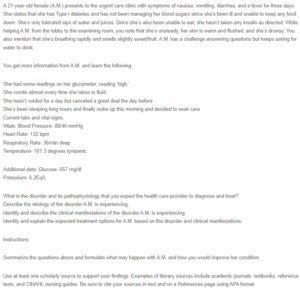
A 21-year-old female (A.M.) presents to the urgent care clinic with symptoms of nausea, vomiting, diarrhea, and a fever for three days. She states that she has Type I diabetes and has not been managing her blood sugars since she’s been ill and unable to keep any food down. She’s only tolerated sips of water and juices. Since she’s also been unable to eat, she hasn’t taken any insulin as directed. While helping A.M. from the lobby to the examining room, you note that she’s unsteady, her skin is warm and flushed, and she’s drowsy. You also mention that she’s breathing rapidly and smells slightly sweet/fruit. A.M. has a challenge answering questions but keeps asking for water to drink.
Case Study-Patient with Diabetic Ketoacidosis
You get more information from A.M. and learn the following:
She had some readings on her glucometer, reading ‘high.’
She vomits almost every time she takes in fluid
She hasn’t voided for a day but canceled a great deal the day before
She’s been sleeping long hours and finally woke up this morning and decided to seek care
Current labs and vital signs:
Vitals: Blood Pressure- 88/46 mmHg
Heart Rate- 132 bpm
Respiratory Rate- 36/min deep
Temperature- 101.3 degrees tympanic
Additional data: Glucose- 657 mg/dl
Potassium- 6.2Eq/L
What is the disorder and its pathophysiology that you expect the health care provider to diagnose and treat?
Describe the etiology of the disorder A.M. is experiencing.
Identify and describe the clinical manifestations of the disorder A.M. is experiencing.
Identify and explain the expected treatment options for A.M. based on the disorder and clinical manifestations.
Instructions:
Summarize the questions above and formulate what may happen with A.M. and how you would improve her condition.
Use at least one scholarly source to support your findings. Examples of literary sources include academic journals, textbooks, reference texts, and CINAHL nursing guides. Be sure to cite your sources in-text and on a References page using APA format.
You can find functional reference materials for this assignment in the School of Nursing guide: https://guides.rasmussen.edu/nursing/referenceebooks