
Case Study – Major Depressive Disorder in an Adolescent Male
ID: SH Age: 17 years Gender: Male Race: Caucasian
Subjective:
CC (chief complaint): “My mood has improved significantly. I still struggle with sleep.”
HPI: 17-year-old Caucasian male presenting to the clinic for routine follow-up. He reports improved mood with less depression. He, however, struggles with attention and experiences sleep disturbances. The symptoms began more than six months ago and have been present since. He was diagnosed with depression and is currently under management. The symptoms manifest most of the time. He is also disorganized and reports having difficulty focusing on one task. The sleep problem persists despite being on sleep medications. The complaints significantly impact his social functioning, prompting him to seek therapy.
Substance Current Use: Denies taking alcohol or smoking.
Medical History:
- Current Medications:
- Wellbutrin 300mg, taken every 24 hours. The dose of Wellbutrin was reduced from 450mg three months ago. He is also on
- Melatonin 2mg, administered at bedtime, for the management of sleep disturbances.
- Allergies: No known food or drug allergies.
ROS:
- GENERAL: The patient is pleasant and cooperative. Denies fever, weight loss, weight gain, or fatigue.
- HEENT: Denies visual and hearing loss, difficulty swallowing, or nasal discharge.
- CARDIOVASCULAR: Denies palpitations, chest pain, or irregularity in his heart rhythm.
- RESPIRATORY: Denies shortness of breath or wheezing.
- GASTROINTESTINAL: Denies changes in bowel movements or abdominal pain.
- GENITOURINARY: Denies dysuria or frequent urination.
- NEUROLOGICAL: Denies headache, seizures, or recent syncope
- MUSCULOSKELETAL: Denies muscle and joint pain, joint stiffness or swelling.
- LYMPHATICS: Denies splenomegaly or lymph swelling.
- HEMATOLOGIC: Denies anemia or excessive bleeding.
- ENDOCRINOLOGIC: Denies heat or cold intolerance or diabetes.
Objective:
The patient was pleasant and cooperative. He appeared fatigued. No signs of scars on the face, over-the-head areas, or other parts of the skin. There were also no signs of swelling on the head and face. Respiratory examination was negative for any difficulty in breathing, wheezing, or use of accessory muscles. Likewise, the cardiovascular exam revealed a regular and rhythmic heart rate. No signs of edema, excessive sweating, or unusual dryness.
Diagnostic results: Complete blood count with differential was normal. The thyroid panel was also normal, ruling out any endocrine involvement in the patient’s manifestations. Evaluation of the patient using the Hamilton Rating Scale for Depression (HAM-D) revealed a score of 27, corresponding to severe depression.
Assessment:
Mental Status Examination: The patient was alert and oriented to place, time and event. He was pleasant and cooperative and could answer the interview questions asked appropriately. His memory was intact as he could remember all events leading to the interview and during the interview. He seemed restless and unable to maintain eye contact. He was also fidgety. His judgment and thought process were logical. His mood is low, and his affect is blunt. He denied experiencing any visual or auditory hallucinations. Likewise, there were no signs of delusional thought processes. The patient denied suicidal ideations or attempts.
Differential Diagnosis:
Major depressive disorder, recurrent severe without psychotic features (F33.2): The patient in the case presented was being managed for depressive disorder. Likewise, he reported complaints of depressed mood and sleep disturbances that persisted despite his being on medications. Assessment findings were negative for any psychotic features. This warranted the inclusion of this differential (Korczak et al., 2023).
Generalized anxiety disorder (GAD) (F41.1): GAD is characterized by intense worry that is difficult to control. The presence of inattentiveness, sleep disturbances, disorganization, and difficulty focusing on one task prompted the inclusion of this differential. However, the absence of excessive anxiety lasting more than six months, per the DSM-V criteria for diagnosing GAD, made this differential less probable (Zakhari, 2020).
Attention-deficit hyperactivity disorder (ADHD), other types (F90.8): ADHD of combined type is characterized by hyperactivity and inattentiveness. The presence of inattentiveness, difficulty focusing on one task, restlessness during physical examination, and disorganization warranted the inclusion of this differential. However, these manifestations fail to meet the threshold for ADHD diagnosis described in DSM-V. Per the criteria, there must be at least six symptoms of ADHD for a diagnosis to be considered. Likewise, the symptoms must have been present across social settings and resulted in significant impairment in social functionalities (DSM-V.,n.d.). This makes ADHD a less likely diagnosis in the case presented (Zakhari, 2020).
Diagnostic Impression: Major depressive disorder, recurrent severe without psychotic features (F33.2). The presence of depressed mood, a working diagnosis of depression, and evidence of persisting depressive manifestations made this diagnosis highly probable. These manifestations are aligned with the DSM-V criteria for MDD, recurrent severe without psychotic features(DSM-V.,n.d.). The symptoms had also been present for the past six months and were confirmed by the Hamilton Rating Scale for Depression (HAM-D). Assessment findings further revealed the symptoms were severe and that there were no identifiable psychotic presentations. This confirmed the diagnosis (Walter et al., 2023).
Case Formulation and Treatment Plan:
- Increase the dose of Wellbutrin to 450mg. Wellbutrin dose escalation is necessitated whenever there is a sub-optimal clinical response to lower doses. Increasing the dose to 450mg once daily dosing may help alleviate the patient’s symptoms and optimize his clinical response (American Psychological Association, 2019).
- Start the patient on hydroxyzine 25mg administered every 8 hours. Hydroxyzine is an antihistamine medication that is FDA-approved for relieving anxiety. It can lessen the manifestations of anxiety, helping the patient to sleep better (Burgazli et al., 2023).
- The patient is also expected to continue attending his psychotherapy sessions. Adjunctive use of psychotherapy and pharmacological interventions is superior to either agent when used alone. The patient should thus be advised to continue attending his therapy classes (American Psychological Association, 2019).
- The patient will be educated on the disease process and the prescribed medications. He will be told to report any side effects experienced. Wellbutrin dose escalation has been linked with a higher frequency of side effects, such as GI disturbances.
- Follow-Up: The patient is expected to return for follow-up after two weeks. The parameters monitored during follow-up include symptom severity and side effects. Symptoms severity assessments will provide insight into the effectiveness of the medications. Likewise, the side effect profile will help determine the tolerability of the medications. A referral to a psychiatrist may be necessitated if the symptoms fail to improve (Walter et al., 2023).
PRECEPTOR VERIFICATION:
I confirm the patient used for this assignment is a patient that was seen and managed by the student at their Meditrek approved clinical site during this quarter course of learning.
Preceptor signature: ________________________________________________________
Date: ________________________
References
American Psychological Association. (2019). Clinical practice guideline for the treatment of depression across three age cohorts. https://www.apa.org/depression-guideline
Burgazli, C. R., Rana, K. B., Brown, J. N., & Tillman, F. (2023). Efficacy and safety of hydroxyzine for sleep in adults: Systematic review. Human Psychopharmacology: Clinical and Experimental, 38(2). https://doi.org/10.1002/hup.2864
DSM-V. (n.d.). DSM. Psychiatry.org – DSM. https://www.psychiatry.org/psychiatrists/practice/dsm
Korczak, D. J., Westwell-Roper, C., & Sassi, R. (2023). Diagnosis and management of depression in adolescents. Canadian Medical Association Journal, 195(21), E739–E746. https://doi.org/10.1503/cmaj.220966
Walter, H. J., Abright, A. R., Bukstein, O. G., Diamond, J., Keable, H., Ripperger-Suhler, J., & Rockhill, C. (2023). Clinical practice guideline for the assessment and treatment of children and adolescents with major and persistent depressive disorders. Journal of the American Academy of Child & Adolescent Psychiatry, 62(5), 479–502. https://doi.org/10.1016/j.jaac.2022.10.001
Zakhari, R. (2020). The psychiatric-mental health nurse practitioner certification review manual. Springer.
ORDER A PLAGIARISM-FREE PAPER HERE
We’ll write everything from scratch
Question 
Case Study – Major Depressive Disorder in an Adolescent Male
Hello here is the sketched patient case.
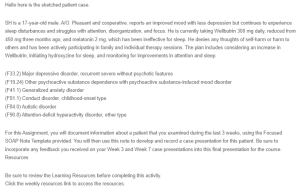
SH is a 17-year-old male. A/O. Pleasant and cooperative. reports an improved mood with less depression but continues to experience sleep disturbances and struggles with attention, disorganization, and focus. He is currently taking Wellbutrin 300 mg daily, reduced from 450 mg three months ago, and melatonin 2 mg, which has been ineffective for sleep. He denies any thoughts of self-harm or harm to others and has been actively participating in family and individual therapy sessions. The plan includes considering an increase in Wellbutrin, initiating hydroxyzine for sleep, and monitoring for improvements in attention and sleep.
Case Study – Major Depressive Disorder in an Adolescent Male
(F33.2) Major depressive disorder, recurrent severe without psychotic features
(F19.24) Other psychoactive substance dependence with psychoactive substance-induced mood disorder
(F41.1) Generalized anxiety disorder
(F91.1) Conduct disorder, childhood-onset type
(F84.0) Autistic disorder
(F90.8) Attention-deficit hyperactivity disorder, other type
For this Assignment, you will document information about a patient that you examined during the last 3 weeks, using the Focused SOAP Note Template provided. You will then use this note to develop and record a case presentation for this patient. Be sure to incorporate any feedback you received on your Week 3 and Week 7 case presentations into this final presentation for the course.
Resources
Be sure to review the Learning Resources before completing this activity.
Click the weekly resources link to access the resources.
WEEKLY RESOURCE
To Prepare
Review the Kaltura button from the Classroom Support Center (accessed via the Help button) for help creating your self-recorded Kaltura video.
Select a child or adolescent patient that you examined during the last 3 weeks who presented with a disorder for which you have not already created a Focused SOAP Note in Weeks 3 or 7. (For instance, if you selected a patient with anorexia nervosa in Week 7, you must choose a patient with another type of disorder for this week.)
Create a Focused SOAP Note on this patient using the template provided in the Learning Resources. There is also a completed Focused SOAP Note Exemplar provided to serve as a guide to assignment expectations.
Please Note:
All SOAP notes must be signed by your Preceptor. Note: Electronic signatures are not accepted.
When you submit your note, you should include the complete focused SOAP note as a Word document and PDF/images of the completed assignment signed by your Preceptor.
You must submit your SOAP note using Turnitin. Note: If both files are not received by the due date, faculty will deduct points per the Walden Grading Policy.
Then, based on your SOAP note of this patient, develop a video case study presentation. Take time to practice your presentation before you record.
Include at least five scholarly resources to support your assessment, diagnosis, and treatment planning.
Ensure that you have the appropriate lighting and equipment to record the presentation.
The Assignment
Record yourself presenting the complex case for your clinical patient.
Do not sit and read your written evaluation! The video portion of the assignment is a simulation to demonstrate your ability to succinctly and effectively present a complex case to a colleague for a case consultation. The written portion of this assignment is a simulation for you to demonstrate to the faculty your ability to document the complex case as you would in an electronic medical record. The written portion of the assignment will be used as a guide for faculty to review your video to determine if you are omitting pertinent information or including non-essential information during your case staffing consultation video.
In your presentation:
Dress professionally and present yourself in a professional manner.
Display your photo ID at the start of the video when you introduce yourself.
Ensure that you do not include any information that violates the principles of HIPAA (i.e., don’t use the patient’s name or any other identifying information).
Present the full complex case study. Include chief complaint; history of present illness; any pertinent past psychiatric, substance use, medical, social, family history; most recent mental status exam; current psychiatric diagnosis including differentials that were ruled out; and plan for treatment and management.
Report normal diagnostic results as the name of the test and “normal” (rather than specific value). Abnormal results should be reported as a specific value.
Be succinct in your presentation, and do not exceed 8 minutes. Specifically address the following for the patient, using your SOAP note as a guide:
Subjective: What details did the patient provide regarding their chief complaint and symptomology to derive your differential diagnosis? What is the duration and severity of their symptoms? How are their symptoms impacting their functioning in life?
Objective: What observations did you make during the psychiatric assessment?
Assessment: Discuss their mental status examination results. What were your differential diagnoses? Provide a minimum of three possible diagnoses and why you chose them. List them from highest priority to lowest priority. What was your primary diagnosis, and why? Describe how your primary diagnosis aligns with DSM-5 diagnostic criteria and supported by the patient’s symptoms.
Plan: In your video, describe your treatment plan using clinical practice guidelines supported by evidence-based practice. Include a discussion on your chosen FDA-approved psychopharmacologic agents and include alternative treatments available and supported by valid research. All treatment choices must have a discussion of your rationale for the choice supported by valid research. What were your follow-up plan and parameters? What referrals would you make or recommend as a result of this treatment session?
In your written plan include all the above as well as include one social determinant of health according to the HealthyPeople 2030 (you will need to research) as applied to this case in the realm of psychiatry and mental health. As a future advanced provider, what are one health promotion activity and one patient education consideration for this patient for improving health disparities and inequities in the realm of psychiatry and mental health? Demonstrate your critical thinking.
Reflection notes: What would you do differently with this patient if you could conduct the session over? If you are able to follow up with your patient, explain whether these interventions were successful and why or why not. If you were not able to conduct a follow up, discuss what your next intervention would be.