
Case Study – Cardiovascular Pathophysiology
The cardiovascular system is critical in delivering blood to every part of the body, thus contributing to homeostasis. Alterations of this system may lead to complications such as high blood pressure, high blood cholesterol, and other cardiovascular diseases. Poor lifestyles, obesity, hyperlipidemia, hypertension, and sedentary lifestyles put Carlyn at high risk of cardiovascular pathology. This paper will focus on the overview of the cardiovascular system, touching on the myocardium conduction system, blood supply to the coronary vessels, lifestyle factors, and metabolic disorders (Ghodeshwar et al., 2023).
Pathophysiology of the Myocardium Conduction System
The myocardium conduction system is responsible for initiating and regulating the contractions of the heart muscles. It contains specialized cardiac tissues, which include the sinoatrial (SA) node, atrioventricular (AV) node, and the bundle of His and Purkinje fibers. SA node is the heart’s natural pacemaker, which generates and sends electrical impulses through the conduction pathway, thus making contractions coordinated throughout the heart. If there are disturbances, for instance, hypertension or electrolyte imbalances, then one can end up with arrhythmia, as Carlyn has at times felt palpitations. Risk factors associated with cardiovascular diseases are so important to be controlled in order not to worsen the condition of myocardial conduction (Manoj et al., 2023).
Structures Supporting Coronary Circulation
Coronary circulation is responsible for replacing non-oxygenated blood with oxygenated blood in the myocardium, enabling efficient function of the heart muscle. The right and left coronary arteries emanate from the aorta to supply the heart muscles with fresh, oxygenated blood. These arteries can be affected by atherosclerosis through the formation of plaque along the inner walls of arteries, hence narrowing the passage of blood. This reduced blood passage causes an insufficient supply of oxygen to the cardiac tissues, which may cause angina pectoris and even myocardial infarction in extreme cases. There is a strong indication of an increased risk of coronary artery disease because of Carlyn’s high low-density lipoprotein and cholesterol levels, which reduces myocardial perfusion and hence increases the chances of ischemic incidents. To avoid myocardial infarctions and other forms of severe cardiovascular diseases, coronary circulation needs to be managed through lifestyle changes and by taking medications (Fan & Watanabe, 2022).
Impact of Lifestyle Choices on the Vascular System
Lifestyle choices have an impact on the state of the circulatory system in terms of its physiological condition; a sedentary lifestyle and unhealthy diet, as well as smoking, lead to inflammatory changes and damage to the endothelium. Carlyn’s lack of exercise and vaping puts her at high risk for cardiovascular issues, as smoking causes an increase in oxidative stress and impairs blood vessels. Also, obesity and poor diet cause an increase in cholesterol levels, which also affects blood vessels. Exercise, cessation of smoking, and good dietary habits, on the other hand, help in the functioning of the endothelium and control hypertension, leading to better heart health. Lifestyle changes are crucial in the management of vascular status and slow the continued decline of cardiovascular functions (Nussbaumerova & Rosolova, 2023).
Effects of Hyperlipidemia on the Cardiovascular System
Hyperlipidemia has adverse effects on the cardiovascular system through the development of atherosclerosis as well as hypertension and cardiovascular disease. Low-density lipoprotein (LDL) is known to deposit and form plaques on the walls of arteries, resulting in a hardening of the arteries, thus causing them to become rigid and narrow. Carlyn’s LDL level of 190 mg/dL is high and is considered a major risk factor for coronary artery disease. The accumulation of cholesterol often also leads to restricted blood circulation and can cause diseases such as ischemic heart disease and stroke. Lifestyle modification and possibly pharmacological therapy for hyperlipidemia are crucial in reducing cardiovascular disease risk factors (Xu et al., 2024).
Effects of Hyperglycemia on the Cardiovascular System
High blood sugar levels, as demonstrated in Carlyn’s case due to prediabetes, can affect the heart and blood vessels. Prolonged hyperglycemia has negative impacts on the heart with consequences, which include impaired endothelial function and inflammatory responses leading to accelerated atherosclerosis. Impaired nitric oxide production due to insulin resistance, which is a characteristic of prediabetes, leads to arterial stiffness and high blood pressure. High glucose levels also lead to the deterioration of blood vessels and increased production of fibrin, which enhances the likelihood of clot formation and the development of vascular complications. Untreated hyperglycemia leads to an increased risk of developing both Type 2 diabetes and cardiovascular diseases, which poses a health risk factor. Modification of dietary practices, physical activity, and possible pharmacological intervention are important in the early stages of halting the progression of cardiovascular diseases (Hill et al., 2021).
Lifespan Considerations in Cardiovascular Health
Cardiovascular diseases occur at all ages, and although some of them may have common risk factors, their manifestation may be different. Congenital heart disease and obesity-related hypertension are some of the early cardiovascular conditions that may be experienced in childhood. The diseases of adulthood, including hypertension, hyperlipidemia, and metabolic syndrome, are predominantly attributed to lifestyle factors, including a poor diet and lack of exercise. Due to the natural aging process, elderly patients suffer from arterial stiffness, decreased cardiac productivity or output, and a high risk of myocardial infarctions. From Carlyn’s example, timely action is critical because her family history of acute myocardial infarction places her at even higher risk. The prevention and control of cardiovascular diseases during one’s lifetime is very important in decreasing mortality and morbidity associated with cardiovascular diseases (Ribeiro et al., 2023).
Conclusion
Understanding these changes in the pathophysiology of diseases affecting the cardiovascular system is important for effective prevention and management. Having considered Carlyn’s case, it is possible to analyze how lifestyle factors, hyperlipidemia, and hyperglycemia impact cardiovascular health. Evaluating these risk factors and making any required alterations may help improve cardiovascular health.
References
Fan, J., & Watanabe, T. (2022). Atherosclerosis: Known and unknown. Pathology International, 72(3), 151–160. https://doi.org/10.1111/pin.13202
Ghodeshwar, G. K., Dube, A., & Khobragade, D. (2023). Impact of lifestyle modifications on cardiovascular health: A narrative review. Cureus, 15(7), 1–8. https://doi.org/10.7759/cureus.42616
Hill, M. A., Yang, Y., Zhang, L., Sun, Z., Jia, G., Parrish, A. R., & Sowers, J. R. (2021). Insulin resistance, cardiovascular stiffening, and cardiovascular disease. Metabolism, 119, 154766. https://doi.org/10.1016/j.metabol.2021.154766
Manoj, P., Kim, J. A., Kim, S., Li, T., Sewani, M., Chelu, M. G., & Li, N. (2023). Sinus node dysfunction: Current understanding and future directions. American Journal of Physiology-Heart and Circulatory Physiology, 324(3), H259–H278. https://doi.org/10.1152/ajpheart.00618.2022
Nussbaumerova, B., & Rosolova, H. (2023). Obesity and dyslipidemia. Current Atherosclerosis Reports, 25, 947–955. https://doi.org/10.1007/s11883-023-01167-2
Ribeiro, A. S. F., Zerolo, B. E., Lopez-Espuela, F., Sanchez, R., & Fernandes, V. S. (2023). Cardiac system during the aging process. Aging and Disease, 0. https://doi.org/10.14336/ad.2023.0115
Xu, D., Xie, L., Cheng, C., Xue, F., & Sun, C. (2024). Triglyceride-rich lipoproteins and cardiovascular diseases. Frontiers in Endocrinology, 15, 1409653. https://doi.org/10.3389/fendo.2024.1409653
ORDER A PLAGIARISM-FREE PAPER HERE
We’ll write everything from scratch
Question 
Case Study – Cardiovascular Pathophysiology
Read the following case study then construct a 3 page essay in Word based on the questions below. This assignment helps to provide a foundation toward applying pathophysiological knowledge in advanced practice.
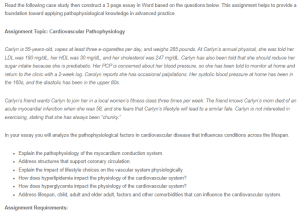
Case Study – Cardiovascular Pathophysiology
Assignment Topic: Cardiovascular Pathophysiology
Carlyn is 55-years-old, vapes at least three e-cigarettes per day, and weighs 285 pounds. At Carlyn’s annual physical, she was told her LDL was 190 mg/dL, her HDL was 30 mg/dL, and her cholesterol was 247 mg/dL. Carlyn has also been told that she should reduce her sugar intake because she is prediabetic. Her PCP is concerned about her blood pressure, so she has been told to monitor at home and return to the clinic with a 2-week log. Carolyn reports she has occasional palpitations. Her systolic blood pressure at home has been in the 160s, and the diastolic has been in the upper 80s.
Carlyn’s friend wants Carlyn to join her in a local women’s fitness class three times per week. The friend knows Carlyn’s mom died of an acute myocardial infarction when she was 58, and she fears that Carlyn’s lifestyle will lead to a similar fate. Carlyn is not interested in exercising, stating that she has always been “chunky.”
In your essay you will analyze the pathophysiological factors in cardiovascular disease that influences conditions across the lifespan.
- Explain the pathophysiology of the myocardium conduction system.
- Address structures that support coronary circulation.
- Explain the impact of lifestyle choices on the vascular system physiologically.
- How does hyperlipidemia impact the physiology of the cardiovascular system?
- How does hyperglycemia impact the physiology of the cardiovascular system?
- Address lifespan, child, adult and elder adult, factors and other comorbidities that can influence the cardiovascular system.
Assignment Requirements:
Before finalizing your work, you should:
- be sure you have an introduction and conclusion
- 3 pages of content are present
- 5 peer reviewed references
- Citation after every paragraph (parenthetical citation)
- use topical level one headings within the paper
- be sure to read the assignment description carefully (as displayed above);
- utilize spelling and grammar check to minimize errors.
Your writing assignment should:
- follow the conventions of Standard English (correct grammar, punctuation, etc.);
- be well ordered, logical, and unified as well as original and insightful;
- display superior content, organization, style, and mechanics; and
- use APA 7th edition format.