
Case Study and a Plan Of Care Incorporating Current Mobile App Technology
Health promotion and disease prevention remain valuable public health strategies for preserving lives within communities. Effective health promotion programs utilize an integrated multifactorial approach that focuses on various aspects of communities that predispose them to diseases. Fundamental in health promotion and disease prevention is identifying the populations of interest. With technological inventions in healthcare information technologies, specific health technologies such as telehealth can find valuable utilities in health promotional campaigns. This paper details a care plan for the diabetic community living in a neighborhood in Akron, OH.
The Selected Population
The population of interest is a diabetic community living in the eastern neighborhoods of Akron. This is a mixed group brought together principally by their health condition. The male gender dominates this group, accounting for more than 55% of the entire group. The group is composed of blacks and other minority groups such as Latinos and Arabs. The elderly are the majority, with the modal age being 67 years. The minority groups characterizing this population are mainly of low socioeconomic status. Most of them face the traditional healthcare disparities experienced among minority groups in the U.S. Additionally, access to healthcare remains a challenge to this population due to poverty, low literacy levels, and their sociocultural practices.
This population subscribes to varied spiritual deities and beliefs. While the majority are Christians and Muslims, atheists also exist in this population. Their healthcare practices and healthcare-seeking behavior are defined by their beliefs. This group generally has poor healthcare-seeking behavior due to their perspective on mainstream healthcare and socioeconomic status.
Healthcare needs specific to this population are insurance coverage, community education on health-seeking behavior, and availability of diabetic comprehensive care facilities. This group lags in insurance coverage, with about 25% lacking insurance coverage. Additionally, they have a negative perception of the mainstream healthcare system as many cast doubts on its effectiveness in delivering healthcare services. These communities also suffer from health disparities accustomed to poor availability of healthcare services due to the scarcity of healthcare facilities offering comprehensive diabetic care.
Addressing these issues may prove beneficial to members of this community. Expansion of insurance coverage to this group is the first strategy towards ensuring the accessibility of healthcare services to them. This will be per the provisions of Healthy People 2020 that reinforce the need to enhance access to basic healthcare for disadvantaged populations (Erlangga et al., 2019). Healthy People 2020 also aims to increase literacy levels in communities with lower literacy levels in an attempt to enhance their understanding of various aspects of healthcare (“Diabetes | Healthy People 2020”, 2022). In this regard, health promotion plans of community education programs on various healthcare practices that promote health can be executed in this population. These educational programs should focus on healthcare seeking for people with diabetes, compliance with antidiabetic medications, community screening for persons at risk of developing the disease, and education on preventive measures against the disease, such as exercising and diet modification. Establishing more healthcare facilities in these areas may bring healthcare services closer to the people, making them easily available.
Case Study
The case presented is of a 65-year-old African American male presenting with complaints of visual disturbances. He reports that he has been having difficulties reading his bible during morning devotions and that the problem has become worse in the past month. He was diagnosed with type 2 diabetes mellitus (DM) three years ago. He, however, ignored the diagnosis, claiming that his suffering was an inherited ancestral curse. He resorted to prayer and fasting. He recounted: “…after a period of prayer and fasting, I was healed.” He also reported using herbal supplements routinely for his disease. The patient is a staunch Christian. He lives alone and has no dependents. He indulges in garden activities to earn a living. He lacks insurance coverage and is currently not on medication. The 65-year-old African American patient reports frequent urination, thirst, and hunger. In addition, the patient looks wasted and fatigued. Preliminary findings reveal a high random blood sugar.
Provider Level of Care
The case presentation is a patient with type 2 diabetes mellitus with apparent vision loss due to a poorly controlled disease. The first step in managing this patient is evaluating and screening him to determine the extent of his disease. This is followed by aggressive antidiabetic therapy to attain glycemic control. Additionally, this patient should be educated on the significance of good health-seeking behavior, insurance coverage, and medication compliance to preserve health. The herbal supplements the patient has been using should be analyzed to determine their effectiveness in controlling glucose levels. Herbs are alternative modalities of care that may be effective in managing specific health conditions. Specific herbs maintain effectiveness in lowering blood sugar levels and may be used to complement antidiabetic medications (Alqathama et al., 2020). Since this patient believes in herbs as a remedy for his health condition, herbal modalities with antidiabetic properties can be integrated into his treatment regimen. Mobile technologies such as telehealth may find use in educating the patient, monitoring the patient, and following up on his condition. Educative mobile applications such as webMed and Medline contain insightful health information that may educate communities and individuals on diabetes and preventive measures for the disease. Healthcare providers can also use video teleconferencing to communicate directly with patients. This tool can also be used to surveil the patient and follow up on their disease.
Conclusion
The diabetic population is sometimes confronted with healthcare challenges due to self-attributes such as beliefs, religious affiliations, socioeconomic status, and culture. All of these impact their healthcare practices and inform their healthcare needs. Addressing these needs may provide the much-required relief for these patients and preserve their lives.
References
Alqathama, A., Alluhiabi, G., Baghdadi, H., Aljahani, L., Khan, O., & Jabal, S. et al. (2020). Herbal medicine from the perspective of type II diabetic patients and physicians: what is the relationship? BMC Complementary Medicine and Therapies, 20(1). https://doi.org/10.1186/s12906-020-2854-4.
Diabetes | Healthy People 2020. Healthypeople.gov. (2022). Retrieved 11 August 2022, from https://www.healthypeople.gov/2020/topics-objectives/topic/diabetes.
Erlangga, D., Suhrcke, M., Ali, S., & Bloor, K. (2019). Correction: The impact of public health insurance on health care utilization, financial protection and health status in low- and middle-income countries: A systematic review. PLOS ONE, 14(11), e0225237. https://doi.org/10.1371/journal.pone.0225237.
ORDER A PLAGIARISM-FREE PAPER HERE
We’ll write everything from scratch
Question 
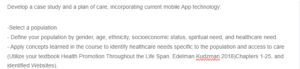
Develop a case study and a plan of care, incorporating current mobile App technology:
-Select a population.
– Define your population by gender, age, ethnicity, socioeconomic status, spiritual need, and healthcare need.
– Apply concepts learned in the course to identify healthcare needs specific to the population and access to care (Utilize your textbook Health Promotion Throughout the Life Span. Edelman Kudzman 2018)Chapters 1-25, and identified Websites).
Case Study and a Plan Of Care Incorporating Current Mobile App Technology
-Also, use at least two references within the five years.
-Develop a case study for a patient in your chosen population.
-Define a provider level of care that includes telehealth, alternative therapies, and mobile App technology discussed in this class. Describe how telehealth could impact the care delivery of this patient.
Length: 3 pages, not including the title page and references page
Format: APA, 7th edition format is to be observed (12 pt., 1” margins, Times New Roman)
Research: Two references within the last five years