
Case Study Analysis
Based on the symptoms – including severe right-sided headache, vomiting, nausea, and “light hurting the eyes” – it is evident that the 24-year-old is suffering from a neurological condition known as “migraine.” Several neurological and musculoskeletal pathophysiologic processes could have resulted in the patient presenting these symptoms (Goadsby, 2012). Although the causes of migraines are often unclear, environmental factors and genetics are believed to play a significant part, and they essentially impact the neurological and musculoskeletal pathophysiologic processes.
Specifically, these factors are believed to trigger an imbalance of serotonin, a significant neurotransmitter that subsequently changes the brainstem and its interaction with the trigeminal nerve (Silberstein, 2020). These factors include hormonal changes, drinks, stress, sensory stimuli, sleep changes, physical characteristics, weather changes, medications, foods, and additives. In the patient’s case, overstaying in the emergency room might have triggered the migraine. In simpler terms, the release of serotonin alters central neural processing by activating brain stem nuclei, spreading cortical depression and hyperexcitability. It is also believed to activate the trigeminovascular system – which consequently triggers neuropeptide release, resulting in painful inflammation in the dura mater and cranial vessels. This might explain some symptoms, including “light hurting” and severe right-sided headaches (Nall, 2017).
Besides these environmental elements, genetic factors might also be attributed to the patient’s migraine. This type of migraine, often known as hemiplegic migraine, is linked with faults on chromosomes 19, 2, and 1 (Burstein, Noseda, & Borsook, 2015). The migraine phenotypes have been found to vary significantly across families, causing vertigo in some, headache in others, and sometimes aura or hemiplegia in others. These genetic factors often interact with the abovementioned environmental factors to generate a more severe form of migraine.
References
Burstein, R., Noseda, R., & Borsook, D. (2015). Migraine: Multiple processes, complex pathophysiology. The Journal of Neuroscience, 35(17), 6619-6629.
Goadsby, P. J. (2012). Pathophysiology of migraine. Annals of Indian Academy of Neurology, 15(1), 15-22.
Nall, R. (2017, Dec. 20). Everything you want to know about migraine. Healthline. Retrieved from https://www.healthline.com/health/migraine#pain
Silberstein, S. D. (2020). Migraine. MERCK Manual Professional Version. Retrieved from https://www.merckmanuals.com/professional/neurologic-disorders/headache/migraine
ORDER A PLAGIARISM-FREE PAPER HERE
We’ll write everything from scratch
Question 
Case Study Analysis
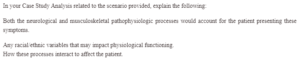
In your Case Study Analysis related to the scenario provided, explain the following:
Both the neurological and musculoskeletal pathophysiologic processes would account for the patient presenting these symptoms.
Any racial/ethnic variables that may impact physiological functioning.
How these processes interact to affect the patient.