
Case 17.1 – Martha Stewart’s Conviction
Case 17.1 recounts the 2004 criminal conviction of Martha Stewart. It mainly highlights Martha’s public announcement of her decision to serve her prison sentence following the verdict that found her guilty of conspiracy, justice obstruction, and making false statements (Cheng, 2011). While she noted she would appeal the verdict, she cooperated and sought the court’s support as she began her sentence.
Case Discussion
The Significance of Ms. Stewart’s Public Announcement
Martha publicly announced her decision as a strategic approach to effectively resolve the conflict by aiming to positively influence public perception and rebuild trust with stakeholders. Essentially, establishing trust is an important step in setting the tone for negotiation (Corvette, 2007). Also, announcing her cooperation with the authorities demonstrated a cooperative response to conflict. Notably, the cooperative/collaborative style is valuable in reinforcing respect and mutual trust and laying the foundation for effective collaboration in the future (Sharma et al., 2014).
Evaluation of Ms. Stewart’s Public Relations
Martha’s public relations strategy mainly focused on her reputation, whereby she aimed to rebuild trust by adopting a communication approach that reflected her values of responsibility and resilience. These efforts were successful, as she was able to restore her image, shifting the public attitude from criticism to admiration. A 2005 poll even showed that she had become more popular, with a 52% favorable rating compared to years before the ordeal (Cheng, 2011).
Comparing Martha’s Public Relations Efforts with Former Enron Executives
Ms. Stewart’s public relations strategy aligns with effective conflict management. Her collaborative approach aimed at rebuilding trust with the public through cooperation, transparency, and responsibility. On the other hand, Enron executives adopted an avoidance strategy—they avoided discussing their financial scandal and tried to deflect the media from the scandal (Reber & Gower, 2006). They also blamed each other, and due to their history of opacity, any corrective measure they tried seemed disingenuous to the public eye (Reber & Gower, 2006).
Conclusion
Case 17.1 is relevant in understanding conflict management as it portrays the outcomes of effective as well as ineffective conflict management styles. It also emphasizes that trust is crucial for successful public relations as well as negotiation. Additionally, the case has taught me that effective communication, responsibility, and accountability can shift perception, leading to successful negotiation outcomes.
References
Cheng, S. S. (2011). A corporate hero with scandal: Lessons learned from Martha Stewart’s insider trading crisis. International Journal of Humanities and Social Science, 1(15), 12–24. https://ir.lib.cyut.edu.tw/bitstream/310901800/22554/2/Never+delete+A+corporate+hero+with+scandal.pdf
Corvette, B. A. B. (2007). Conflict management: A practical guide to developing negotiation strategies. Pearson Prentice Hall.
Reber, B. H., & Gower, K. K. (2006). Avow or avoid? Journal of Promotion Management, 12(3–4), 215–239. https://doi.org/10.1300/j057v12n03_12
Sharma, V., Goyal, V., & Panwar, S. (2014). Managing conflict at workplace. International Journal of Management, IT and Engineering, 4(6), 179–191. https://www.indianjournals.com/ijor.aspx?target=ijor:ijmie&volume=4&issue=6&article=015&type=pdf
ORDER A PLAGIARISM-FREE PAPER HERE
We’ll write everything from scratch
Question 
Case 17.1 – Martha Stewart’s Conviction
Case 17.1
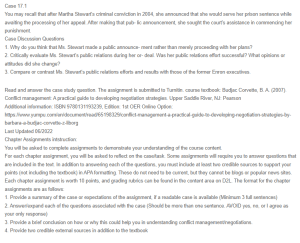
You may recall that after Martha Stewart’s criminal conviction in 2004, she announced that she would serve her prison sentence while awaiting the processing of her appeal. After making that public announcement, she sought the court’s assistance in commencing her punishment.
Case 17.1 – Martha Stewart’s Conviction
Case Discussion Questions
1. Why do you think that Ms. Stewart made a public announce- ment rather than merely proceeding with her plans?
2. Critically evaluate Ms. Stewart’s public relations during her ordeal. Was her public relations effort successful? What opinions or attitudes did she change?
3. Compare or contrast Ms. Stewart’s public relations efforts and results with those of the former Enron executives.
Read and answer the case study question. The assignment is submitted to Turnitin. course textbook: Budjac Corvette, B. A. (2007). Conflict management: A practical guide to developing negotiation strategies. Upper Saddle River, NJ: Pearson
Additional information: ISBN 9780131193239, Edition: 1st OER Online Option:
https://www.yumpu.com/en/document/read/65198329/conflict-management-a-practical-guide-to-developing-negotiation-strategies-by-barbara-a-budjac-corvette-z-liborg
Last Updated 06/2022
Chapter Assignments intstruction:
You will be asked to complete assignments to demonstrate your understanding of the course content.
For each chapter assignment, you will be asked to reflect on the case/task. Some assignments will require you to answer questions that are included in the text. In addition to answering each of the questions, you must include at least two credible sources to support your points (not including the textbook) in APA formatting. These do not need to be current, but they cannot be blogs or popular news sites. Each chapter assignment is worth 10 points, and grading rubrics can be found in the content area on D2L. The format for the chapter assignments are as follows:
1. Provide a summary of the case or expectations of the assignment, if a readable case is available (Minimum 3 full sentences)
2. Answer/expand each of the questions associated with the case (Should be more than one sentence. AVOID yes, no, or I agree as your only response)
3. Provide a brief conclusion on how or why this could help you in understanding conflict management/negotiations.
4. Provide two credible external sources in addition to the textbook