
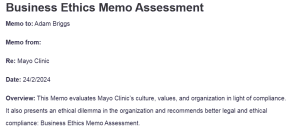
Business Ethics Memo Assessment
Memo to: Adam Briggs
Memo from:
Re: Mayo Clinic
Date: 24/2/2024
Overview: This Memo evaluates Mayo Clinic’s culture, values, and organization in light of compliance. It also presents an ethical dilemma in the organization and recommends better legal and ethical compliance: Business Ethics Memo Assessment.
Name and Description of the Organization
The Mayo Clinic is a nonprofit medical center that is well-known for its integrated clinical practice, education, and research. Its headquarters is in Rochester, Minnesota, but it maintains hospital and clinic facilities in multiple states and provides world-class patient services in various medical specializations. As a healthcare innovator, Mayo Clinic is focused on evidence-based treatments, patient-centric care, and medical breakthroughs(Caine et al., 2022). Its role in healthcare extends to pioneering new treatments, training medical professionals, and setting industry standards for quality and ethical medical practice.
Description of the Organizational Culture
Mayo Clinic’s culture is grounded in ethical behavior through values, teamwork, and prioritizing innovation. The primary value, “The needs of the patient come first,” is what makes up an integrity culture in which decisions made by staff prioritize patients’ welfare. Its teamwork focus also enhances accountability and transparency, keeping unethical behavior to a minimum. The blend of education, research, and practice solidifies ethical practices by fostering evidence-based treatments and continual education.
Three key reasons allow Mayo Clinic to uphold ethical standards. First, its nonprofit status removes monetary pressures on for-profits that usually lead to compromising on ethics. Second, strong leadership and ethics education programs ensure employees have clear expectations and parameters for maintaining integrity. Third, strict regulations for compliance and external partnerships ensure regular checks, minimizing chances for unethical practices.
The Mission, Code of Ethics, and Core Values of the Organization
Mayo Clinic’s mission is to inspire hope and contribute to health and wellness by delivering excellent care for each patient through research, teaching, and integrated clinical practice (Caine et al., 2022). The mission is to focus on patient-centric care, medical innovations, and continuous learning to improve health outcomes. The organization creates an environment of excellence, and every decision and action is taken by its dedication to medicine in an ethical context. By fostering quality treatment and innovative research, Mayo Clinic is always ahead in health improvement.
Integrity, compassion, healing, teamwork, creativity, excellence, stewardship, and respect are the cornerstones of the Mayo Clinic’s code of conduct. These values guide employees to uphold moral practices through honesty, accountability, and professional conduct in business and patient care. The organization upholds strict adherence to ethics education and compliance to ensure employees maintain such values. Such a strong moral code assures trust between patients, employees, and the general medical society and between Mayo Clinic.
Leadership Strategies to Promote Legal and Ethical Compliance
Mayo Clinic employs several leadership practices to provide legal and ethical compliance, and employees uphold the highest possible standard of integrity. The leaders lead by example by practicing moral behavior and maintaining values through clear and transparent decisions and accountability (Lapatoura, 2025). The clinic employs comprehensive ethics education programs, and employees are taught to deal with tough moral and legal situations. Continuous auditing and checks on compliance ensure potential dangers and reinforce adherence to regulations.
An accessible employee guidebook lays down clear practices and policies, and employees clearly understand their legal and moral commitments. Open communication channels, such as confidential reporting systems and ethics committees, encourage employees to confidently provide their opinions and complaints (Atiku et al., 2024). These practices ensure Mayo Clinic upholds an environment of moral excellence and compliance with regulations.
Legal and/or Ethical Issues
One ethical challenge Mayo Clinic found itself in entailed accusations of prioritizing privately insured patients over Medicare and Medicaid patients. A former administrator claimed privately insured patients were prioritized for advanced treatments for greater reimbursement, and health equity and moral integrity questions were raised. The behavior was unethical to the extent that it violated the goal of prioritizing patients’ needs, regardless of their ability to pay. In response, Mayo Clinic did not confess to intentional favoritism but reinforced fair treatment focus by re-examining scheduling practices and re-affirming fair access to treatment policies.
The organization acted responsibly by addressing complaints in the public eye and reaffirming its commitment to moral choice. No official sanctions were imposed, but the scandal reminded everyone of continued oversight in maintaining fiscal sustainability while maintaining moral commitments. Ultimately, the Mayo Clinic reinforced accountability and reassured stakeholders of their commitment to patient-oriented treatment.
Recommendations to Strengthen Legal and Ethical Compliance
To improve adherence to the law and ethics, Mayo Clinic could use an advanced ethics and compliance education system to handle daily healthcare scenarios. The initiative would comprise regular case studies on solving ethical dilemmas, legal regulations, and patients’ rights. By incorporating interactive learning methods such as simulations and scenario-based discussions, employees would develop critical thinking skills to handle complex ethical issues effectively (Holdsworth et al., 2024). The system would make the organization more ethical by sensitizing employees to potential weaknesses in compliance, confirming Mayo Clinic’s integrity, and assisting them in upholding ethical practices in their daily routines.
Another recommendation is to have an independent external professionals’ oversight board to guide policies and address questions of ethics. The board regularly checks Mayo Clinic’s practices to ensure fairness and transparency in patients’ decisions. The board would also ensure accountability by inquiring about potential unethical acts and issuing policy suggestions.
The initiative would advance the organization’s practices in ethics by ensuring fair judgments, establishing trust between patients and stakeholders, and addressing potential compliance issues before they escalate to serious heights. These steps would solidify Mayo Clinic’s position in health practice leadership.
References
Atiku, S. O., Itembu-Naunyango, K. A., & Oladejo, O. M. (2024). Inclusive leadership and employee engagement as critical drivers of sustainability in telecommunication companies. Administrative Sciences, 14(6), 126–126. https://doi.org/10.3390/admsci14060126
Caine, N. A., Ebbert, J. O., Raffals, L. E., Philpot, L. M., Sundsted, K. K., Mikhail, A. E., Issa, M., Schletty, A. A., & Shah, V. H. (2022). A 2030 vision for the Mayo Clinic department of medicine. Mayo Clinic Proceedings, 97(7), 1232–1236. https://doi.org/10.1016/j.mayocp.2022.02.010
Holdsworth, S., Sandri, O., Hayes, J., & Maslen, S. (2024). Scenario-based capability assessment in professional learning contexts. Journal of Adult and Continuing Education. https://doi.org/10.1177/14779714241297069
Lapatoura, C. (2025). The role of leadership in shaping ethical culture and practices of excellence: A system thinking approach. In IntechOpen eBooks. https://doi.org/10.5772/intechopen.115308
ORDER A PLAGIARISM-FREE PAPER HERE
We’ll write everything from scratch
Question 
As a risk manager, you have been assigned to an organizational committee that has been asked to evaluate the organization and make recommendations to the compliance officer on ways to strengthen legal and ethical compliance. Using a memo format, you explain the effect of organizational ethics, culture, and values on compliance to evaluate business ethics.
A memo template has been provided for you to use.
You will research organizations, not agencies, for this assessment. Remember that an organization is a company or business, such as a hospital, clinic, or insurance company. Whereas an agency is a part of the government at the federal, state, or local levels, such as the U.S. Food & Drug Administration (FDA), the U.S. Department of Labor (DOL), or a state health department.
Business Ethics Memo Assessment
Choose 1 of the following options to complete this assignment:
- Verizon Healthcare IT Solutions
- United Healthcare
- Tuskegee University Hospital
- Stryker Corporation
- Mayo Clinic/Health care
- Juvenile Diabetes Research Foundation (JDRF)
- GE Healthcare
- Aetna Insurance
Research your selected organization’s compliance information.