
BarkBox SWOT Chart & Porter’s Five Forces Model
BarkBox has emerged as a leader in the bustling world of pet products, particularly in the subscription area. The customizable options offered by the company attract clients who see their dogs as family, hence the willingness to invest significantly in their nutritional and social well-being. BarkBox’s survival in an industry characterized by fierce competition largely depends on customer loyalty. To that end, BarkBox has put efforts into providing quality products and improving the customer shopping experience. Considering BarkBox’s inroads in the urban pet food market, the company’s subscription-based model has been successful.
SWOT Analysis
| Strengths
· Strong brand loyalty · Engaging subscription model · High-quality and diverse products · Collaborative networks with other industry players |
Weaknesses
· Overdependence on the subscription model · Limited international shipping options · Potential customer dissatisfaction if the delivered contents fail to align with customer expectations |
| Opportunities
· International expansion will significantly broaden BarkBox’s market share · The introduction of health-focused and eco-friendly products will bolster the customer base · Collaboration with credible veterinarians and renowned dog trainers will bolster credibility |
Threats
· Significant competition from other pet companies · Economic downturns affect the subscription model · Shifting customer preferences to one-time purchases over subscription |
One of BarkBox’s strengths is that the company has cultivated a loyal customer base, making it a strong brand compared to other industry players. With over 90% of customer subscriptions lasting more than a year, it is clear that most customers are satisfied with the curated offerings offered by BarkBox (Feng, 2022). Besides, BarkBox’s subscription model is quite flexible, offering customers the opportunity to explore offerings that align with their budget. Besides, BarkBox offers a range of diverse food products and toys designed for pets of varying ages. Passionate dog owners can be sure to have all their dogs’ needs sorted by visiting the BarkBox website. Also, the company’s collaboration with renowned industry players such as PetSafe and Maries Pet Food bolsters BarkBox’s brand credibility since these players are trusted.
On the flipside, BarkBox’s weaknesses include the overreliance on the subscription model. With over 85% of the company’s revenue coming from customers in the subscription business model, revenues will significantly reduce during economic downturns. Another weakness is the limited international shipping capability. BarkBox primarily operates in North America, foregoing a significant market in Europe and Asia due to a lack of international shipping mechanisms. Also, there are concerns regarding customer dissatisfaction with the subscription content. This is particularly concerning considering that most clients who frequent BarkBox do so to acquire high-quality product offerings.
Looking into the future, BarkBox can exploit existing and emerging opportunities to thrive. One such opportunity is to tap into the bustling global market beyond Canada and the US. The pet parenting culture is taking root in European countries such as Germany and the UK; hence, expanding into such locations will expand the company’s market share. Also, BarkBox may leverage the ongoing health and environmental consciousness by diversifying its products to include organic and eco-friendly offerings. Health-conscious customers will embrace such options, expanding the company’s reach even further (Feng, 2022). Additionally, BarkBox can enhance its credibility by collaborating with accredited dog trainers and veterinarians. Given the huge pet population in the US, collaborating with these key players will come in handy since they can act as BarkBox brand ambassadors.
Threats faced by BarkBox include the increasing competition in the pet products industry. For instance, the entrance of new brands such as PetBox and Chewy presents new concerns for BarkBox, as it has to make efforts to gain a competitive advantage over them (Feng, 2022). Also, there is a constant threat of customers capping their nonessential expenditures, particularly during economic downturns, and this will seriously affect BarkBox’s bottom line. Additionally, the possibility of customers shifting preferences toward one-time purchases over subscription baskets will affect the company’s revenue since it relies heavily on the subscription model.
Porter’s Five Forces Analysis
Competition Rivalry
BarkBox’s main competition comes from the Chewy brand. Just like BarkBox, the Chewy brand also offers subscription-based services to dog owners. The equivalent of the BarkBox basket provided by Chewy is the Goody Box. Whereas the BarkBox pricing is based at $23, the Goody Box is priced between $24.99-$34.32 (Ghoreishi, 2022). Given that there are not many brands that compete with BarkBox in the US subscription market, the company faces little competitive pressure. Therefore, rival competition is low in the market.
Threat of New Entrants
The threat of new entrants in the US pet products market is significantly high. From the outset, signs indicate that Chewy has positioned itself to compete directly with BarkBox in terms of product offerings and branding messaging (Ghoreishi, 2022). Besides, it is also possible that other players like Petco and PetSmart will rival BarkBox’s subscription-based offerings. The low cost of entry and an expanding market have made it possible for new players to thrive speedily. A key challenge posed by the significantly high threat of new entrants is that vertical product development becomes costly, and this is likely to affect the company’s bottom line. Since the company is growing, market saturation has not yet been reached, and this presents an opportunity to enter the market and grow. Petco and Chewy are some of the new entrants that threaten BarkBox’s position as a leader in the pet products industry.
Threat of Substitutes
Since BarkBox focuses on bundled pet products, the brand’s substitutes are individual treats and toys. These substitutes can be acquired from pet stores across the US. As of 2021, pet stores across the US were over 13,000, and the number keeps growing as more Americans adopt the pet parenting culture (Ghoreishi, 2022). The single individual brand that controls many stores is Chewy, which offers a myriad of toys and treats customers may choose from. Other brands, such as Petco and PetSmart, equally present significant competition. Given the high market saturation that offers customers an opportunity to choose from a wide variety, the threat presented by substitute offerings is significantly high.
Buyer Power
The overall buyer bargaining power at BarkBox is medium. An analysis of the company’s statements shows that there is no single customer who makes up more than 10% of its total revenue (Ghoreishi, 2022). This is because a majority of customers have alternative avenues where they can purchase their pet products from. However, in the commerce segment, where products are sold through online marketplaces and large retailers, customers have moderate bargaining power. Overall, the buyer power ranges from low to medium.
Supplier Power
BarkBox’s suppliers have low bargaining power. This is partly because the company has spread its supplier networks to avoid the risks associated with overreliance on a single supplier. By sourcing finished products from multiple suppliers, the company gets favorable terms. Also, it is easy to switch because there are many suppliers.
Conclusion
In summary, A SWOT analysis of BarkBox shows that the company will benefit greatly by expanding into international markets. That is because it is limited to the US and Canada, yet emerging markets in Europe and Asia present a significant potential market. Also, the growing competition in the pet products market shows a need to innovate new products to gain a competitive edge. On the other hand, Porter’s five forces analysis re-emphasizes the need to innovate to arrest competition posed by new entrants who offer substitute pet food, treats, and toys.
References
Feng, Y. (2022). Digital PET product & service platforms. In Advances in Economics, Business and Management Research. Atlantis Press International B.V. https://doi.org/10.2991/aebmr.k.220307.466
Ghoreishi, D. (2022). Bark case analysis. https://daryoushghoreishi.com/assets/analysis/bark-case-analysis.pdf
ORDER A PLAGIARISM-FREE PAPER HERE
We’ll write everything from scratch
Question 
BarkBox SWOT Chart & Porter’s Five Forces Model
Topic: Barkbox
Task
Write a 3–5-page paper addressing the following sections. Include headings, sub-headings, and references.
Provide a brief introduction and overview of your selected product.
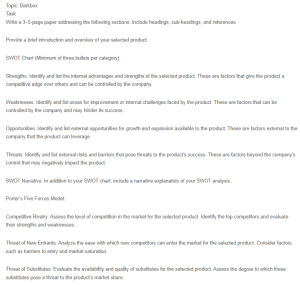
BarkBox SWOT Chart & Porter’s Five Forces Model
SWOT Chart (Minimum of three bullets per category):
Strengths: Identify and list the internal advantages and strengths of the selected product. These are factors that give the product a competitive edge over others and can be controlled by the company.
Weaknesses: Identify and list areas for improvement or internal challenges faced by the product. These are factors that can be controlled by the company and may hinder its success.
Opportunities: Identify and list external opportunities for growth and expansion available to the product. These are factors external to the company that the product can leverage.
Threats: Identify and list external risks and barriers that pose threats to the product’s success. These are factors beyond the company’s control that may negatively impact the product.
SWOT Narrative: In addition to your SWOT chart, include a narrative explanation of your SWOT analysis.
Porter’s Five Forces Model:
Competitive Rivalry: Assess the level of competition in the market for the selected product. Identify the top competitors and evaluate their strengths and weaknesses.
Threat of New Entrants: Analyze the ease with which new competitors can enter the market for the selected product. Consider factors such as barriers to entry and market saturation.
Threat of Substitutes: Evaluate the availability and quality of substitutes for the selected product. Assess the degree to which these substitutes pose a threat to the product’s market share.
Buyer Power: Evaluate the bargaining power of buyers in the market for the selected product. Consider factors such as the number of buyers and their ability to influence prices.
Supplier Power: Assess the bargaining power of suppliers providing inputs for the selected product. Consider factors such as the number of suppliers and the ease of switching between them.
Format:
This assignment should be double spaced, 12-point Arial or Times New Roman Font
Include references and in-text citations
Assignment will be 3-5 pages not including the title page or reference list
Note: Ensure that your analysis is thorough and supported by evidence. Use relevant marketing terminology and concepts to demonstrate your understanding.