
Asset Based Assessment
Part 1
| Needs Assessment | Community Strengths and Existing Resources |
| Environment/Living arrangements | A daily average of 63,000 people, mainly children, live in shelters in New York. There is Medicaid Managed Care for Special Health Needs and other programs, including Federal housing programs. |
| Access to transportation | The Coalition for the Homeless organization has established a network of 24-hour clinics and centers for the homeless in prone areas across New York, eliminating the need for long-distance movements. |
| Financial Considerations | The majority of people experiencing homelessness are low-income earners who were once tenants but failed to maintain their rent arrangements. They lack financial resources for legal presentation. The Coalition for the Homeless has plans to provide legal support to low-income tenants. |
| Cultural/language barriers | A majority of the homeless New Yorkers speak English and can easily converse in Spanish. |
| Public perception of the group | People experiencing homelessness were once perceived as lazy or a danger to the public (Markowitz et al., 2019). However, the perception is slowly changing to a more compassionate and liberal one. |
| Common health risks | The standard health risks are tuberculosis, obesity and diabetes, mental health disorders, high blood pressure, flu, asthma, illicit substances, and drug use. |
| Access to health and social services | Despite the availability of special health needs programs in New York, a majority of the homeless population has limited access to healthcare and social services (Claudio et al., 2020). |
Part 2: Information on the Organization and Person Interviewed
Organization name: Coalition for the Homeless
URL of the organization’s website: https://www.coalitionforthehomeless.org/
Person interviewed:
Interviewee’s’ title and role in the organization:
Email address of the person interviewed:
Services Provided by the Coalition for the Homeless
The Coalition for the Homeless organization provides various services to homeless people in New York. Through the Grand Central Food Program, the organization serves nutritious meals to homeless New Yorkers. It also provides crisis services from headquarters in Lower Manhattan that support homeless and at-risk men, women, and children. Other services include supporting housing programs, job training and supporting placement, lost youth education support, and advocacy for the rights of homeless New Yorkers.
Summary of the Interview
The interview respondent believes that the issues of homeless people without housing have a negative impact on both people experiencing homelessness and housed New people experiencing homelessness. The respondent believes that people experiencing homelessness deserve to have dignity and the right to access health, housing, transport, healthy food, privacy, and a safe place to live. They believe that shelters do not offer a permanent solution to think of homelessness. They also believe homelessness and homelessness can be resolved by establishing proper permanent housing programs.
Interview Transcript
Intervpeople without housing think the shelters for people without housing in New York are the solution to the homelessness problem we are currently experiencing.
Respondent: In short. No. It is just a patch, not a solution.
Intervipeople experiencing homelessness On your experiences with people experiencing homelessness, do you feel they have hope to one day own a home?
Respondent: No. Their experiences so far have drained all of their hopes for owning a home or even having a chance to move from the streets into a temporary house.
Interviewer: But do you believe, someday, it is possible for them?
Respondent: Yes. Based on our programs, people experiencing homelessness are ultimately restoring hope for people without housing.
Interviewer: Can you tell me about the housing programs?
Respondent. Currently, there are three programs: The Coalition hive-story brownstones, which now provide permanent housing and supportive services to 38 homeless single adults in Manhattaoffers. The Bridge Building program offers safe and affordable one- and two-bedroom apartments fo. In contrast, there are fewer mothers and their children. In contrast, the Scattered Site Housing Program provides private permanent housing and support for homeless people living with HIV/AIDS.
Interviewer: How easy is it for homeless people to access health care and other services, such as legal and social support services, in New York?
Respondent: That is extremely hard. Really hard. They rarely have access to legal services.
Interviewer: Currently, do you have programs that ease the case?
Respondent: Yes. In Coalitipeople experiencing homelessnessomeless, we believe that people experiencing homelessness deserve to have dignity and the right to access health, housing, transport, healthy food, privacy, and a safe place to live. We currently have programs that support access to health for people experiencing homelessness and legal services for people without housing in New York.
References
Claudio, E., Donahue, J., Niles, P. M., Pirsch, A., Ramos, P., Neely, I., Conceiçaõ, R., Thomas, M. P., St Vil, T., & Kaplan, D. (2020). Mobilizing a Public Health Response: Supporting the Perinatal Needs of New Yorkers during the COVID-19 Pandemic. Maternal and Child Health Journal 2020 24:9, 24(9), 1083–1088. https://doi.org/10.1007/S10995-020-02984-6
Markowitz, F., Behavior, J. S.-D., & 2021, undefined. (2019). Race, gender, and homelessness stigma: Effects of perceived blameworthiness and dangerousness. Taylor & Francis, 42(7), 919–931. https://doi.org/10.1080/01639625.2019.1706140
ORDER A PLAGIARISM-FREE PAPER HERE
We’ll write everything from scratch
Question 
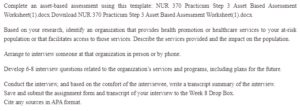
Complete an asset-based assessment using this template: NUR 370 Practicum Step 3 Asset Based Assessment Worksheet(1).docx Download NUR 370 Practicum Step 3 Asset Based Assessment Worksheet(1).docx
Asset Based Assessment
Based on your research, identify an organization that provides health promotion or healthcare services to your at-risk population or that facilitates access to those services. Describe the services provided and the impact on the population.
Arrange to interview someone at that organization in person or by phone.
Develop 6-8 interview questions related to the organization’s services and programs, including plans for the future.
Conduct the interview, and based on the comfort of the interviewee, write a transcript summary of the interview.
Save and submit the assignment form and transcript of your interview to the Week 8 Drop Box.
Cite any sources in APA format.