
Assessing and Treating Patients with ADHD
The patient described in the case study is a Caucasian female aged eight years named Katie, who is presented to the clinic by her parents upon a referral from a primary healthcare provider. This referral resulted from suspicion of attention deficit hyperactive disorder (ADHD) in the child. An evaluation tool filled by the teachers indicates that Katie is not only easily distracted in her classwork but is also inattentive, forgets things she learns from class quickly, and is poor at spelling, reading, and arithmetic. The teacher also noted that Katie has a short attention span and is only attentive to things that interest her. Additionally, she exhibits considerable difficulties in finishing chores and following instructions.
On subjective examination, Katie admits to having subject favorites in art and recess, with other subjects boring. She further explains that the tedious nature of those subjects is because she feels lost in these subjects. She also notes that she experiences episodes in which the teacher would call her name in class and find her not relating to what the teacher is discussing. However, she reports being okay at school and home and also denies any form of bullying or abuse at school. Mental examination reveals that she is developed appropriately for her age and exhibits clarity, logic, and coherence in speech. She is also oriented adequately to time, place, and event and is appropriately dressed for the weather. She denies any auditory or visual hallucinations and exhibits age-appropriate insight and judgment.
Katie has a positive diagnosis of ADHD. ADHD is a mental disorder characterized by short attention span, easy distractibility, forgetfulness, task organization difficulty, inability to stick to tasks, inability to get instructions, and difficulty in concentration. The symptoms exhibited by Katie are consistent with ADHD. As evident in the Conner Teacher Rating Sale revised tool, Katie exhibits easy distraction, is forgetful, is inattentive, has a short attention span, and has difficulty accomplishing tasks. All these symptoms are consistent with ADHD and formed the basis of diagnosis.
Decision point 1
The best clinical decision for Katie is to begin methylphenidate (Ritalin) chewable tablets at 10mg once daily in the morning. Methylphenidate is a stimulant that is FDA-approved as a first-line agent in the treatment of ADHD among children and adolescents (Shier et al., 2016). This drug maintains considerably high efficacy in the alleviation of symptoms attributable to ADHD. Methylphenidate enhances the release of the neurotransmitters dopamine and norepinephrine by blocking their reuptake, thus increasing their levels in the brain’s prefrontal cortex. Their level of efficacy in ADHD informed my selection as the first-line agent to be used in this patient.
The other two options available in the management of this patient were bupropion 150mg and Intuniv extended-release at 1mg once daily. Bupropion is an antidepressant that has an off-label utility in the treatment of ADHD. Bupropion is equally highly efficacious in the alleviation of symptoms of ADHD (Brown et al., 2018). This medication, however, exhibits adverse drug reactions that limit its use in children. Such adverse effects include suicidal thoughts, tachycardia, diaphoresis, and headaches, among others. These effects make it unfavorable for utility in children. Intuniv(guanfacine), on the other hand, is a non-stimulant anti-ADHD agent of the alpha two agonist class that is used in ADHD. It also maintains high efficacy in symptom alleviation in this disorder but is linked to intolerable side effects such as marked sedation, xeropthalmia, constipation, and headache, which limits its use (Brown et al., 2018). The toxicity profile of these two drugs was the basis for their exclusion as agents of choice for the management of ADHD in an 8-year-old child.
The aim of selecting Ritalin as the first choice in the management of ADHD in this child was to offer symptomatic relief while preventing adverse drug effects that may be debilitating to the patient. Ritalin is one of the first-line medications utilized in ADHD. This drug is generally effective and safe in children and adolescents. They, however, present with some cardiovascular side effects, such as tachycardia, although this increase may not be sufficient to be classified as abnormal (Shier et al., 2016). They are generally well-tolerated and have been utilized in the long-term management of ADHD. ADHD is a mental disorder that can present with issues such as stigma. Therefore, healthcare providers must maintain confidentiality with the patient and treat them respectfully as human beings.
Decision point #2
After four weeks, the patient returned to the clinic with improved symptoms and performance at school. She, however, reported tachycardia and complaints of “daydreaming” and “staring off into space.” The second decision would be to switch to a long-acting Ritalin at 20mg oral morning dose. Ritalin LA produces less pronounced side effects than the conventional Ritalin preparation available in the market. This is because the extended-release formulation enters the bloodstream more slowly and steadily, thereby preventing spikes in the serum level of the drug attributable to the drug’s toxic profiles (Childress et al., 2018). As evident in the patient, the conventional Ritalin chewable tablets produced a pronounced tachycardia affecting the patient. These effects are expected to be reduced by switching to extended-release formulations.
The side effects of tachycardia were pronounced with a dose of 10mg. It was, therefore, inappropriate to continue with the same dose due to these side effects. On the other hand, discontinuation of Ritalin and subsequent initiation of Adderall was also not warranted in this patient. This is because the drug use seems to be effective, as evident in the increase in performance and alleviation of symptoms of these patients. The occurrence of predictable side effects as those seen in the child does not warrant substitution to second-line agents such as Adderall.
The clinical decision was aimed at addressing the side effects of the immediate-release formulation of Ritalin. The most pronounced side effect is tachycardia, which was confirmed by clinical values of 130 bpm. This warranted the switch to extended-release formulations that will adequately address this. Ethical codes of beneficence and fidelity should be observed when addressing this patient and her parents. Beneficence will enable the provider to decide well for the patient and her family (Kinsinger, 2016). On the other hand, fidelity will ensure that the provider honors the patient’s opinions and perspectives.
Decision point 3
After four weeks of returning to the clinic, Katie reported a resolution of symptoms and side effects. The best decision is to maintain the current dose of Ritalin LA for four weeks before returning for reevaluation. Clinical effectiveness was established with the utilization of Ritalin LA at 20mg. At this dose, the side effects were also resolved considerably. This, therefore, necessitates the maintenance of this regimen unless informed otherwise by a clinical event.
Increasing the dose to 30mg is not warranted in this case due to the absence of clinical indication for upward dose titration. The resolution of adverse drug effects also points to the absence of a need to increase the dose. Obtaining an EKG is also of no clinical importance. This is because the resolution of tachycardia that was initially present was achieved by switching to the extended-release formulation (Drechsler et al., 2020). These reasons formed the basis of the exclusion of these options in the treatment plan for this patient.
This selection aimed to ensure the maintenance of controlled symptoms and freedom from side effects. The patient’s case seems controlled, as evidenced by the clinical presentation during the current visitation. The side effects initially present have also been resolved. Therefore, it is in the best interest of the patient and the provider to maintain this therapy to enhance the patient’s well-being. Ethical codes of non-maleficence and beneficence were considered in this decision. Non-maleficence ensures that the provider’s decision does not harm the patient, while beneficence ensures that the provider’s decision does well for the patient.
ADHD is a mental disorder that various pharmacological agents manage; these include bupropion, Ritalin, Intuniv, Adderall, and Dexedrine. All these medications maintain high efficacy in the management of ADHD. However, their utilization depends on the appropriateness of use as informed by their toxicity profiles.
Conclusion
Ritalin is an FDA-approved drug in the first-line management of ADHD. It is highly productive in the alleviation of symptoms associated with this mental disorder. However, the immediate-release formulation of this drug is associated with a myriad of side effects that may limit its utility in the management of this disorder. The extended-release formulation is thus recommended for long-term use in ADHD. Bupropion, on the other hand, is an antidepressant that has found an off-label use in ADHD. It alsointains high efficacy in themanagingis disease, but its use is limited by its intolerable side effect profile. Guanfacine ER(Intuniv) also has limited use in children due to its side effect profile.
References
Brown, K., Samuel, S., & Patel, D. (2018). Pharmacologic management of attention deficit hyperactivity disorder in children and adolescents: a review for practitioners. Translational Pediatrics, 7(1), 36-47. https://doi.org/10.21037/tp.2017.08.02
Childress, A., Mehrotra, S., Gobburu, J., McLean, A., DeSousa, N., & Incledon, B. (2018). Single-Dose Pharmacokinetics of HLD200, a Delayed-Release and Extended-Release Methylphenidate Formulation, in Healthy Adults and Adolescents and Children with Attention-Deficit/Hyperactivity Disorder. Journal Of Child And Adolescent Psychopharmacology, 28(1), 10-18. https://doi.org/10.1089/cap.2017.0044
Drechsler, R., Brem, S., Brandeis, D., Grünblatt, E., Berger, G., & Walitza, S. (2020). ADHD: Current Concepts and Treatments in Children and Adolescents. Neuropediatrics, 51(05), 315-335. https://doi.org/10.1055/s-0040-1701658
Kinsinger, F. (2016). Beneficence and the professional’s moral imperative. Journal Of Chiropractic Humanities, 16(1), 44-46. https://doi.org/10.1016/j.echu.2010.02.006
Shier, A., Reichenbacher, T., Ghuman, H., & Ghuman, J. (2016). Pharmacological Treatment of Attention Deficit Hyperactivity Disorder in Children and Adolescents: Clinical Strategies. Journal Of Central Nervous System Disease, 5, JCNSD.S6691. https://doi.org/10.4137/jcnsd.s6691
ORDER A PLAGIARISM-FREE PAPER HERE
We’ll write everything from scratch
Question 
https://cdnfiles.laureate.net/2dett4d/Walden/NURS/6521/05/mm/decision_trees/week_09/index.html
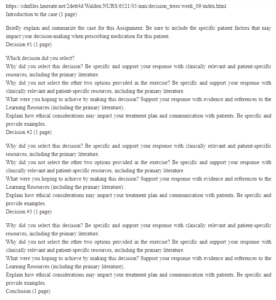
Introduction to the case (1 page)
Assessing and Treating Patients with ADHD
Briefly explain and summarize the case for this Assignment. Be sure to include the specific patient factors that may impact your decision-making when prescribing medication for this patient.
Decision #1 (1 page)
Which decision did you select?
Why did you select this decision? Be specific and support your response with clinically relevant and patient-specific resources, including the primary literature.
Why did you not select the other two options provided in the exercise? Be specific and support your response with clinically relevant and patient-specific resources, including the primary literature.
What were you hoping to achieve by making this decision? Support your response with evidence and references to the Learning Resources (including the primary literature).
Explain how ethical considerations may impact your treatment plan and communication with patients. Be specific and provide examples.
Decision #2 (1 page)
Why did you select this decision? Be specific and support your response with clinically relevant and patient-specific resources, including the primary literature.
Why did you not select the other two options provided in the exercise? Be specific and support your response with clinically relevant and patient-specific resources, including the primary literature.
What were you hoping to achieve by making this decision? Support your response with evidence and references to the Learning Resources (including the primary literature).
Explain how ethical considerations may impact your treatment plan and communication with patients. Be specific and provide examples.
Decision #3 (1 page)
Why did you select this decision? Be specific and support your response with clinically relevant and patient-specific resources, including the primary literature.
Why did you not select the other two options provided in the exercise? Be specific and support your response with clinically relevant and patient-specific resources, including the primary literature.
What were you hoping to achieve by making this decision? Support your response with evidence and references to the Learning Resources (including the primary literature).
Explain how ethical considerations may impact your treatment plan and communication with patients. Be specific and provide examples.
Conclusion (1 page)
Summarize your recommendations on the treatment options you selected for this patient. Be sure to justify your recommendations and support your response with clinically relevant and patient-specific resources, including the primary literature.