
Assessing a Healthcare Program/Policy Evaluation
| Healthcare Program/Policy Evaluation |
Psychiatric Mental Health Nurse Practitioner (PMHNP) |
| Description | The Psychiatric Mental Health Nurse Practitioner (PMHNP) program is a graduate course of academic and clinical training program designed to meet the overall goal of rectifying the lack of mental health professionals in the country coupled with the associated need to provide more rapid access to psychiatric care particularly to those people who live in vulnerable situations. The program teaches accredited registered nurses to provide all-encompassing mental health care, such as psychiatric assessments, diagnosis, maintenance of psychotropic drugs, and evidence-based psychotherapy procedures. Facilitated by such nationwide programs as the HRSA BHWET program, the PMHNP track is designed to expand the number of trained psychiatric providers in the U.S. (Health Resources and Services Administration, 2024). |
| How was the success of the program or policy measured?
|
The success of the PMHNP program was measured through multiple indicators: graduation and certification rates, student clinical performance evaluations, post-graduate employment in mental health settings, and improvement in patient access to psychiatric care. Surveys were used to assess graduate satisfaction and employer feedback, and workforce distribution data helped determine how many graduates served in rural or Health Professional Shortage Areas (HPSAs). |
| How many people were reached by the program or policy selected? How much of an impact was realized with the program or policy selected?
|
Today, thousands of PMHNPs have graduated in the U.S., completing the PMHNP programs. An example is that Walden University alone reported more than 5,000 active students of PMHNP. These professionals expand psychiatric services to millions of Americans especially in underserved and rural areas. Its effects are more access to care, a decrease in the wait times to mental health services, and a better inclusion of psychiatric care within primary care clinics (Delaney, 2023). |
| At what point in program implementation was the program or policy evaluation conducted?
|
Evaluation was carried out at different stages: mid-program (to assess progress and address gaps), post-completion (to determine graduation and certification outcomes), and one-year post-graduation (to evaluate employment status and impact on clinical practice). Annual accreditation reviews by the Commission on Collegiate Nursing Education (CCNE) also played a key role in quality assurance. |
| What data was used to conduct the program or policy evaluation?
|
Data sources included student academic records, American Nurses Credentialing Center (ANCC) PMHNP-BC certification pass rates, employer surveys, preceptor evaluations, clinical placement logs, and U.S. workforce distribution statistics. Graduate and patient outcome data were also analyzed to determine clinical effectiveness and community impact. |
| What specific information on unintended consequences were identified?
|
Unintended consequences included challenges in securing adequate preceptorships, particularly in rural areas. Some students faced limited exposure to complex psychiatric cases due to preceptor shortages. Additionally, concerns about variation in curriculum rigor among institutions led to calls for standardization across PMHNP programs (Mangano et al., 2020). |
| What stakeholders were identified in the evaluation of the program or policy? Who would benefit most from the results and reporting of the program or policy evaluation? Be specific and provide examples. | Stakeholders identified include academic institutions, faculty and students, clinical preceptors, employers of health care, professional nursing associations, patients and policymakers. The immediate beneficiaries are those patients who do not access psychiatry very well. To illustrate, the availability of psychiatric services is augmented in the form of telepsychiatry or in-person clinics led by PMHNPs in rural settings and among underserved youth populations. |
| Did the program or policy meet the original intent and objectives? Why or why not? | The PMHNP program effectively achieved its purpose to increase the psychiatric workforce and to increase access to mental health care, and provide nurses with advanced knowledge. Its effectiveness can be reflected in the fact that more certified psychiatric nurse practitioners are working in underserved regions, and that more vulnerable populations are getting better mental health outcomes as well. |
| Would you recommend implementing this program or policy in your place of work? Why or why not? | I would suggest the introduction of this program in the workplace. As psychiatric needs continue to grow, having PMHNPs integrated into care teams can reduce patient wait times, enhance quality of care, and address behavioral health crises. PMHNPs also support interprofessional collaboration and provide culturally competent, evidence-based treatment. |
| Identify at least two ways that you, as a nurse advocate, could become involved in evaluating a program or policy after one year of implementation. | My first way of helping the program evaluation is that I could participate in graduate surveys and clinical outcomes studies that will focus on the impact that PMHNPs can have in different settings. Second, I could serve as a preceptor or advisory board member, offering feedback on curriculum development, quality assurance, and aligning program goals with community mental health needs. |
| General Notes/Comments | The PMHNP program is a critical response to the ongoing mental health provider shortage in the U.S. It has demonstrated measurable success in improving patient access, enhancing nurse education, and supporting healthcare equity. Continuous evaluation and support from nurse advocates are vital to ensuring its sustainability and growth. |
References
Delaney, K. R. (2023). Inclusion of Psychiatric–Mental Health Advanced Practice Nurses in Federal Behavioral Workforce Planning. Psychiatric Services, 75(6). https://doi.org/10.1176/appi.ps.20230321
Health Resources and Services Administration. (2024). Behavioral Health Workforce Education and Training Program for Professionals | HRSA. Hrsa.gov. https://www.hrsa.gov/grants/find-funding/HRSA-25-068
Mangano, E., Gonzalez, Y., & Kverno, K. S. (2020). Challenges Faced by New Psychiatric–Mental Health Nurse Practitioner Prescribers. Journal of Psychosocial Nursing and Mental Health Services, 58(10), 7–11. https://doi.org/10.3928/02793695-20200915-01
ORDER A PLAGIARISM-FREE PAPER HERE
We’ll write everything from scratch
Question 
Assessing a Healthcare Program/Policy Evaluation
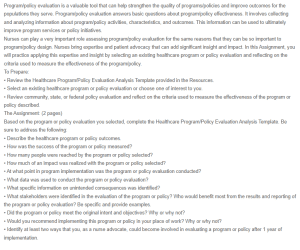
Program/policy evaluation is a valuable tool that can help strengthen the quality of programs/policies and improve outcomes for the populations they serve. Program/policy evaluation answers basic questions about program/policy effectiveness. It involves collecting and analyzing information about program/policy activities, characteristics, and outcomes. This information can be used to ultimately improve program services or policy initiatives.
Assessing a Healthcare Program/Policy Evaluation
Nurses can play a very important role assessing program/policy evaluation for the same reasons that they can be so important to program/policy design. Nurses bring expertise and patient advocacy that can add significant insight and impact. In this Assignment, you will practice applying this expertise and insight by selecting an existing healthcare program or policy evaluation and reflecting on the criteria used to measure the effectiveness of the program/policy.
To Prepare:
• Review the Healthcare Program/Policy Evaluation Analysis Template provided in the Resources.
• Select an existing healthcare program or policy evaluation or choose one of interest to you.
• Review community, state, or federal policy evaluation and reflect on the criteria used to measure the effectiveness of the program or policy described.
The Assignment: (2 pages)
Based on the program or policy evaluation you selected, complete the Healthcare Program/Policy Evaluation Analysis Template. Be sure to address the following:
• Describe the healthcare program or policy outcomes.
• How was the success of the program or policy measured?
• How many people were reached by the program or policy selected?
• How much of an impact was realized with the program or policy selected?
• At what point in program implementation was the program or policy evaluation conducted?
• What data was used to conduct the program or policy evaluation?
• What specific information on unintended consequences was identified?
• What stakeholders were identified in the evaluation of the program or policy? Who would benefit most from the results and reporting of the program or policy evaluation? Be specific and provide examples.
• Did the program or policy meet the original intent and objectives? Why or why not?
• Would you recommend implementing this program or policy in your place of work? Why or why not?
• Identify at least two ways that you, as a nurse advocate, could become involved in evaluating a program or policy after 1 year of implementation.
The program i selected is psychiatric mental health nurse practioner( PMHNP}.
can it be done in two hours
Also its to pages not two i will add the payment if ts done in two hours